


Some family stories survive only as a sentence or two — a name, a year, a faint outline of sorrow passed down through the generations. For decades, my great-grand-uncle Theron Pace was one of those stories. We knew he had died young. We knew his sister mourned him. But the why had blurred into the soft edges of family memory.
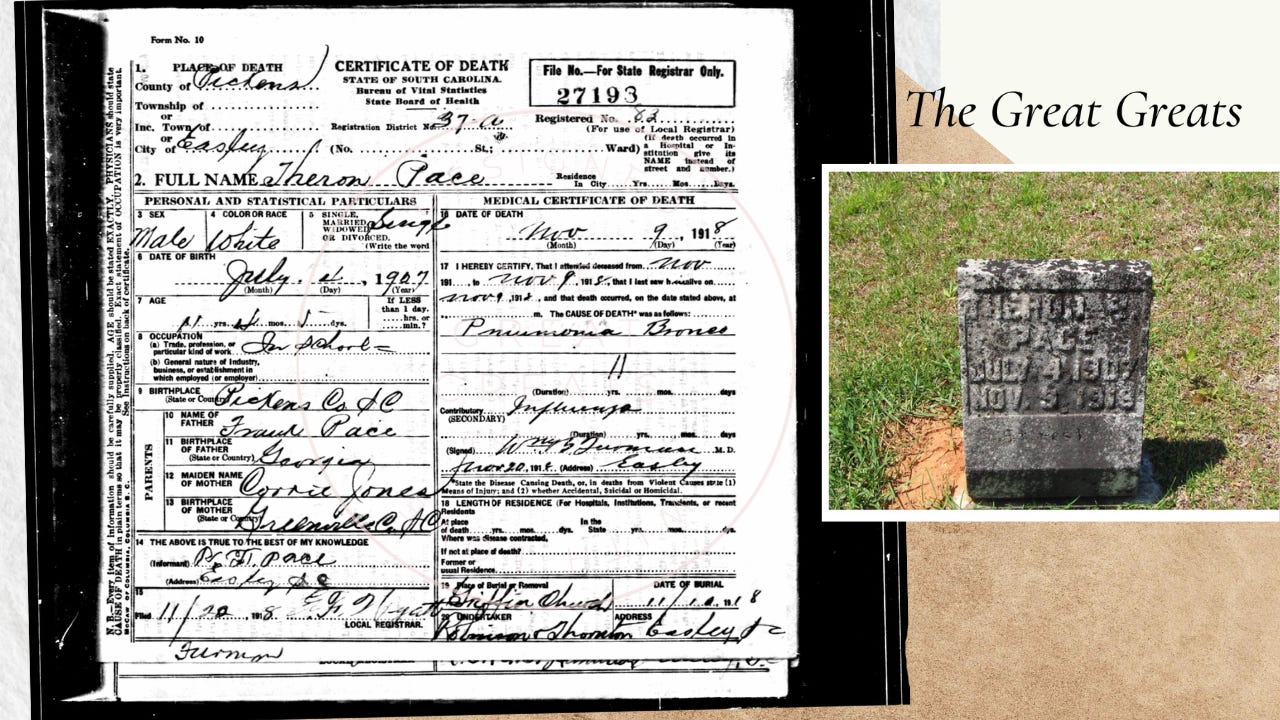
Then a single document brought him back into focus: his 1918 South Carolina death certificate. With it, the outline finally fills in.
A Fourth of July baby
Theron Pace was born on July 4, 1907, in Pickens County, South Carolina — a holiday baby, the seventh of twelve children born to Richard Franklin “Frank” Pace and Corrie Ann Jones.
By the autumn of 1918 the Pace household had moved to Easley, part of a larger shift in the family’s life. Frank Pace had brought his children down from the farm northeast of Pickens to seek work in the textile mills — the same migration that reshaped so many South Carolina families in those years. On the certificate, eleven-year-old Theron’s occupation is recorded simply, and movingly: “in school.”
November 1918
Theron died on November 9, 1918, at eleven years, four months, and five days old.
The cause of death was broncho-pneumonia, with influenza listed as the contributory, secondary cause. To anyone who knows the calendar of 1918, those two words together tell the whole story. Theron died at the very peak of the great influenza pandemic, which tore through the United States in October and November of that year and which so often turned, in its final and deadliest stage, into exactly the kind of pneumonia that took him.
His father, Frank Pace, is named on the certificate as the informant — the one who answered the questions, who supplied the dates and the names, who stood at the registrar’s desk and accounted for the life of his son. There is a particular weight in that small administrative fact: a father reporting the death of his eleven-year-old.
Buried at Griffin Church
Two days later, on November 11, 1918, Theron was buried at Griffin Church.
That detail, too, knits him into the larger family story. Griffin Baptist Church Cemetery holds generations of the Pace family — among them Theron’s grandfather Richard King Pace and his great-grandfather Daniel Pace. The boy was laid to rest among his own.
The grief that remained
A death certificate can give us dates and causes, but it can’t measure what a loss meant to the people left behind. For that, we have the memory of Theron’s sister, Emma Pace Forister, who carried the grief of losing her brother in 1918 for the rest of her life and spoke of it directly.
What the certificate adds is context — and with it, a kind of dignity. Theron’s death was not random misfortune. It was part of a global catastrophe that killed tens of millions of people and reached all the way into a mill town in Pickens County to take a schoolboy who had been born, eleven years earlier, on Independence Day.
His story is small, and it is also enormous. That is the strange arithmetic of family history: a single name on a single certificate, standing in for a whole world of loss.
A note on his sister Kate
There’s one more sibling whose presence hovers over this story, because she is my own great-grandmother: Kate Pace, born December 3, 1900, six and a half years ahead of Theron.
The two of them grew up together on the family farm near Oolenoy Creek and lived through the same great upheaval — the move from the land to the Pickens Cotton Mill Village. But by 1918 their lives had diverged sharply. Theron’s death certificate lists his occupation as “in school.” Kate’s childhood had ended years earlier: she began working in the Pickens mill at just twelve years old, around 1912. By the time her little brother died, she had already spent six years as a laborer in the noise and grind of the factory floor.
So when Theron died on November 9, 1918, the contrast within that one household was stark — an eleven-year-old still tucked into a schoolboy’s life, and his seventeen-year-old sister, a mill veteran one month shy of her eighteenth birthday, who had already been forced to grow up fast. It is hard not to imagine her carrying that loss with the weariness of someone who had seen too much, too young.
Just six months later, Kate married Jay Robert Edens and set off on her own long journey of wandering through one mill village after another — a new chapter beginning almost in the same breath as her brother’s ending.
If you have your own Theron — an ancestor whose story finally came clear because of one surviving record — I’d love to hear about it in the comments, as well as any further information as to date we are quite limited, as expected. Love to all.
My father Jim Knox was a Fourth of July baby too. I will think of Theron as I rember my Dad this weekend. 🇺🇸