


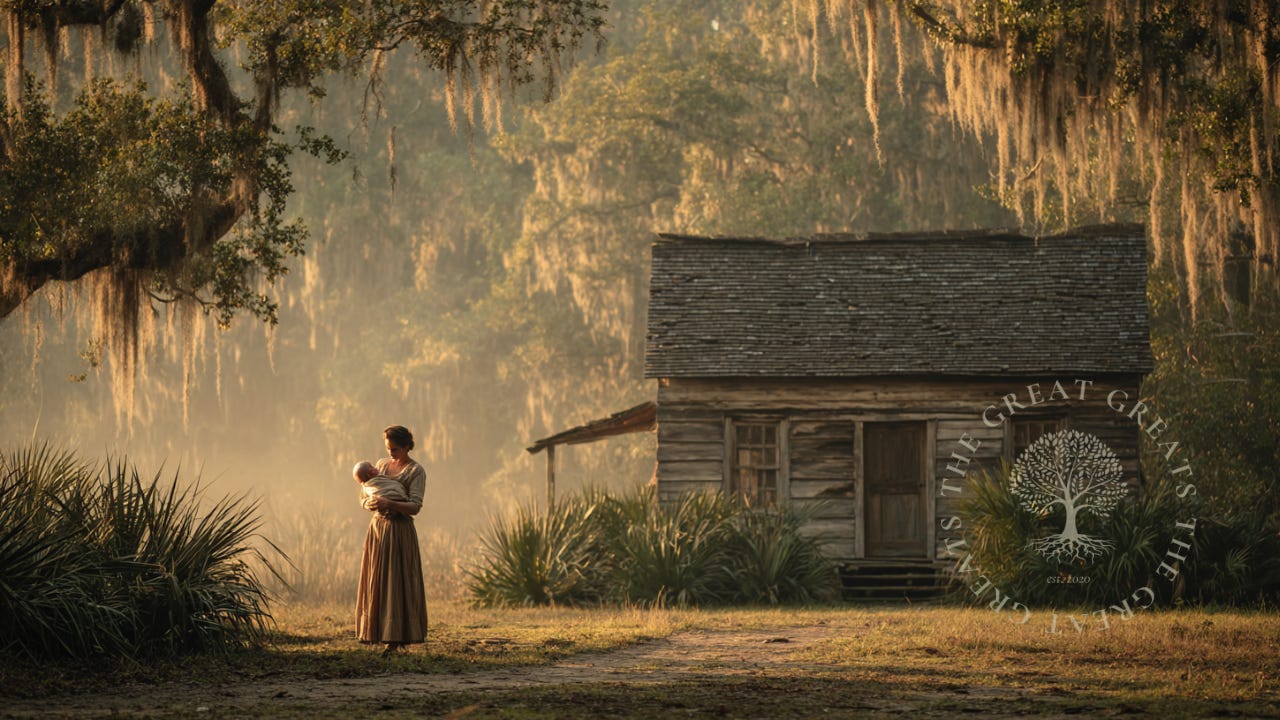
I was deep in the weeds of genealogy research—you know the drill, squinting at faded census pages, cross-referencing dates, building out family trees one record at a time—when a single line stopped me cold…….
“Richard Tidwell, age 75, deaf, born in Florida, 1785”
He was living in rural Tennessee with a houseful of women and children I'd never seen him connected to. No family stories mentioned him. No obvious place in our tree. But there he was, recorded for posterity in the home of our 3rd great-grandmother, and something about his presence felt like a door opening onto a story I'd never heard.
A story that, as it turns out, reaches back to the edges of early American history.
The Household That Raises Questions
1860 U.S. Federal Census, Middle Division, Dickson County, Tennessee
Enumerated August 28, 1860
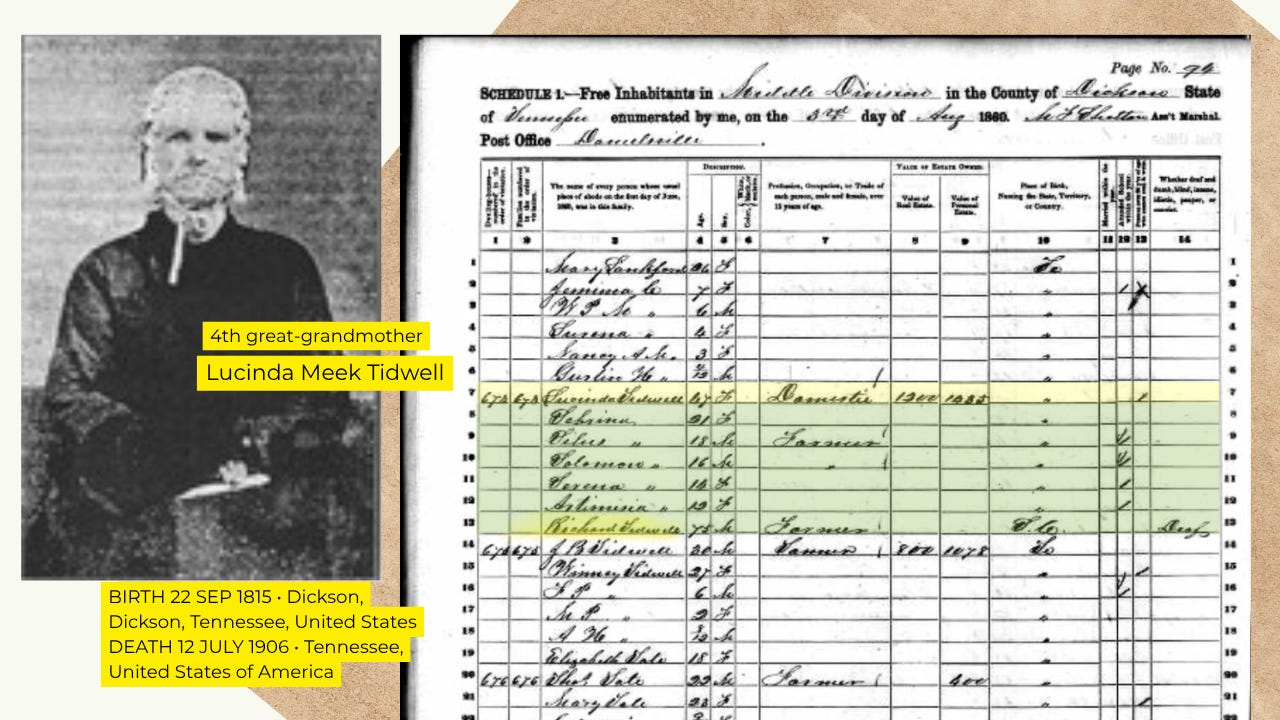
The head of household was Lucinda Meek Tidwell, our 3rd great-grandmother. At 47, she was a widow managing a Tennessee farm, raising five children, and somehow accumulating over $2,600 in property—no small feat for a woman the census noted "cannot read or write."
Living with her were her children: Sabrina, 21; Silas, 18; Solomon, 16; Serena, 14; and Artemisia, 12. A typical frontier family, you might think.
Except for the last entry: Richard Tidwell, 75, farmer, deaf, born in Florida.
Here's why that Florida birth date should make you sit up and take notice.
The Problem with 1785
In 1785, Florida wasn't American territory. It was Spanish land, recently returned from British control after the Revolutionary War. The United States wouldn't acquire Florida until 1821, and statehood wouldn't come until 1845.
So how does a man born in Spanish Florida end up decades later as an elderly, deaf farmer living in the Tennessee home of our ancestor?
The answer lies somewhere in the tangled migrations of early American families, the forgotten pathways that brought people from one frontier to another, often leaving only the faintest documentary traces.
Florida's Forgotten Frontier
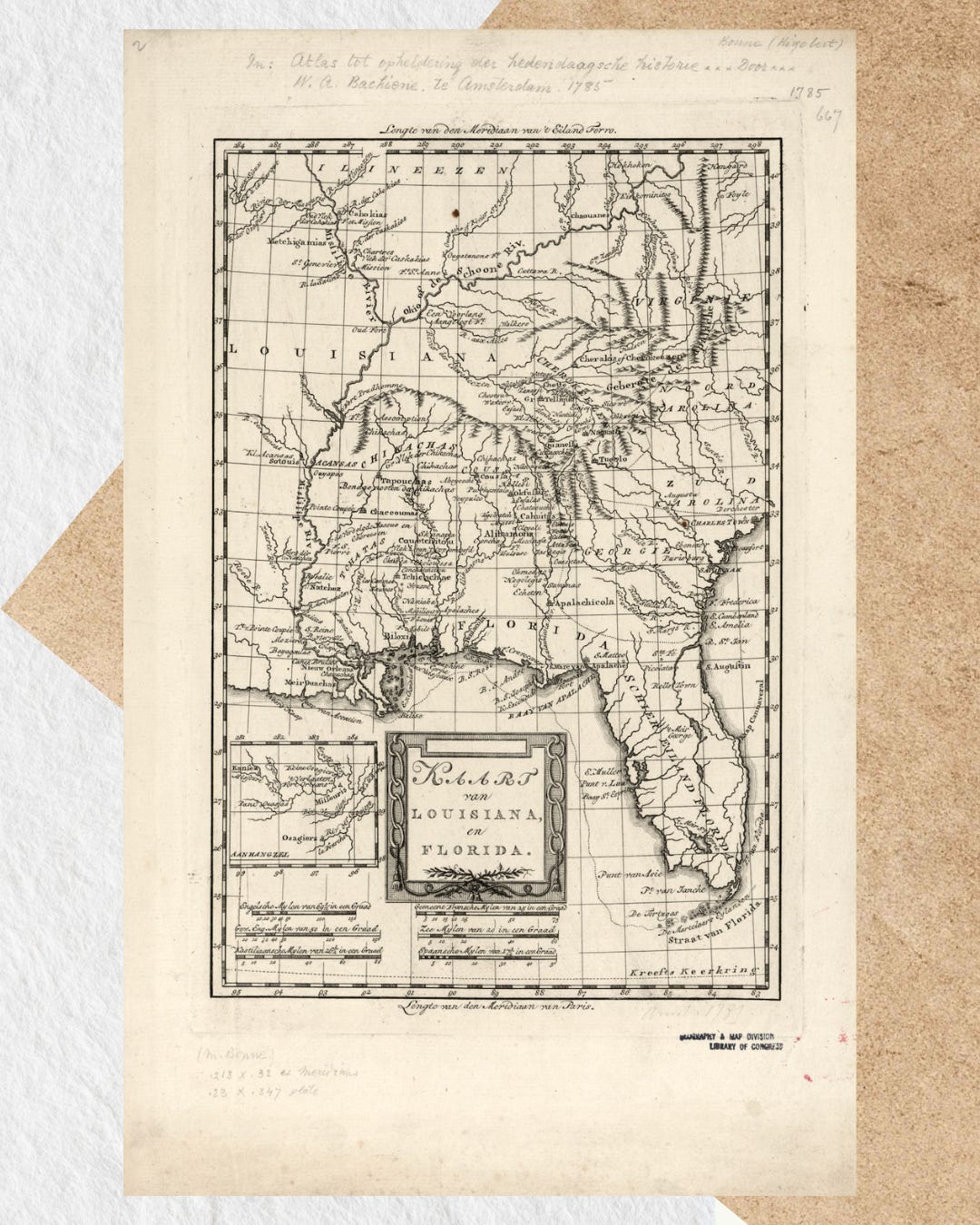
Picture Florida in 1785: a sparsely settled territory where Spanish officials, British Loyalists who'd fled south after the Revolution, and frontier traders carved out precarious lives. Families from Georgia and the Carolinas sometimes crossed the border seeking land or escaping political trouble. Military families passed through, especially along the contested St. Marys River.
It was rough country, the kind of place where a Tidwell child might be born into circumstances we can barely imagine. That this child grew up to be Richard—deaf, dependent in old age, cared for by our 3rd great-grandmother in Tennessee—suggests a family story of migrations, hardships, and quiet acts of loyalty that census records can only hint at.
The Woman Who Held It Together
Let's talk about Lucinda for a moment. Widowed young, unable to read or write, she was nevertheless listed as head of household with substantial property holdings. She was raising five children, running a farm, and caring for an elderly deaf man who may or may not have been blood relation.
She lived until 1906—46 years after that 1860 census—outliving her husband Benjamin by more than half a century. Through her daughter Mary Ann Tidwell, who married George Wyatt Austin, she became our direct maternal ancestor. The thread that connects her quiet strength to our family story today.
Women like Lucinda held frontier families together through sheer determination, often with little recognition. Richard's presence in her household tells us something about her character: she didn't abandon family members who couldn't care for themselves.
Following the Trail
I'm still piecing together Richard's story, but here's what I'm chasing:
"Early Spanish land grants and settlement records in East Florida. Tidwell family connections in Georgia and South Carolina, especially among Loyalist families. Post-Revolutionary militia records. Earlier census records that might show Richard's movements. Family Bible entries, pension files, probate records—anything that might mention a deaf relative who needed care."
The deeper I dig, the more I suspect Richard's story intersects with larger historical currents: the displacement of Loyalist families after the Revolution, the fluid borders of early Florida, the networks of kinship that helped families survive on successive frontiers.
Questions Without Easy Answers
Who was Richard Tidwell, really? A brother to Lucinda's late husband Benjamin? A forgotten uncle? A family friend taken in out of duty or compassion?
How did he travel from Spanish Florida to Tennessee? What happened to make him deaf—birth, illness, accident? Why was he living with Lucinda rather than his own children or siblings?
And what does his story reveal about the hidden migrations and family loyalties that shaped early American life?
These are the questions that make genealogy more than just names and dates. They're doorways into the lived experiences of people who left only fragmentary records but whose choices and journeys shaped the families that came after them.
The search for Richard Tidwell continues. Sometimes the most compelling family stories are hiding in plain sight, waiting for someone to ask the right questions about a single puzzling line in a census record.
Have you found mysterious figures in your own family records—people who appeared in households where they seemingly didn't belong, whose origins raise more questions than they answer? These genealogical puzzles often lead to the most interesting discoveries about how our families really lived.
People in my own family tree, like your Richard Tidwell, with mysterious origins and stories keep me up at night. My husband doesn’t really feel comfortable when I climb into our bed at night and invite specific ones to come and haunt me! I just tell him I have questions that need answers and some friendly ghostly interviewing sometimes seems like the only possible source. It hasn’t happened yet but I keep looking for records while occasionally inviting them to my home for a visit…just in case it’s the only way!