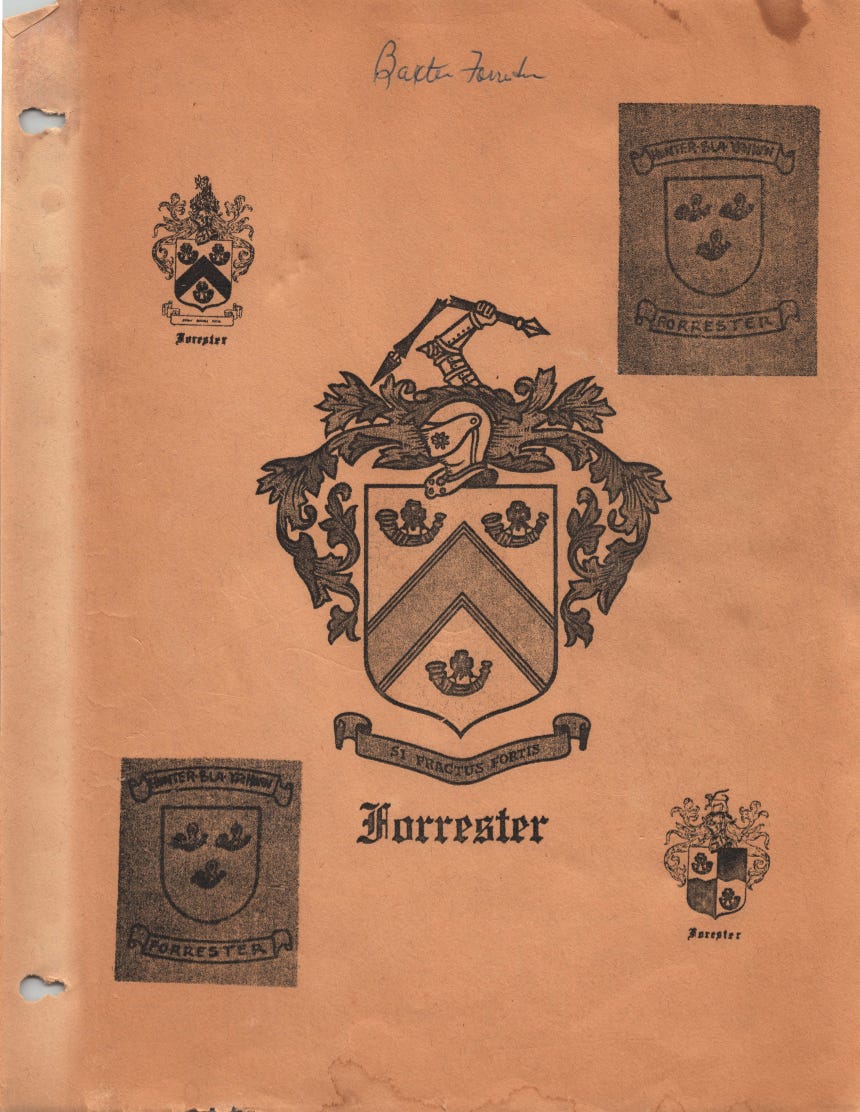
In the age before dog tags, before unit insignia, before military ID cards, there was the coat of arms—a warrior’s identity painted on a shield, meant to be recognized in the chaos of medieval battle. For the Forrester family, that shield tells a story eight centuries in the making.
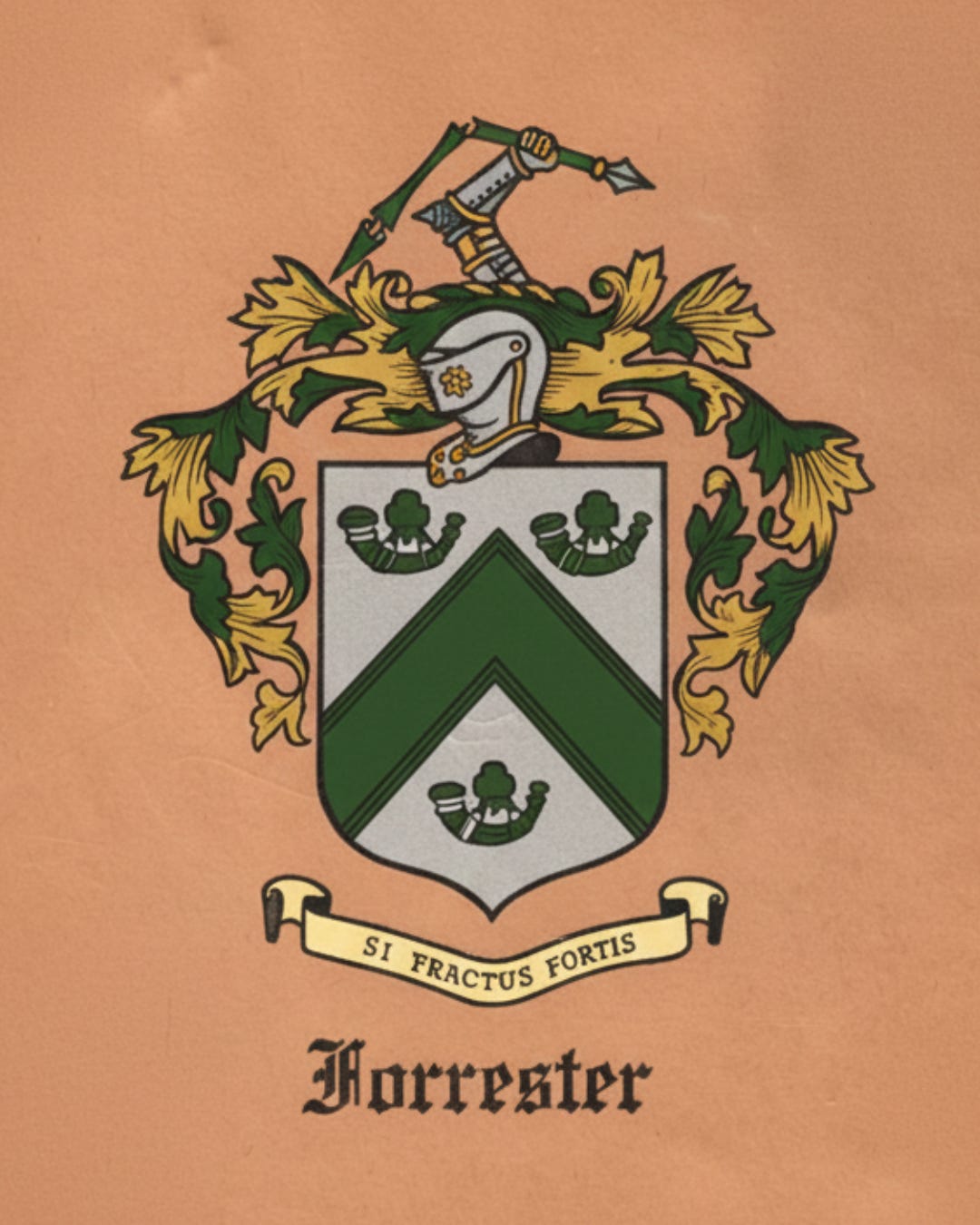
The Original Three Horns
The earliest known Forrester Coat of Arms was strikingly simple: an outline of a shield displaying three bugles, or hunting horns. These weren’t decorative flourishes—they were functional symbols, painted on the shields of ancient chieftains so their men could find them in the fog of war.
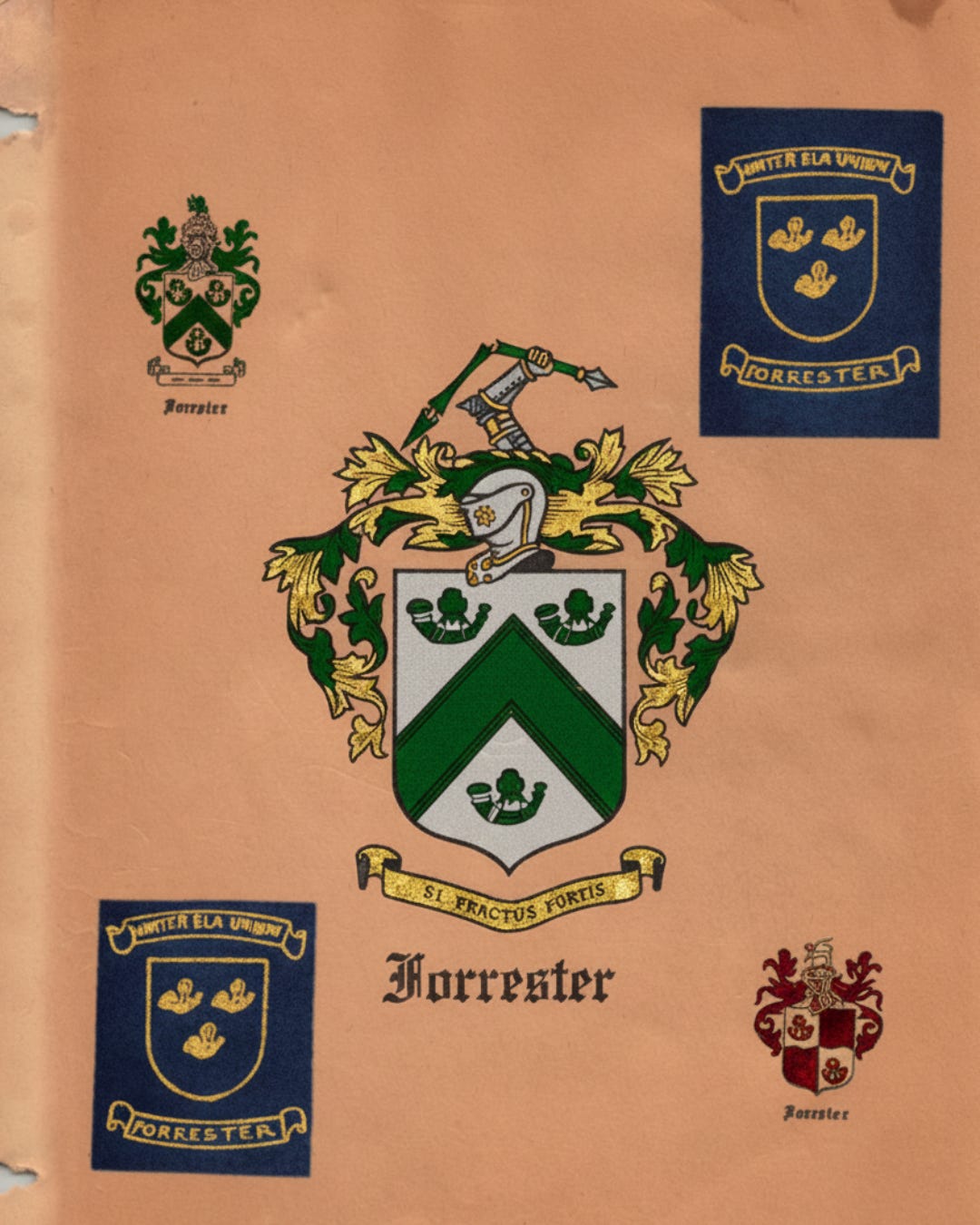
What makes this particular heraldry remarkable is its persistence. Across every known variant of the Forrester arms—spanning centuries and continents—those three hunting horns remain. They’re the family’s heraldic DNA, present whether the coat of arms appears on a Crusader’s shield or a 20th-century military citation.
Earning the Right to Embellish
In medieval Britain, a coat of arms wasn’t simply designed—it was earned. Each new element required royal permission, granted as reward for specific acts of valor. The Forrester coat of arms became, in effect, a visual military record, updated across generations as family members distinguished themselves in combat.
The version believed to have been carried during the Crusades reveals this layering of honor:
The Motto: “Si Fractus Fortis”—”Though Broken, Brave.” Not a boast of invincibility, but an acknowledgment that courage persists through defeat.
The Crest: An arm embowered in armor, holding a broken tilting spear. The spear is shattered, but the arm still holds it aloft. This wasn’t an image of failure—it was an image of resilience, of continuing the fight even when the weapon fails.
The Men Who Shaped the Shield
Sir John Forster at Acre, 1192
The Third Crusade was faltering. At the siege of Acre in Palestine, the Crusader army faced annihilation. According to family records, Sir John Forster demonstrated such exceptional bravery and tactical skill that he is credited with saving the nearly destroyed army and rescuing King Richard himself from imminent death.
For these deeds, the Lionheart knighted him on the field and later appointed him Governor of Bamborough Castle—a fortress that still stands on the Northumberland coast.
Sir Richard Forster at Crécy, 1356
Sixty-four years later, another Forster earned his knighthood at one of history’s most decisive battles. Sir Richard Forster fought at Crécy on September 19, 1356, where English longbowmen shattered the flower of French chivalry. His valor that day earned him his own elevation to knighthood—and likely, additional modifications to the family arms.
The Younger Son’s Path
In the British Isles, younger sons faced a particular challenge: inheritance laws typically passed titles and lands to the eldest. For ambitious younger brothers, the military offered a path to independent honor.
Many began as armor bearers for nobles—a position roughly equivalent to a modern military aide—earning merit for themselves and their families through years of service. Through accumulated deeds of valor, they could gain titles in their own right, no longer dependent on their elder brothers’ generosity.
This tradition helped spread the Forrester name across military history, as each generation produced new officers eager to prove themselves worthy of the family’s martial heritage.
Into the Modern Era
The tradition of valor didn’t end with the age of knights. In the trenches of World War I, Robert Richmond Forrester (B-78 in the family genealogy) earned the Distinguished Service Cross for gallantry in battle—one of the highest decorations an American officer can receive.
A generation later, during World War II, John Clinton Davis (N-69) received the Silver Star Medal for gallantry in action, continuing a line of military distinction that stretches back to the Crusades.
The Shield as History Book
The Forrester Coat of Arms functions as something rare: a continuously updated battle standard where every achievement of courage is literally woven into the fabric of family identity. The three hunting horns anchor it to ancient origins. The broken spear speaks to the Crusades. The motto—Though Broken, Brave—captures a philosophy that seems to have guided the family across eight centuries of warfare.
Not every family can trace its values through heraldry. The Forresters can look at a piece of painted metal and see the accumulated courage of thirty generations.
Have stories about your own family’s heraldry or military traditions? I’d love to hear them in the comments.