


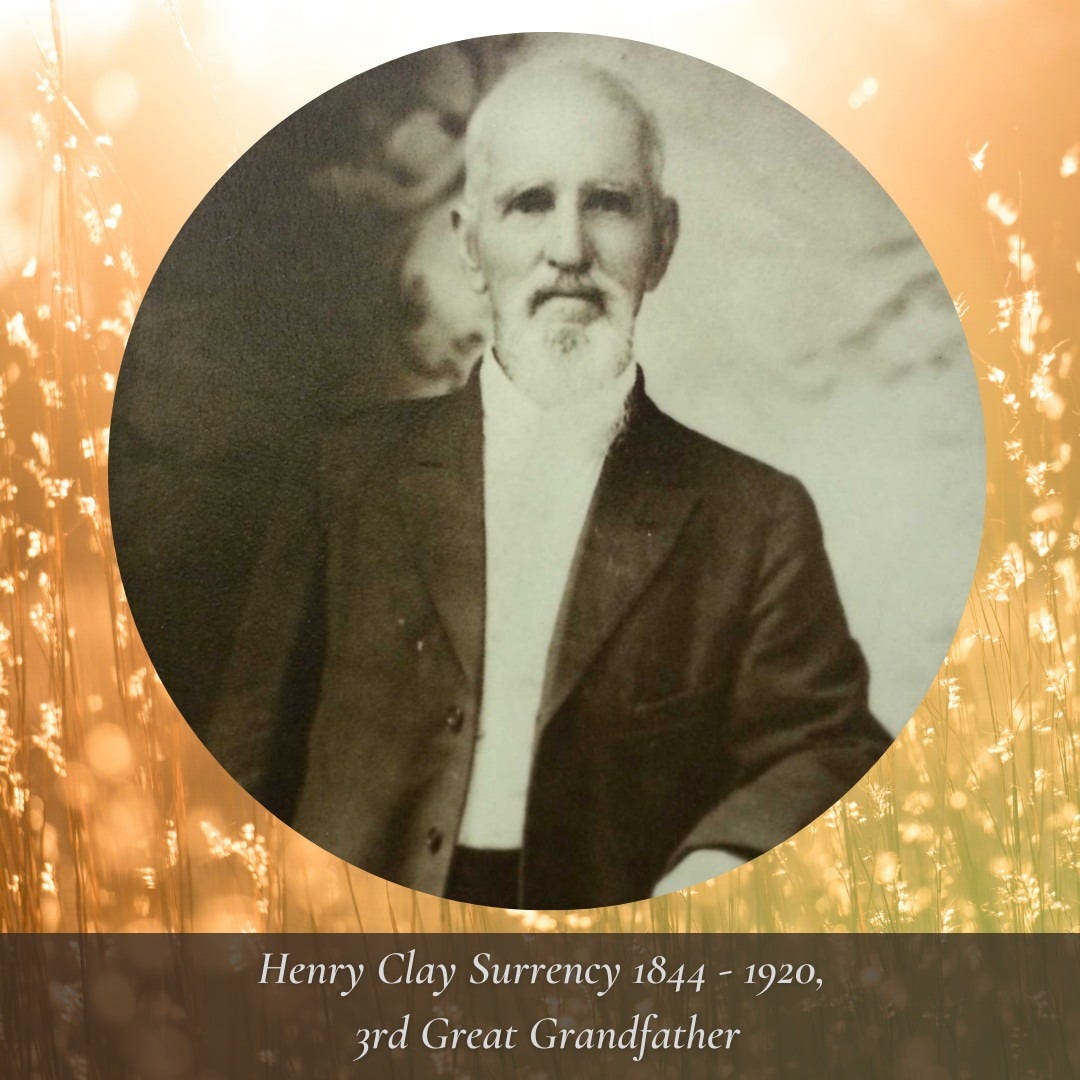
Every family tree has a face that feels like the beginning. For ours, that face belongs to Henry Clay Surrency (1844–1920) — born in Tattnall County, Georgia, son of Jacob and Zilpha, father of six sons and four daughters, who lived seventy-six years and was laid to rest in Brooker, Florida. He is my third-great-grandfather, and for a long time he sat at the far edge of what I could see.
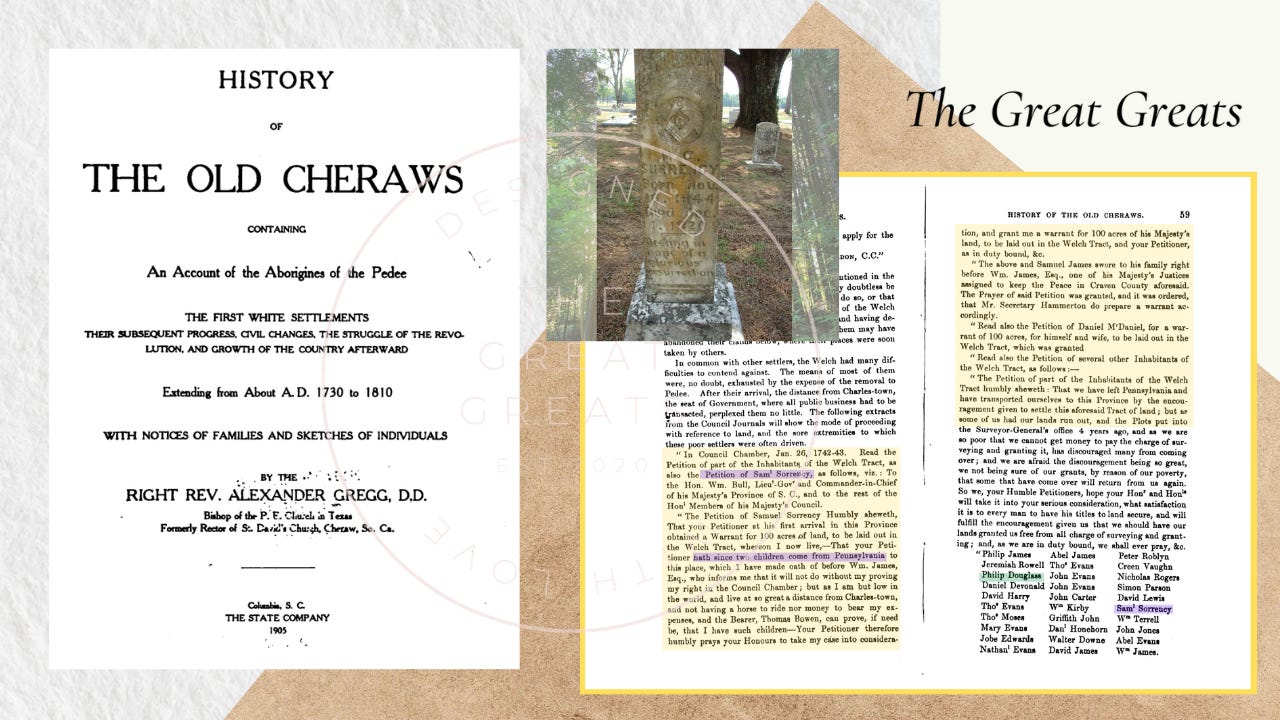
But a surname is a thread, and threads run backward. Pull on Surrency hard enough and it does not stop in Georgia. It runs up through the Carolinas and out across the ocean to a green corner of Wales — and along the way it leaves a paper trail in one of the best early records the region ever produced: the Reverend Alexander Gregg’s History of the Old Cheraws (1867). This is what those pages tell us.
A Welsh Baptist colony on the Pedee
The story starts in 1701, when several Baptist families from the Welsh counties of Pembroke and Carmarthen resolved to go to America. They sailed from Milford Haven that June aboard the William and Mary and landed at Philadelphia, where they eventually took up a 30,000-acre “Welsh Tract” purchased from William Penn — land that began in Pennsylvania and, after a boundary change, ended up in Delaware. (That detail explains a quirk you’ll see again and again in the old records: the same people are described as coming “from Pennsylvania” in one document and “from Delaware” in the next.)
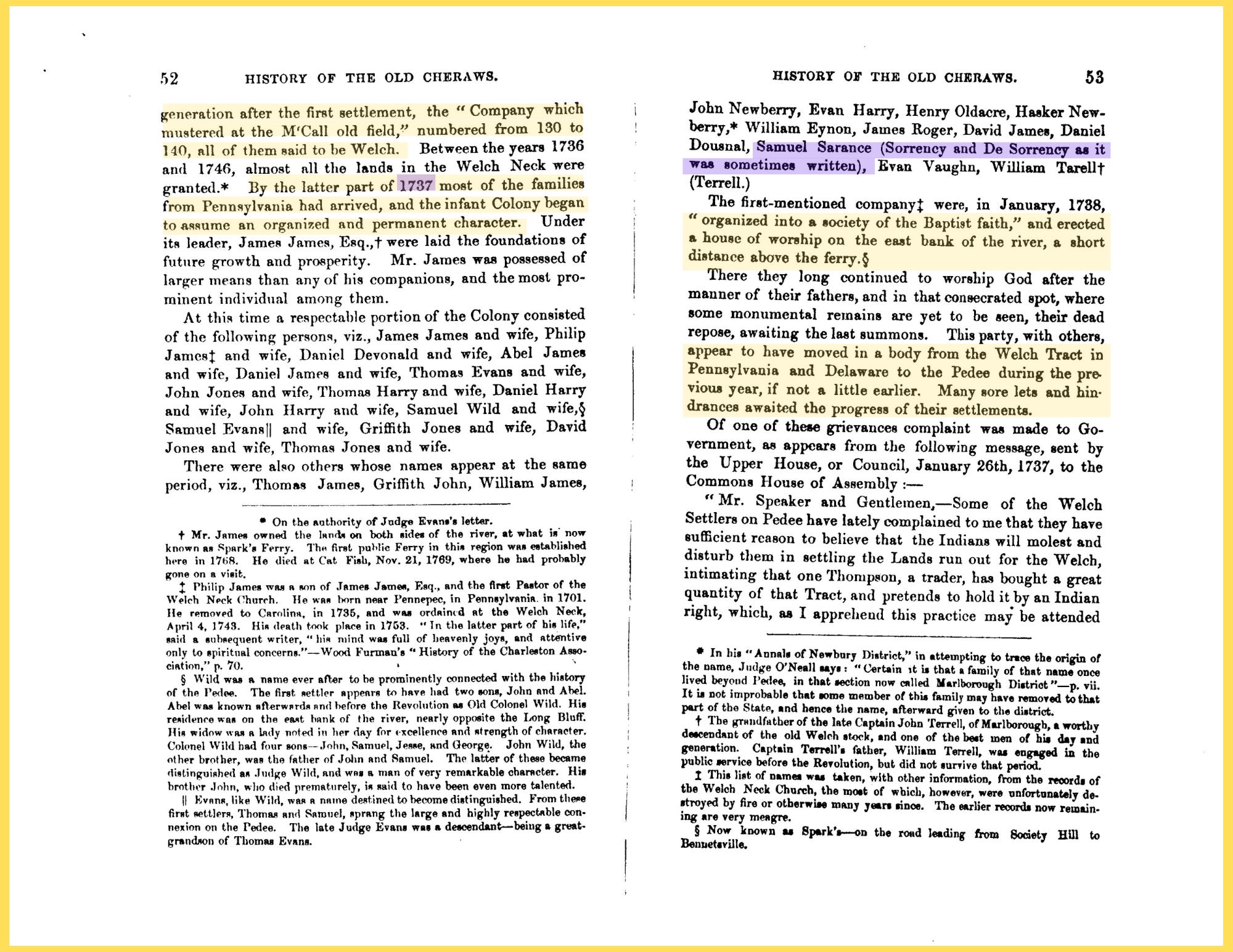
A generation later, their children went looking for better ground. The first Welsh exploration of the Pedee River came in the spring of 1736, and by the latter part of 1737 most of the families had arrived from Pennsylvania, and “the infant Colony began to assume an organized and permanent character.” They gathered at a rich bend of the river opposite present-day Society Hill, a place that took the name Welch Neck, and in January 1738 they were organized into a Baptist society and raised a meeting-house on the east bank above the ferry. South Carolina’s government, eager for industrious Protestant settlers, reserved an enormous tract for them in Craven County and later dangled a £6,000 bounty — corn, beef, pork, an axe, a hoe, a cow and calf — to draw still more Welsh across the Atlantic.
This is the world our ancestor walked into.
Samuel Sorrency, settler
Among the founding company of the Welch Neck colony, Gregg lists the man himself — and, crucially, he tells us why the name has been so slippery to track:
Samuel Sarance (Sorrency and De Sorrency as it was sometimes written)
There it is, in one line: Sarance / Sorrency / De Sorrency, all the same man. That single clerical aside is the bridge between a strange-looking colonial spelling and the name we carry today.
He does not appear just once. He surfaces across the records like a man living an ordinary, difficult frontier life:
A landholder, August 29, 1738. In the official list of township plots filed with the Surveyor-General, “Sam¹. Sarance — 100 acres“ holds a plot in Queensborough Township, dated that late-August day in 1738, shoulder to shoulder on the page with the James, Evans, Harry, and Jones families who founded the colony.
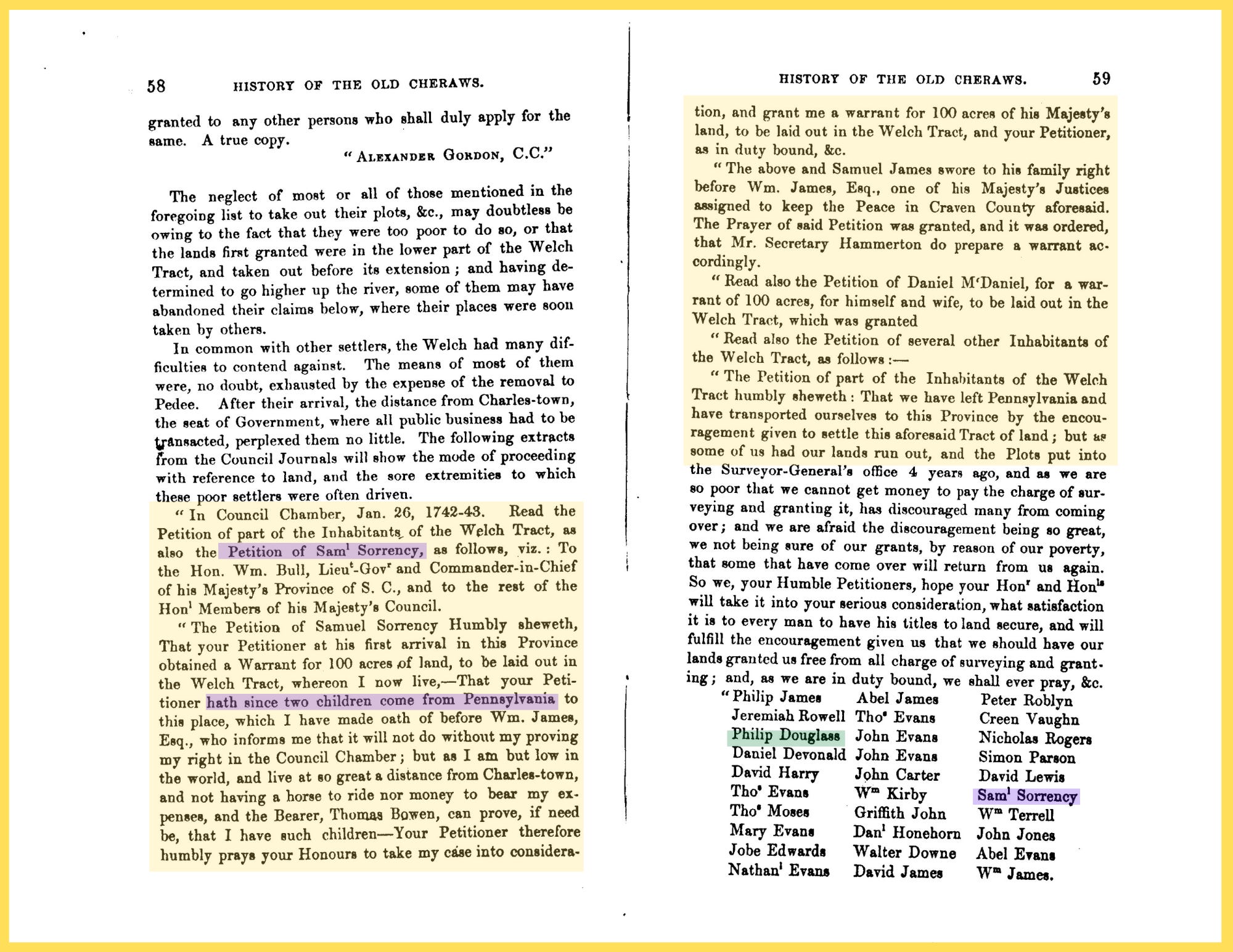
A petitioner, January 1742–43. Years later, his own words reach us. In the Council Chamber the clerk read “the Petition of Sam¹ Sorrency,” in which he explains that on first arriving he obtained a warrant for 100 acres “whereon I now live,” and that he “hath since two children come from Pennsylvania“ — children whose arrival entitled him to claim more land. But he is honest about his circumstances: “low in the world,” living so far from Charles-town, with “not having a horse to ride nor money to bear my expenses.“ A neighbor named Thomas Bowen carried the petition and stood ready to vouch that the children were real. The Council granted it. You can feel the whole texture of a poor, determined settler’s life in those few lines.
A neighbor among neighbors. On that same day, the broader community of the Welch Tract petitioned together — a wonderful column of names that reads like a roll call of the colony. Sam¹ Sorrency signs it. And a few names above his, so does a Philip Douglass (not yet verified as a direct relative — most likely, but not proven).
A name that lasted
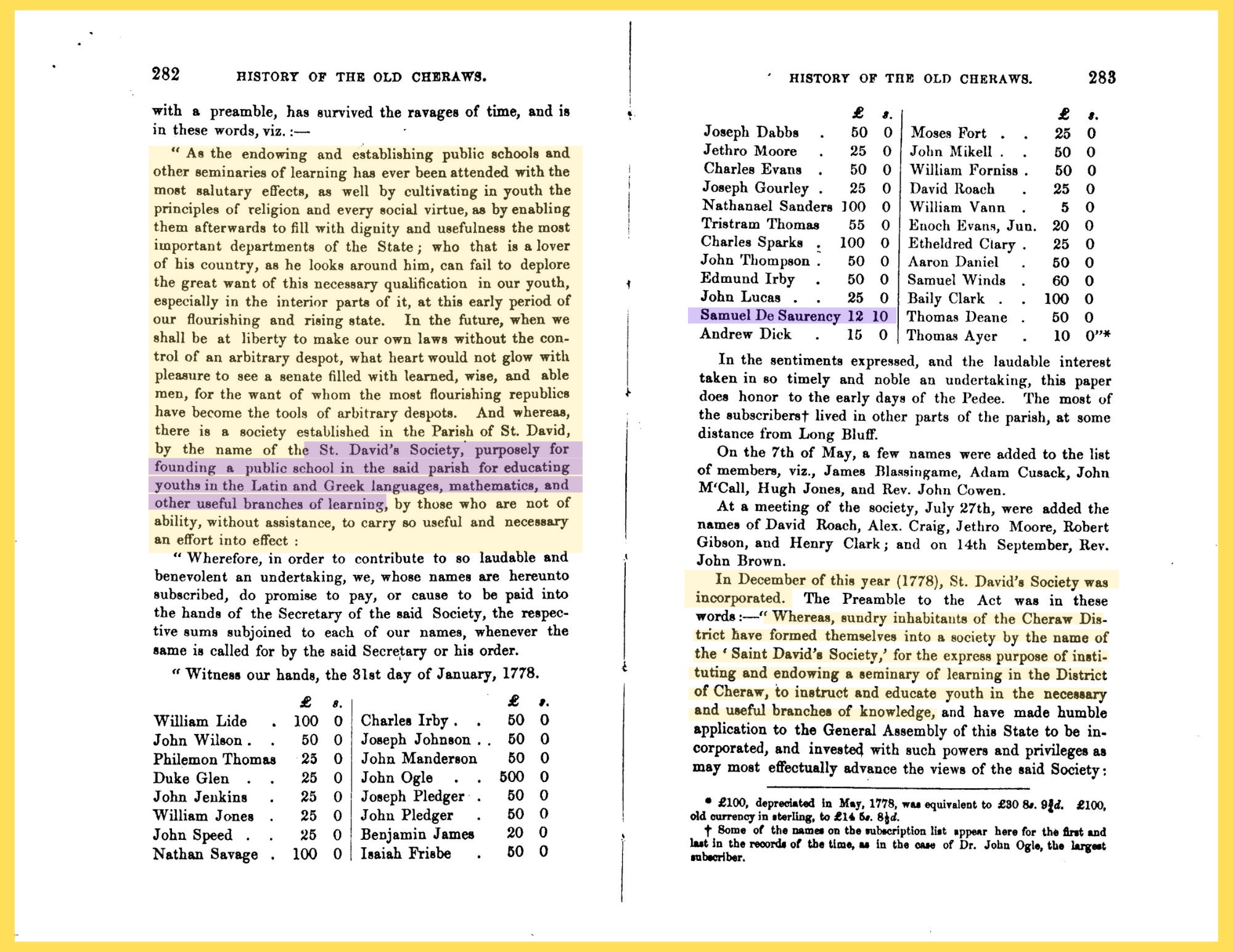
The Sorrency name did not flicker out. Forty years on, in January 1778, when the leading men of the Cheraw district pledged money to found St. David’s Society — a school “for educating youths in the Latin and Greek languages, mathematics, and other useful branches of learning” — the subscription list includes Samuel De Saurency, good for £12 10s. Whether this is the original settler grown old or a son carrying the family name, it tells us the same thing: by the eve of the Revolution, the Sorrencys were established, literate-minded, civic-minded people of the Pedee, investing in the next generation’s education.
The Douglass thread
Here is the detail that made me sit up. Our family doesn’t only descend from the Surrencys. It runs back to the Douglass line as well. And there, in that 1742–43 petition, signing alongside Samuel Sorrency in the same little Welsh Baptist community on the Pedee, is a Philip Douglass.
I’ll be careful here, because good genealogy means saying what we know and what we only suspect. This Philip Douglass is not yet verified as a direct relative — most likely one, given the time, place, and tight-knit Welsh community, but not proven. Still, two surnames that converge in our own tree generations later were standing together — literally on the same page, in the same parish, signing the same plea to the Crown — in the 1740s. At minimum it’s a striking coincidence. At most, it’s a research thread worth tugging hard.
From the Pedee to Tattnall County
So how do we get from a 100-acre plot on the South Carolina frontier in 1738 to Henry Clay Surrency in Georgia in 1844?
Honestly, these pages don’t draw that line for us. They give us the deep roots — the colonial bedrock of the name — but the intervening century, the generations that carried Sorrency southwest out of the Pedee and softened it into Surrency, is still ours to document, one record at a time. That’s the work ahead, and it’s the fun part.
But the shape of the journey is already visible. A Baptist family leaves Pembrokeshire and Carmarthenshire in 1701. Their children push south to the Pedee in the 1730s. The name travels and changes spelling under the pens of clerks who’d never seen it before — Sarance, Sorrency, De Sorrency, De Saurency — until it settles into the form a Georgia census-taker would one day write down as Surrency. By the time Henry Clay was born in 1844, the family had been on this continent for nearly a century and a half.
He felt like the beginning. He was really the middle of a very long story — and thanks to a careful rector who wrote it all down in 1867, we can read a few of the earliest chapters in the family’s own words.
And his own chapter? Henry Clay enlisted in the 7th Florida Infantry at seventeen, was captured at the Battle of Nashville, and sat in a Northern prison camp until two months after the war had already ended — then lived another fifty-five years, only to meet an unexpected end at seventy-six. But that’s a story for anther post!
— Sources: Rev. Alexander Gregg, D.D., History of the Old Cheraws (1867), pp. 46–61, 282–283. Drawn from colonial Council Journals, the South Carolina Gazette*, and the records of the Welch Neck Church.*


Fantastic work and fantastic story telling! Interesting find of a possible Douglass connection. Can’t wait to see what happens when that thread gets pulled!