


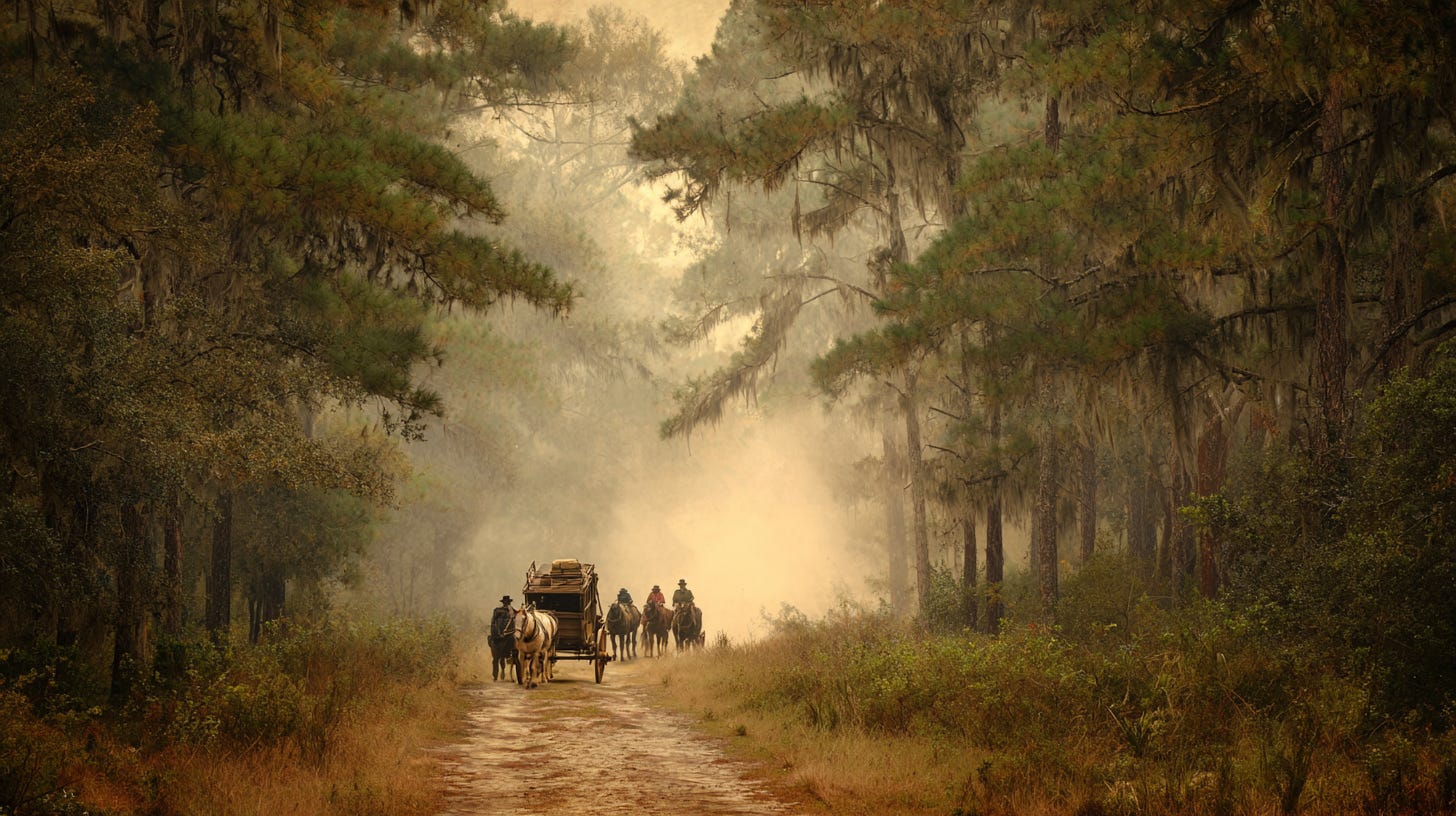
The story of the Walker family is written in the red clay of South Carolina, the pine forests of Georgia, and the wild frontier lands of North Florida. Over the course of nearly a century, six generations of Walkers pushed steadily westward and southward, following rivers, seeking land, and building communities wherever they settled. Their journey mirrors that of countless American families in the late 18th and 19th centuries—a restless pursuit of opportunity that transformed wilderness into home.
The South Carolina Beginnings
Our story begins in Colleton County, South Carolina, where Isham Walker Sr. was born around 1730. Little is known about his early life, but by the time the American Revolution had ended and the new nation was finding its footing, Isham and his wife Mary Carter were already looking west. The coastal lowlands of South Carolina, once the domain of plantation agriculture and colonial society, were becoming crowded. Land prices rose, and opportunities for those without significant means grew scarce.
By the late 1790s, Isham Sr. and Mary had made the move to Georgia, part of the great wave of migration that followed the opening of Georgia’s interior lands. They settled in Wayne County, where Mary would eventually die in 1818. Her will, recorded that year, stands as one of the few documentary traces of this first generation’s foothold in Georgia.
The Georgia Frontier: Isham Jr.’s Era
The real architect of the Walker family’s southward migration was Isham Walker Jr., born in 1769 in Colleton County. Like his father, Isham Jr. felt the pull of frontier lands. Around 1793, at the age of 24, he arrived in Camden County, Georgia, in the far southeastern corner of the state near the Florida border. This was raw country—swamps, pine barrens, and oak hammocks where Creek and Seminole peoples still maintained their presence.
Isham Jr.’s first marriage to Miss Hiers produced a son, Solomon, born in 1792. On October 11, 1797, he married Civility Jones in nearby Glynn County. The name “Civility” was not uncommon on the frontier—a hopeful gesture toward the refinement and order that settlers sought to bring to the wilderness.
What distinguished Isham Jr. from many of his contemporaries was his deep involvement in frontier religious life. In 1819, he became a charter member of Sardis Primitive Baptist Church in what is now Charlton County, Georgia. The Primitive Baptists, with their emphasis on predestination, foot-washing, and congregational autonomy, found fertile ground among frontier families. These churches weren’t just places of worship—they were social centers, courts of moral authority, and networks of mutual aid in isolated communities.
The Walker family’s religious footprint continued to expand. On April 10, 1824, Isham and Civility were received by letter into High Bluff Primitive Baptist Church, a common practice that allowed members to transfer their standing between congregations. Three years later, on March 10, 1827, they were dismissed—likely as they prepared for yet another move.
By the late 1830s, Isham Jr. had drifted westward again, this time to Thomas County in Georgia’s southwestern corner. He died there on November 21, 1839, at the age of 70, having spent his entire life on the moving edge of American settlement.
The Florida Leap: Generation Three
Isham Walker III, born in Georgia in 1813, came of age in a time of dramatic change. Florida had become a U.S. territory in 1821, wrested from Spanish control. The Seminole Wars of the 1830s and 1840s devastated the territory but also opened vast tracts of land for white settlement. For families like the Walkers, Florida represented the next frontier.
On February 12, 1835, Isham III married Eliza Kemp, and within fifteen years, they had made the leap southward. The 1850 Census shows the young family living in the 3rd Division of Walton County, Florida, in the Panhandle region. This was pioneer country in every sense—few roads, scattered neighbors, and a landscape of longleaf pine and wiregrass stretching to the horizon.
Curiously, the 1860 Census shows the family back in Thomas County, Georgia, where Isham was listed as a laborer. Whether this was a temporary return or a failed Florida experiment, we cannot say. What we do know is that Isham III’s life ended tragically. He served in the Georgia Militia during the Civil War and died en route home on September 22, 1864, likely from disease or exhaustion—the fate of more soldiers than bullets ever claimed.
Around this same time, Mount Zion Primitive Baptist Church was constituted in Union County, Florida, on February 20, 1847. While Isham III’s direct connection to this church isn’t documented, Mount Zion became a major religious hub for Florida pioneers of that generation, and the Walker family’s pattern of church involvement suggests they would have been aware of it.
Establishing North Florida Homesteads: The Fourth Generation
The children of Isham III and Eliza Kemp became the true Florida generation, scattering across the north-central part of the state and putting down permanent roots.
James Berry Walker (1848-1922) was born in Walton County, Florida, and married Mary Jane Sweat around 1870 in South Georgia. James embodied the frontier builder archetype. He constructed a “big split log house” on a homestead near Bell, Florida—a dwelling that spoke to both ambition and practical skill. Split-log construction required considerable labor and expertise, but it produced a substantial, lasting home. James is buried in Midway Cemetery, one of the many small family burial grounds that dot the Florida landscape.
John Kemp Walker (b. 1850) married Louatha “Lulu” Byrd and settled in Raiford, Florida. Lulu served as a midwife, a vital role in communities where doctors were scarce and neighbors relied on each other for survival. Interestingly, John became a member of the Church of Jesus Christ of Latter-day Saints, a departure from the family’s Primitive Baptist roots that hints at the religious diversity of frontier Florida.
William Cone “Bill” Walker (1858-1934) was born in Georgia but married Luvina Susan Roberts on April 21, 1881, and moved to Gilchrist County around 1900. Bill and Luvina’s migration represents the final push into Florida’s interior—Gilchrist County, with its springs, rivers, and fertile hammocks, was still being actively settled at the turn of the 20th century.
Susannah “Sue” Walker (1860-1947) married her cousin Fleming Bates “B” Walker and lived in the “Big House” on Main Street in Barney, Georgia. Sue’s decision to remain in Georgia rather than follow her siblings to Florida reminds us that not every family member embraced the southward pull. Her marriage to a cousin was also typical of the era, when frontier families often intermarried to preserve property and strengthen kinship bonds.
The Road to High Springs: Convergence of Faith and Family
The Walker family’s migration from the mid-18th century to the mid-20th century follows a classic pioneer trajectory: beginning in the coastal Carolinas, pushing westward through the Georgia “Wiregrass” frontier, and finally moving south to settle the North Florida wilderness, eventually establishing deep roots in High Springs.
South Carolina to Coastal Georgia (c. 1730–1800)
The journey began with Isham Walker Sr. (born c. 1730), who resided in Colleton County, South Carolina. Around 1800, the elder Walkers moved westward into Georgia. His son, Isham Walker Jr. (born 1769), preceded them, locating in Camden County, Georgia, around 1793. During this era, the family served as “agents” for community land and established themselves as early citizens of the new state.
The Wiregrass Frontier and Religious Foundations (1819–1839)
As the family moved through Georgia, they were instrumental in the “Wiregrass” Primitive Baptist movement. Isham Walker Jr. was a charter member of the Sardis Primitive Baptist Church (organized 1819 in present-day Charlton County) and later joined the High Bluff Primitive Baptist Church in 1824. His westward drift continued into Ware County (1829) and finally Thomas County, where he died in 1839.
The Foray into the Florida Panhandle (1840s–1864)
The third generation, led by Isham Walker III (1813–1864), pushed further south and west. By 1850, the family had settled in the 3rd Division of Walton County, Florida. However, the instability of the Civil War era saw them return briefly to Thomas County and Lowndes County, Georgia. Isham III served in the Georgia Militia and died en route home from the war in 1864.
Settling the North Florida Homesteads (1870s–1890s)
James Berry Walker (1848–1922) was born during the family’s time in Walton County but returned to South Georgia to marry Mary Jane Sweat around 1870. The final move into the North Florida frontier occurred in the mid-1880s. James Berry moved his family to Gilchrist County when his son Robert was an infant (c. 1885), building a “big split log house” on his homestead near Bell, Florida, where Lettye Nora Walker was raised.
The Final Leg: Alachua to High Springs (1916–1940s)
The family’s establishment in High Springs was driven by both marriage and economic shifts in the early 20th century. Lettye Nora Walker moved to Alachua to live with her brother Isham while attending school. There, she met and married James Paul (Jim) Douglas in 1916. After living in Plant City (where Mary Lois was born in 1921) and Bradenton, the Douglas family returned to Alachua. When the highway bypassed Alachua during the Depression, Jim and Lettye Nora moved to High Springs to establish an automotive business.
In High Springs, the family transitioned from their Primitive Baptist roots to become faithful members of the Church of Christ. Mary Lois Douglas Forrester attended David Lipscomb College and lived in High Springs for her entire married life, eventually researching and compiling the very records that preserve this migration today.
This journey from a South Carolina homestead and the Revolutionary-era frontier to a prominent High Springs family represents over 200 years of movement across the American South.