


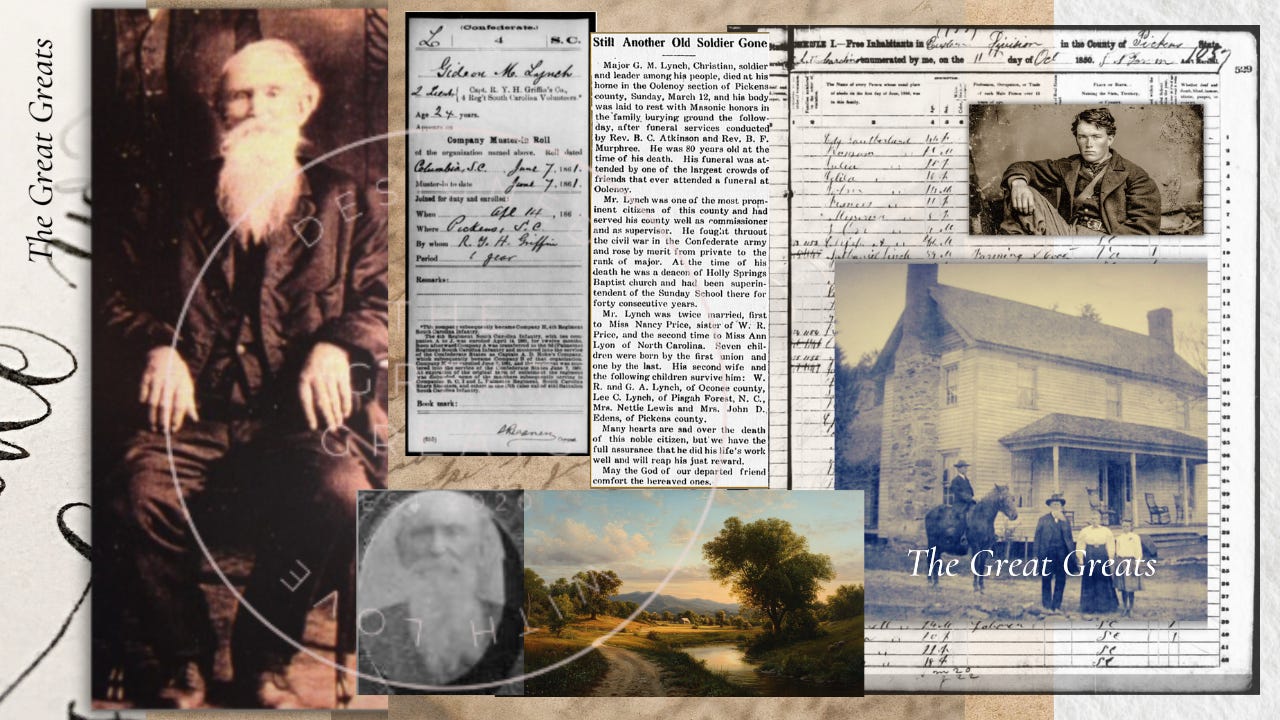
The Bottom Line Up Front: Our 3rd great-grandfather wasn't just another Civil War veteran. Major Gideon Moon Lynch was a man who wrote letters about lightning-struck mules and spent forty years showing up to teach children—a Confederate soldier who became a steady force for education and community building in Pickens County, South Carolina for nearly eight decades.
The Lightning That Killed Will Price's Mule
On August 11, 1913, an 76-year-old Major Gideon Moon Lynch sat down to write a letter to his daughter, Mary Florence Edens. In his careful handwriting, he mentioned the kind of everyday tragedy that marked rural Southern life: lightning had struck Will Price's farm, killing both his mule and hog. Mrs. Hendricks lost her horse the same way.
But Gideon also had news to share—there would be a "protracted meeting" soon, one of those extended community gatherings that could last for weeks.
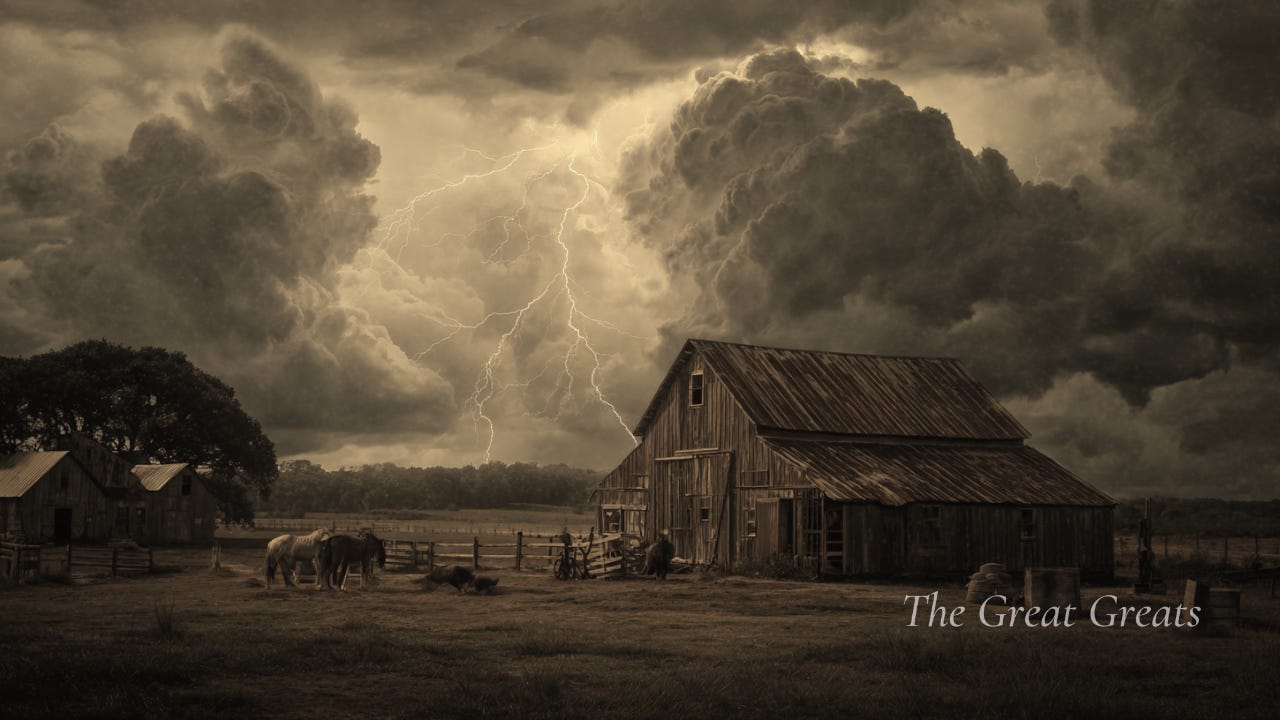
This single letter, preserved in family records, captures the essence of who Gideon Moon Lynch was: a man deeply connected to his neighbors and community, someone who noticed both their losses and their gathering opportunities.
It's a remarkable window into the mind of our ancestor just three years before his death.
Born Into a World in Upheaval
When Gideon Moon Lynch was born on June 29, 1837, in Pickens County, South Carolina, he entered a world convulsing with change. Just three months earlier, Martin Van Buren had been sworn in as the eighth president of the United States, inheriting an economy teetering on the edge of disaster.
The very month of Gideon's birth would prove prophetic. In May 1837, New York City banks failed, and unemployment reached record levels as the Panic of 1837 gripped the nation. South Carolina's plantations were especially hard hit when worldwide cotton markets turned down in 1837–1849, creating economic devastation that would shape the young boy's formative years.
Pickens County itself was young—created just eleven years earlier in 1826 from what had been Cherokee territory until after the American Revolution. The Lynch family was among the early settlers building their lives in this newly opened region of the South Carolina mountains.
A Name That Tells a Story
In this turbulent landscape, Nathaniel Lynch and Sarah Lay chose their son's name with deliberate care. "Gideon" came from his maternal grandfather, Gideon Moon. His middle name "Moon" honored his paternal grandmother, Ann Moon, who had married into the Lynch family. Pickens County had been created just eleven years earlier, in 1826, from Pendleton County—it was still a frontier region where families like the Lynches were among the early settlers building communities on recently opened Cherokee lands.
In the 1830s, names weren't chosen lightly. They carried the weight of family history, the hope of character traits passed down, and the responsibility of honoring those who came before. That they named him after the biblical Gideon—a leader who united fractured groups against overwhelming odds—seems remarkably prescient given the life he would lead.
From Private to Major: A Soldier's Rise
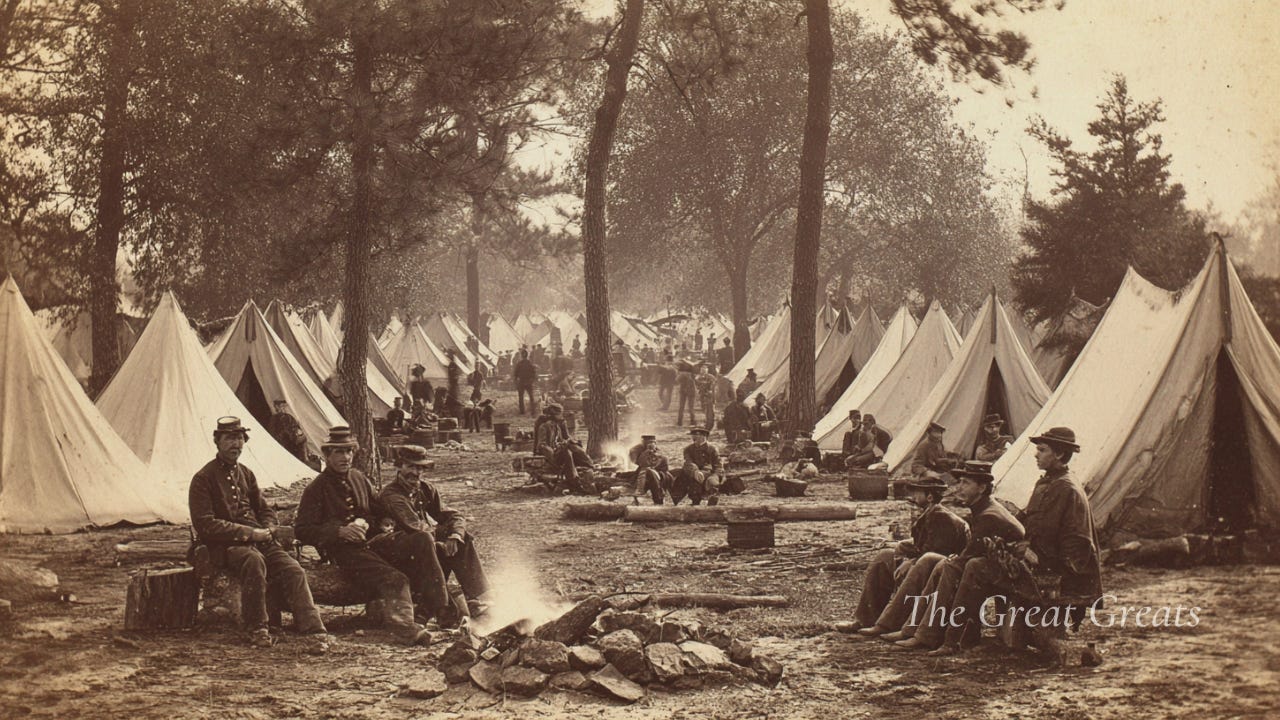
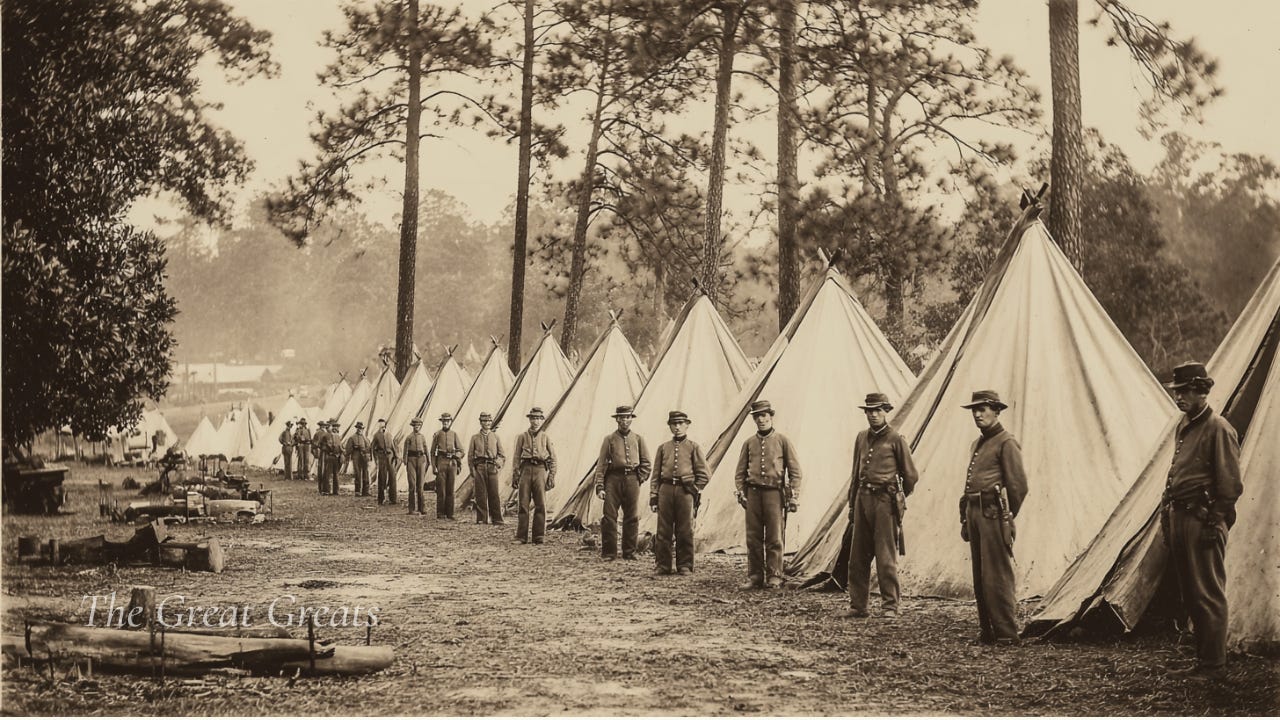
When the Civil War erupted, Gideon Moon Lynch was just 24 years old, newly married to Nancy E. Price (they wed on December 12, 1862), and probably already thinking about starting a family. Like so many young Southern men, he enlisted in the Confederate army—but unlike most, he wouldn't just survive the war, he'd rise through its ranks.
Starting as a private in the 25th South Carolina Infantry, part of Hagood's Brigade, Gideon fought "throughout the Civil War." The sparse military records we have paint a picture of dedication under fire. By war's end, he had earned the rank of Major—a significant achievement that spoke to his leadership abilities and the trust his fellow soldiers placed in him.

The war wasn't kind to him physically. Hospital records from November to December 1864 at Jackson Hospital in Richmond, Virginia, list "stricture" as a medical condition he battled. Richmond's hospitals were overwhelmed during those final, desperate months of the Confederacy, and the fact that Gideon was there suggests he saw some of the war's heaviest fighting.
But he survived, returned home to South Carolina, and began the work of rebuilding—both his family and his community.
The Administrator and the Father
Peace brought new responsibilities. In 1864, even as the war raged, Gideon became the administrator of his father Nathaniel Lynch's estate—a role that required both legal acumen and family diplomacy. Records show he was set to receive $1,235 from the assets of Jane Lynch, a substantial sum that would help establish his post-war life.
Meanwhile, his family was growing. He and Nancy had seven children together: Salena A, Freeman, Thomas Calvin, William Robert, Nettie, Arkeleus V., and Mary Florence. Each name tells its own story of family hopes and 19th-century naming traditions.
But tragedy struck on November 17, 1878, when Nancy died. Gideon, now 41, was left to raise seven children alone—a daunting prospect in any era, but especially challenging in post-Reconstruction South Carolina.
A Second Chapter: Love and Leadership
Life, however, had more chapters in store. Before 1881, Gideon married Ann Lyon from North Carolina, and together they had one child, Lee C. Lynch. This second marriage brought new love and expanded his family across state lines—a connection that would prove important throughout his life.
By this time, Gideon was establishing himself as a community leader. In 1875, he was elected as a trustee of the Pumpkintown School district. Think about that title for a moment—"Pumpkintown School district." It captures the rural, agricultural world where education was precious and trustees like Gideon were responsible for ensuring the next generation could read, write, and calculate.

Forty Years in the Same Sunday School
Perhaps the most remarkable aspect of Gideon's later life was his consistency. From approximately 1876 to 1916—a span of forty consecutive years—he served as Superintendent of the Sunday School at Holly Springs Baptist Church.
Forty years. Consider what that means. He began this role during Reconstruction and continued through the Spanish-American War, the dawn of the automobile age, and the early years of World War I. He watched children grow up, get married, and bring their own children to the same Sunday School. He was there for countless Christmas pageants, Easter celebrations, and summer revivals.
This wasn't just community duty—it was community building of the highest order. As Sunday School Superintendent, Gideon helped shape the educational foundation of generations of Pickens County families. He was teaching children to read using available materials when public education was still spotty, providing guidance when communities were rebuilding after war, and offering stability when the world seemed to change at breakneck speed.
On May 28, 1881, he was present at a Ministers' and Deacons' meeting at Mountain Grove Church, where he was listed as a minister (though he may have been serving as a deacon). Whether ordained minister or devoted layman, his community leadership was recognized throughout the region.
The Final Chapter
Major Gideon Moon Lynch died at his home in the Oolenoy section of Pickens County on March 12, 1916, at age 79. The next day, his body was "laid to rest with Masonic honors in the family burying ground" after funeral services conducted by Rev. B. C. Atkinson and Rev. B. F. Murphree.
Those "Masonic honors" tell us something important—Gideon was a Freemason, part of that network of men who emphasized moral improvement, community service, and brotherhood. It was fitting recognition for a man who had spent his life building up his community.
He was survived by his second wife Ann and several children from both marriages, including W. R. Lynch and G. A. Lynch (both of Oconee County), Lee C. Lynch (of Pisgah Forest, NC), Mrs. Nettie Lewis, and Mrs. John D. Edens (both of Pickens County). His obituary noted that he was "recognized as a prominent citizen who served his county as commissioner and supervisor."
What We Can Learn
Major Gideon Moon Lynch lived through one of the most transformative periods in American history. He saw his country torn apart by civil war and slowly knit back together. He witnessed the end of slavery, the dawn of the industrial age, and the beginning of the modern era.
Through it all, he remained rooted in his community, committed to education and service, and dedicated to building something larger than himself. He rose from private to major through merit and leadership. He served his community as educator, community leader, and public servant. He raised a large family and maintained connections across state lines.
Most remarkably, he showed up—day after day, year after year, decade after decade. Forty years as Sunday School Superintendent. That's not glamorous work, but it's the kind of steady, reliable service that builds communities and shapes character.
In our age of rapid change and short attention spans, there's something deeply admirable about a man who found his calling and stuck with it for four decades. Major Gideon Moon Lynch understood that true leadership isn't always about dramatic gestures—sometimes it's about showing up every Sunday, teaching the children, and making sure the community has the moral and educational foundation it needs to thrive.
That's the legacy he left us: not just stories of wartime heroism (though he had those), but a model of sustained service, community commitment, and quiet leadership that built something lasting.
What questions do you have about Major Gideon Moon Lynch's life? What other family stories should we explore? Drop a comment below or reach out—I love hearing from fellow family historians and descendants.