


She was born with the whole nineteenth century ahead of her — and she outlived nearly all of it.
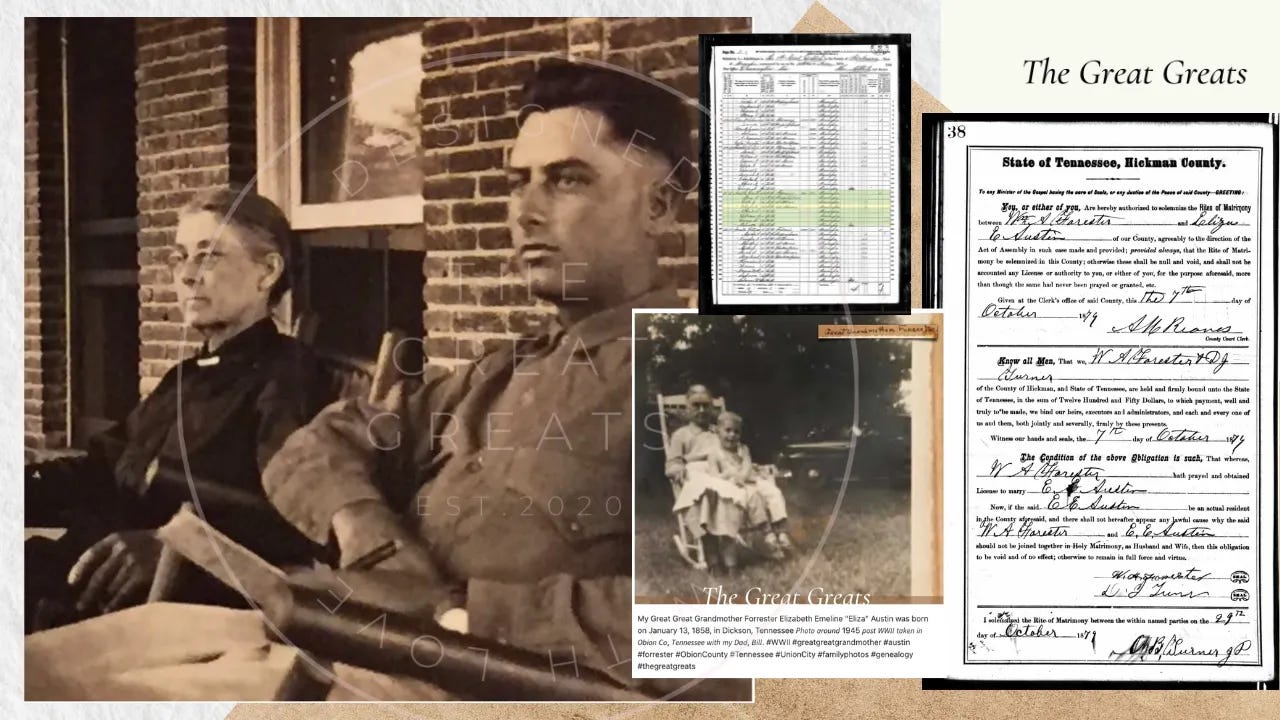
There is a photograph of her sitting beside her fourth child — my great-grandfather, William Baxter “Willie B.” Forrester — in the years he wore the uniform of the First World War. Look at it long enough and you realize what you’re holding: a woman born before the Civil War, standing beside a son of the Great War. One frame. Two wars. A century between them. And a third still waiting downstream.
Consider the year she was born. January of 1858: James Buchanan in the White House. Abraham Lincoln a Springfield lawyer, months from the debates that would make him famous — and from the Senate race he would lose. The first transatlantic cable would sputter to life that summer and die within weeks. Minnesota was not yet a state. And three years and three months after Eliza’s first cry on a Dickson County farm, the guns opened on Fort Sumter.
Now consider the year she died. 1954: Eisenhower. Brown v. Board of Education. The Salk polio vaccine going into the arms of more than a million schoolchildren. That same summer, a day’s drive south of her bed, a nineteen-year-old truck driver named Elvis Presley walked into a Memphis studio and cut his first record.
Historians divide the past into eras. Families divide it into lives. Elizabeth Emeline “Eliza” Austin Forrester (January 13, 1858 – September 7, 1954) is the rare life long enough to measure both — ninety-six years, all of them Tennessee. This is her story, and the story of the five children she raised at the hinge of the century: Zona, Otho, Ray, Willie B., and Eugene.
A Civil War childhood, a farmhouse full of brothers and sisters, a son sent to one World War and a grandson to the next.
A name written in grief
To understand Eliza, start three years before she was born — with a week the Austin family never forgot.
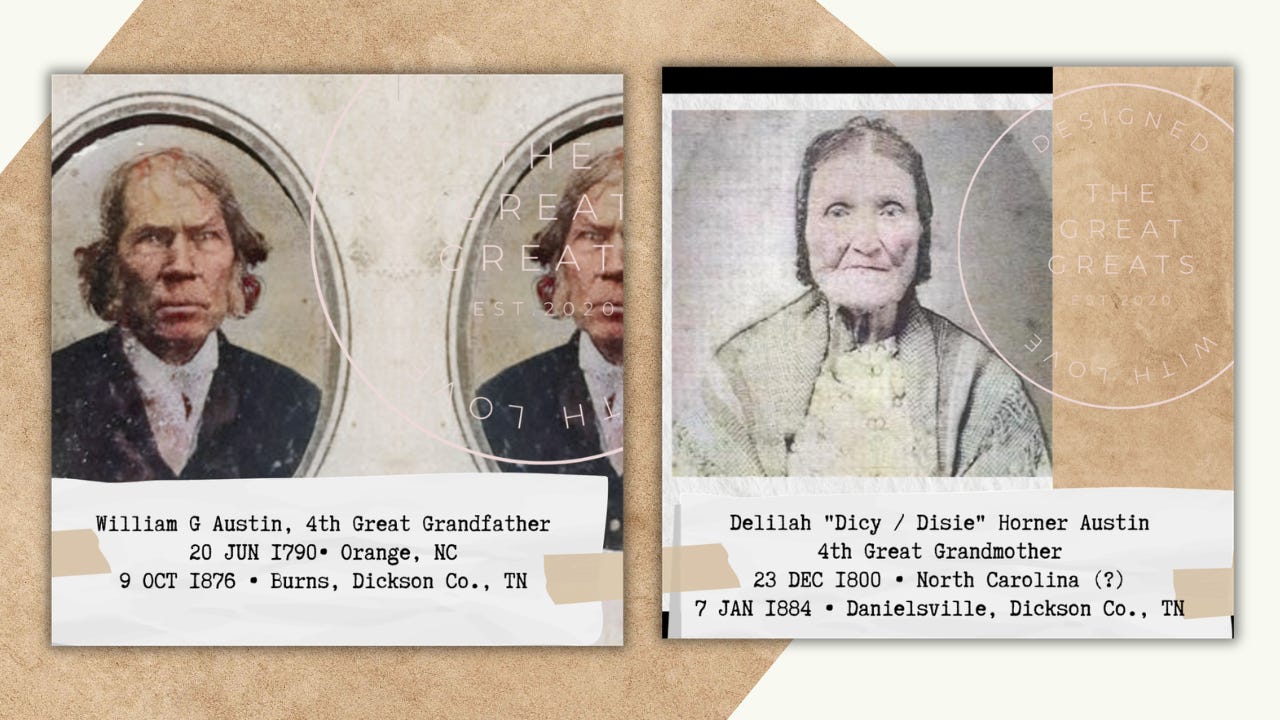
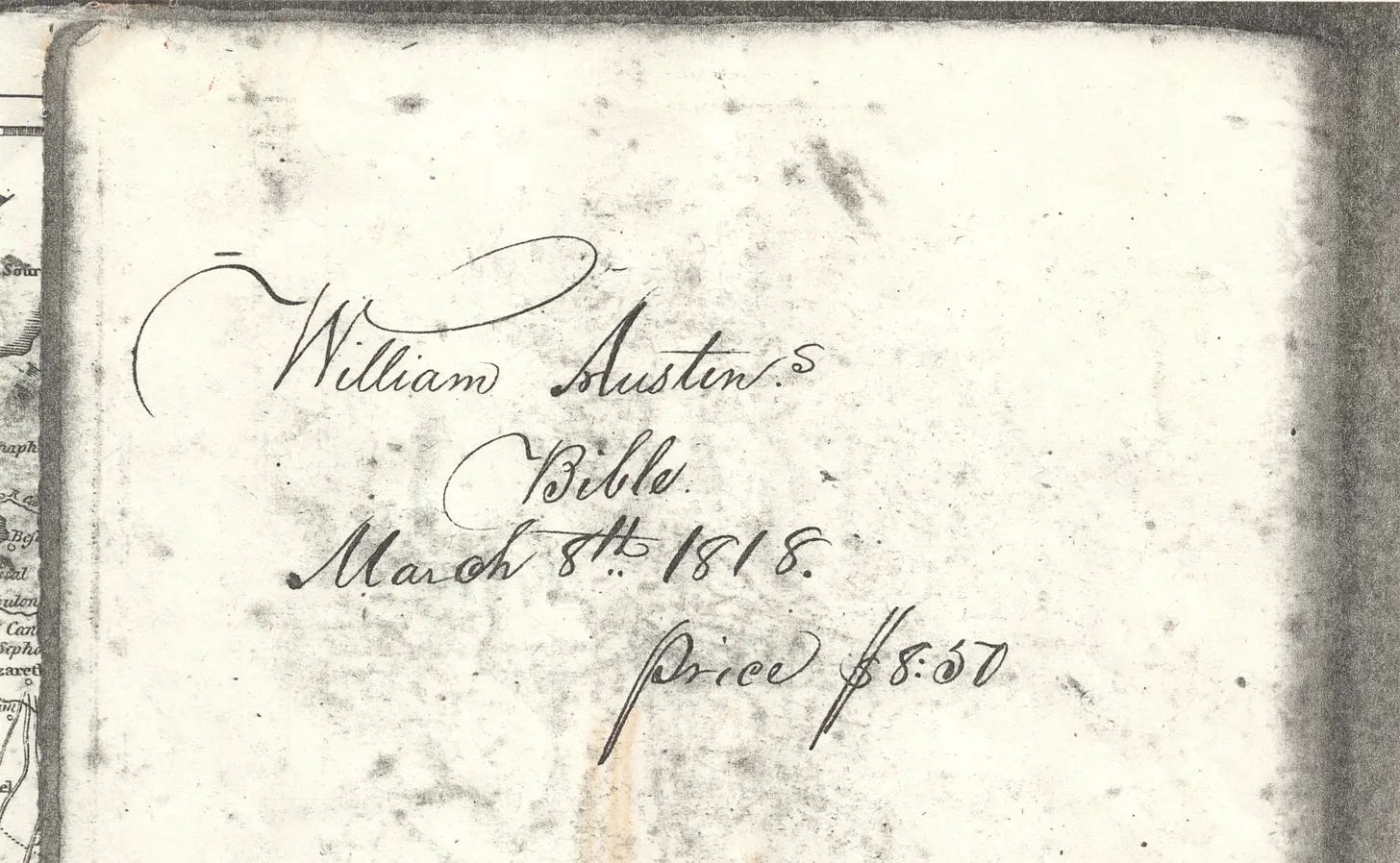
Her grandparents, William Austin (1790–1876) and Dicy Horner (1800–1884), married on October 21, 1819, and raised a big family on their Dickson County farm. William had bought the family Bible on March 8, 1818, for $8.50, and its family register would hold the next ninety-five years of births and deaths in slanted ink. Then, in one late-summer week, the ink turned to grief: three of William and Dicy’s grown daughters — Jane, twenty-six; Emmeline, twenty-four; and Betty, twenty-two — died within days of each other and were laid in the Austin Cemetery at Burns. None had married. The Bible’s register says 1855; a granddaughter’s typed family notes say 1854. Every telling agrees on the part that matters: it happened inside a single week, and the records point to typhoid.
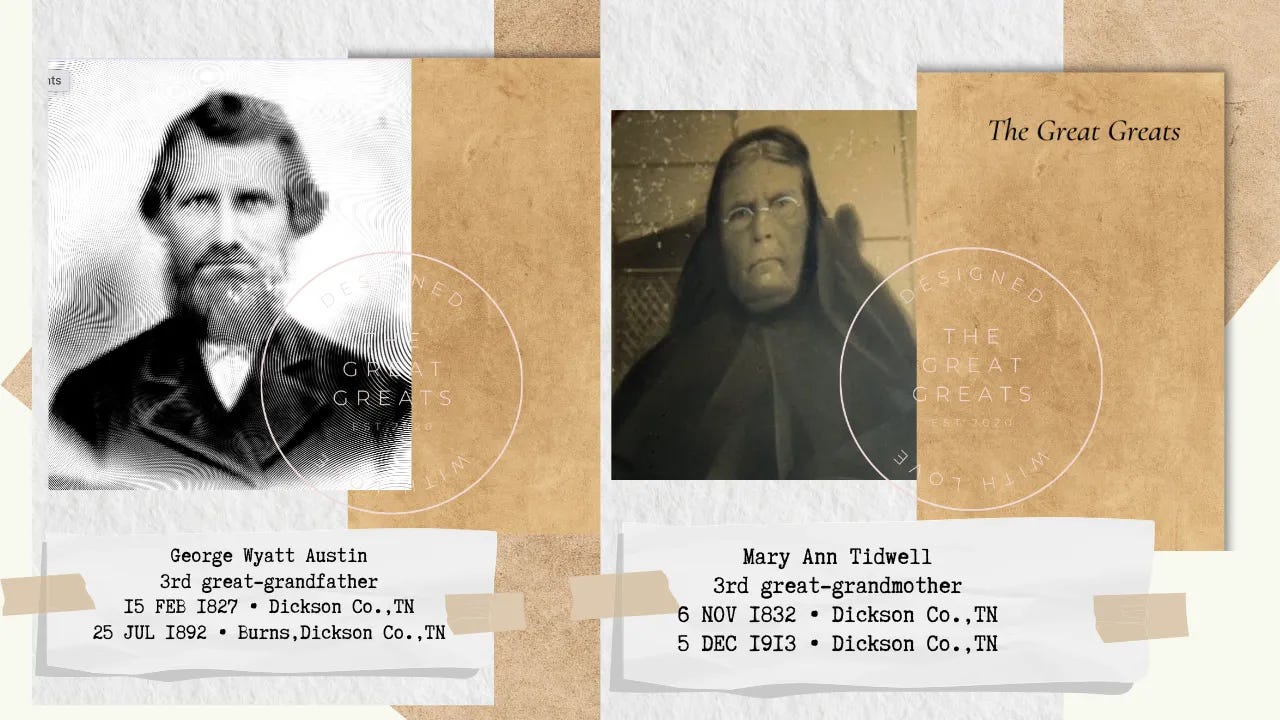
Eliza’s father, George Wyatt Austin (1827–1892), was a young newlywed that week — married that February to Mary Ann Tidwell (1832–1913), whose people counted among their cousins Captain Franklin Fulton Tidwell of Company K, 11th Tennessee Infantry. George stood with his parents as they buried three of his sisters in seven days. And when Mary Ann delivered a January daughter four winters later, they named her Elizabeth Emeline — a name I read as a quiet memorial: Elizabeth for Betty, Emeline for Emmeline. The lost aunts handed her their names, and she carried them for ninety-six years.
Her own beginning knew loss, too. George and Mary Ann’s first child, Lucinda, lived only eight days in March of 1855. Then came Dicy Jane in 1856. Then, at last, Eliza.
A childhood in the cannon’s shadow
Eliza was three years old when the war came to Middle Tennessee — and Dickson County, with its iron furnaces and its railroad, was never a bystander. Her first memories would have formed against the noise of a nation tearing itself in half: soldiers on the road, armies living off the land, news arriving late and wrong.
In the autumn of 1863 — the same autumn as Chickamauga — her four-year-old sister Amanda died. Childhood in that decade meant learning early what grown faces did when a name went quiet.
By the 1870 census she is there in ink: twelve-year-old Eliza in District 8, Dunnington, Hickman County, in a farmhouse filling fast with brothers and sisters — Albert, William Benjamin, George Franklin, Marietta, Nellie Ann, and finally Zenie Ethel in 1875. Ten children in all.
And here is the fact I cannot get over. In October of 1876, when Eliza was eighteen, her grandfather William Austin died. She knew him — sat in rooms with him, heard his voice. A man born in 1790, while George Washington was President of the United States. Family memory is not a ladder. It is a hand-span.
The boy from Sugar Creek
On October 29, 1879, in Hickman County, twenty-one-year-old Eliza married William Albert “Billy” Forrester (1856–1923) — a son of the Sugar Creek Forresters, who had farmed that creek valley since 1815, carriers of an old Scottish motto I’ve written about before: Si Fractus Fortis — “Though Broken, Brave.”
Then they did what their generation did: they moved. Not all at once — the 1880 census finds them in Humphreys County, and their first child was born in Waverly the following autumn — but steadily west, until the family set down its roots for good in Obion County, in the far northwest corner of the state. The Hickman County lines stayed behind in the census columns. Eliza and Billy founded something new: the Obion branch.
Five children at the hinge of the century
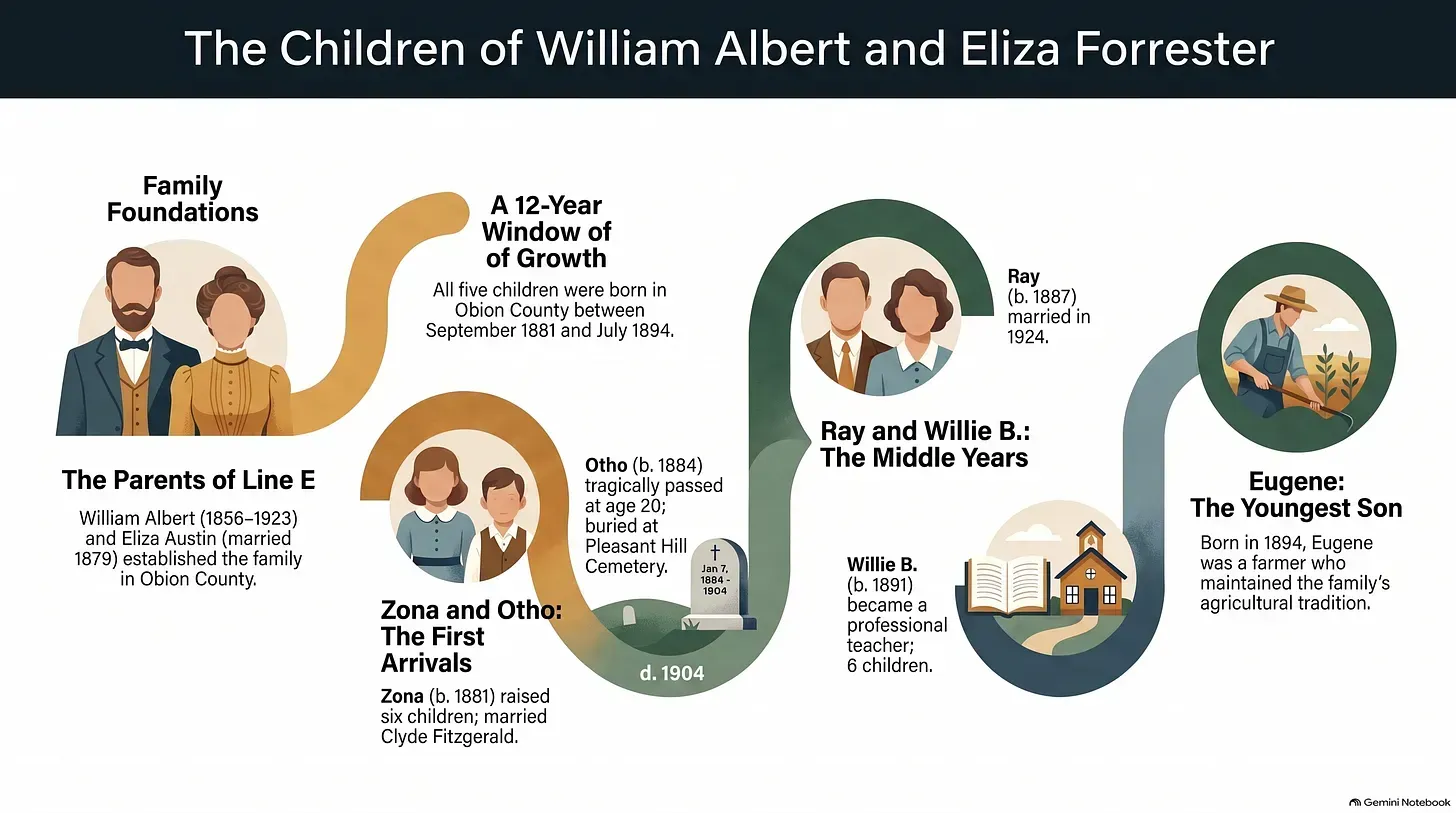
Between 1881 and 1894 — twelve years — Eliza bore five children. Each deserves a paragraph here, because this is a story about brothers and sisters, and because one of them was my great-grandfather.
Arizona “Zona” Forrester (1881–1975), the eldest — the helper, the second pair of hands. Her name may be an echo: family notes remember a cousin Zona who came visiting from Mayfield, Kentucky, in those years. Zona married Clyde Fitzgerald in 1906 and raised six children of her own.
Otho Forrester (1884–1904), born in January — the quiet one in the records, a young man who never married. In the spring of 1904, at twenty years old, he died, and was buried at Pleasant Hill Cemetery. The first break in the circle.
Raymond “Ray” Forrester (1887–1971), the steady middle — he married Ima Lee Holloway in 1922 and made his life in the county.
William Baxter “Willie B.” Forrester (1891–1979), the fourth of five — my great-grandfather. More on him below.
Eugene Payne Forrester (1894–1982), the baby — and the one who stayed closest to the soil. He farmed Obion County all his life.
What did it mean to grow up on an Obion County farm between 1881 and 1894? It meant kerosene light and a wood stove, corn and cotton and a kitchen garden, chores sized to small hands. It meant the Illinois Central whistle threading through the river bottoms — the sound that tied Troy and Rives to Chicago and New Orleans, that carried the Sears, Roebuck catalog and the newspapers in a few days late. It meant a one-room schoolhouse that doubled as the county’s social anchor, and church at Pleasant Hill. It meant overhearing the grownups argue falling crop prices, railroad freight rates, the Farmers’ Alliance, and the new People’s Party of 1892 across the kitchen table.
And it meant doing all of it together, five across. Picture Willie B. in that house: ten years younger than Zona, chasing Otho and Ray through the cornrows, towing little Eugene behind him. The fourth child of five learns early how to listen — how to be student and teacher in the same skin. In Willie B.’s case, the schoolhouse claimed him outright. He grew up to teach in it — and, in time, to preside over the Troy school as its principal.
The long goodbye
A long life is also a long series of farewells, and Eliza’s were not gentle.
She buried her son Otho in 1904, when he was twenty and she was forty-six. She buried her mother, Mary Ann, in 1913. And on September 23, 1923 — four days short of his sixty-seventh birthday — she buried Billy. She was sixty-five, with thirty-one years still to live.
But the record refuses to read as retreat. There was a son’s homecoming to witness: Willie B., who had gone into the Army in 1917 and come home from the First World War, married Vivian White and raised six children of his own — the schoolteacher’s house loud again, a whole field of grandchildren growing up within knowing distance of their grandmother Eliza. One of those six was a boy named Baxter — my grandfather.
And then the wars came around again. In 1943 — the year Eliza turned eighty-five — Baxter went into the Army and shipped overseas with the 45th Infantry Division. He was wounded in Asweiler, Germany, and came home with a Purple Heart and a Bronze Star. Think of her in those years: a woman born before the Civil War, waiting on news of a grandson fighting in Germany — the third war of her lifetime to reach into her own house, and her own blood.
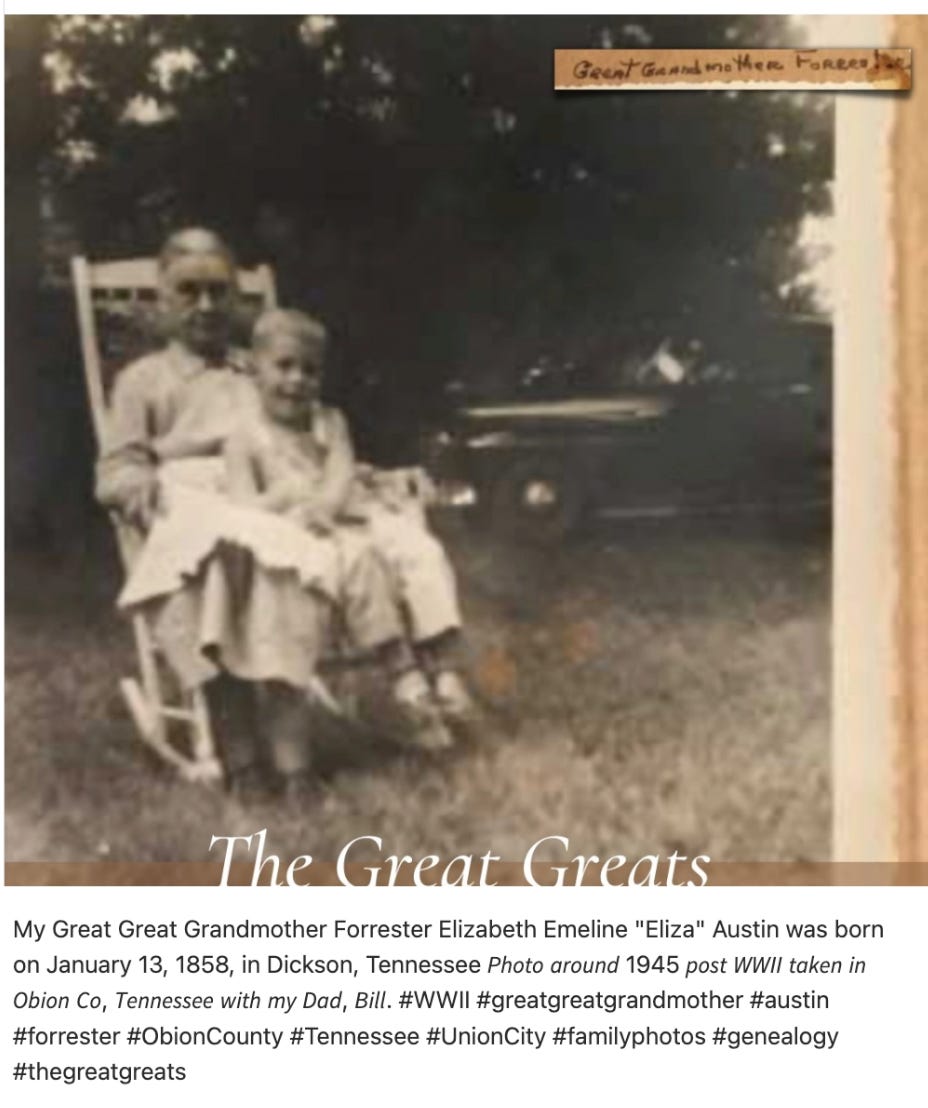
And there is a second photograph I love. It was made around 1945, just after the second of the world wars, in Obion County: Eliza, in her late eighties, beside her great-grandson — my father, a toddler in the frame with her. The woman who once sat in a room with a man born under George Washington, sharing a frame with a boy of the television age.
On September 7, 1954, in Troy, Tennessee, Eliza died at ninety-six. They laid her at Rives, a few miles from the farm, in the ground of the branch she and Billy had founded.
Do the arithmetic one more time. She knew her grandfather, born in 1790 — a man of George Washington’s America. She sat for a photograph with my father when he was a toddler, in the age of the atom bomb. That is a hundred and sixty-four years of American memory, joined by two pairs of hands — and I am here because the chain held.
Why I keep coming back to her
Eliza Austin never made a history book. No office, no invention, no headline. But line her ninety-six years up against the timeline and she is the history: a Civil War childhood, Reconstruction, the railroads, the agrarian revolt, two world wars, the Model T, the radio, the bomb — all of it filtered through one farmhouse kitchen and one woman’s endurance.
That is the premise of this whole project: the great-greats are not footnotes to history. They are the load-bearing walls.
And I will confess it — part of why I am writing her now is the photograph I opened with: Eliza beside Willie B. in his First World War years. She looks at the camera like someone who has already buried a child and a war and does not intend to bury another. He looks like a boy who grew up fourth of five in a loud house and learned to stand still for the things that matter. Somewhere between those two expressions is nearly everything I know about where I come from.
Can you help fill in the gaps?
In 1987, an Austin cousin I never met — William W. Austin, an engineering professor at NC State — closed a letter to my grandparents with a sentence that could be this newsletter’s motto: “It really is great finding cousins we didn’t even know we had.”
If any of these names or places live in your tree, I would love to hear from you:
Austin, Tidwell, or Forrester lines in Dickson, Hickman, Humphreys, or Obion Counties, Tennessee
The Austin Cemetery at Burns, Pleasant Hill Cemetery in Obion County, or the burial ground at Rives
Descendants of Eliza’s brothers and sisters — Dicy Jane, William Benjamin, George Franklin, Marietta, Nellie Ann, or Zenie Ethel (who married Josiah “Uncle Joe” Alspaugh)
Photographs, letters, or Bible pages — especially anything naming the three Austin daughters lost in that single week
Drop a comment, or reach out directly. Every lead — even a small one — helps bring these lives back into focus.
— With gratitude for the great-greats, and for everyone still searching for them.
A quick note on process, because this newsletter believes in honest records: the research behind this piece — Bible pages, census lines, letters and all — is organized in Notion, with edits and research assistance from Kimi K3. Eliza supplied the plot.
Support the Archive

Over the past 45 years, this archive has been built with biscuit tins, love letters, shoeboxes of photos, courthouse microfilm, oral history tapes, and the sheer will to re…