


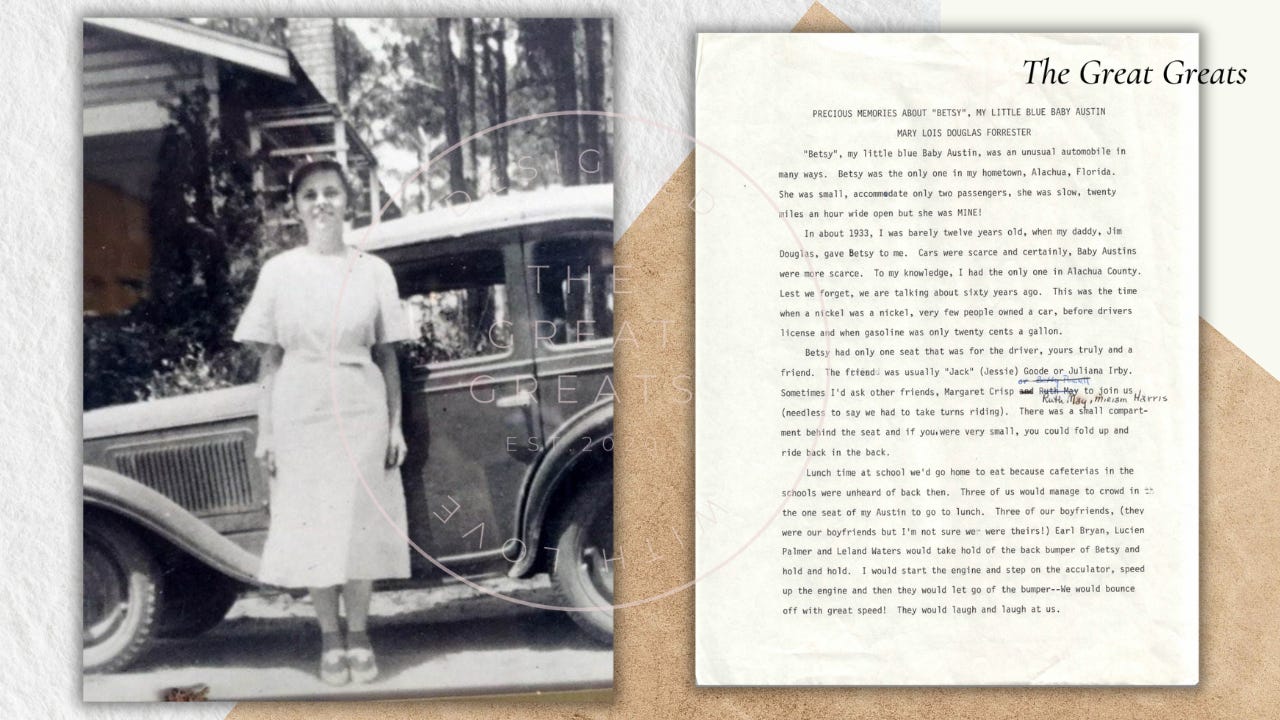
When Twelve-Year-Olds Could Drive (And Did!)
In an era when most families didn't own automobiles and driver's licenses weren't required, imagine a twelve-year-old girl in 1933 Florida receiving her very own car. This isn't fiction—it's the true story of Mary Lois Douglas Forrester and her beloved "Betsy," a little blue Baby Austin that became the center of countless adventures in Alachua County.
Mary Lois's handwritten story, penned decades later as part of her role as family historian, captures not just the tale of an unusual gift, but a window into Depression-era small-town life where gasoline cost twenty cents a gallon, nickels were precious, and school cafeterias didn't exist. What makes this story even more remarkable is that her dad, my great grand Jim Douglas owned a Chevrolet dealership—now celebrating its 98th year—yet he chose to give his twelve-year-old daughter this quirky little Baby Austin. Her tale reminds us that the relationship between Americans and their automobiles has always been deeply personal—even when that automobile had only one spark plug and a top speed of twenty miles per hour.
The Tiny Car That Could (Sometimes)
Mary Lois Douglas received "Betsy," a small blue Baby Austin automobile, from her father Jim Douglas when she was barely twelve years old in 1933. Living in Alachua, Florida, she believed hers was the only Baby Austin in the entire county. The tiny car accommodated only two passengers and had a maximum speed of twenty miles per hour, but it provided endless adventures for Mary Lois and her friends.
The car's quirks were numerous: it had only one spark plug that would get wet in the rain, causing the engine to stop; a small radiator that would overheat during spirited drives; and a clutch positioned so close to the floorboard that only Mary Lois could operate it effectively. Her emergency kit consisted of a Maxwell House coffee can and tea strainer for collecting and filtering ditch water when the radiator ran dry.
Mary Lois's daily routine included driving friends to lunch (since school cafeterias didn't exist), carefully timing her trips with a clock she carried in the rear compartment, and navigating the deep sandy ruts of country roads—her father's preferred route for safety. The car was so narrow it couldn't fit in both ruts, so they'd drive sideways with one wheel in the rut and one in the middle. Despite the car's limitations and her father's watchful eye over her adventures, Mary Lois treasured every moment with her little blue Baby Austin.
The Story: "Precious Memories About 'Betsy', My Little Blue Baby Austin"
As written by Mary Lois Douglas Forrester
"Betsy", my little blue Baby Austin, was an unusual automobile in many ways. Betsy was the only one in my hometown, Alachua, Florida. She was small, accommodated only two passengers, she was slow, twenty miles an hour wide open but she was MINE!
In about 1933, I was barely twelve years old, when my daddy, Jim Douglas, gave Betsy to me. Cars were scarce and certainly, Baby Austins were more scarce. To my knowledge, I had the only one in Alachua County. Lest we forget, we are talking about sixty years ago. This was the time when a nickel was a nickel, very few people owned a car, before drivers license and when gasoline was only twenty cents a gallon.
Betsy had only one seat that was for the driver, yours truly and a friend. The friend was usually "Jack" (Jessie) Goode or Juliana Irby. Sometimes I'd ask other friends, Margaret Crisp and Ruth May to join us (needless to say we had to take turns riding). There was a small compartment behind the seat and if you were very small, you could fold up and ride back in the back.
Lunch time at school we'd go home to eat because cafeterias in the schools were unheard of back then. Three of us would manage to crowd in the one seat of my Austin to go to lunch. Three of our boyfriends, (they were our boyfriends but I'm not sure we were theirs!) Earl Bryan, Lucien Palmer and Leland Waters would take hold of the back bumper of Betsy and hold and hold. I would start the engine and step on the accelerator, speed up the engine and then they would let go of the bumper -- We would bounce off with great speed! They would laugh and laugh at us.
We would pretend to be angry actually, we were excited to be noticed by the boys.
The two "accessories" that I took along with me in the rear compartment, were johnny cakes (large cookies) and a clock. Time was an important factor so I'd know exactly what time to be home, school and church. It was very important to me that I never did anything to cause my mama and daddy to worry or be upset with me.
My little blue treasure had only one spark plug, very small tires and the clutch was about an inch from the floorboard making it almost an impossibility to make "her" go unless the driver was me! Gasoline capacity was about five gallons. I could go almost endlessly on a tank of gas.
Hurry was one thing you didn't do if you were going someplace in my "Betsy". Sunny days were essential for a good ride because if it rained the one spark plug would get wet and she'd stop dead in her tracks. I'd jump out and get the tire pump to blow the water off the plug, then away we'd go! Forgot to mention "her" water (radiator) capacity was small and if I got her going, I mean, really going, "her" steam would come up and pretty soon the water was gone. In the back compartment was an empty Maxwell House coffee can and tea strainer, this was my emergency kit. I'd pull over by the side of the road to a drainage ditch, Julianna or Jack, whoever was riding would hop out scooping up water that was in the ditch, and strain it before putting it in the radiator. Betsy would simmer down and off we'd go again. Oh! what fun.
My daddy told me to drive on the country roads instead of the highways because it was safer. Country roads-- you'd be surprised where you could travel without ever getting on the highways. The country roads were deep sandy ruts.
However, that didn't stop Betsy and me. She wasn't wide enough to get in both ruts, so we'd take one, go sideways. By that I mean we were leaning, one wheel in the rut and the other the middle. This, of course, was very peculiar looking but that was exciting.
Daddy kept close watch on me with "Betsy". If I decided to take a trip without telling him, he'd know because someone would stop me and tell me that my daddy said to come home. I didn't slip off very often because I'd get caught so why take the chance and upset my parents.
Precious memories, how they linger about my little blue Baby Austin, Betsy.
My Thoughts: When Breaking Down Was Half the Fun
Mary Lois's tales of her adventures with Betsy capture more than just the story of a girl (also our Nana) and her car—it's a snapshot of a time that feels both distant and familiar. Her respect for her parents' rules, her resourcefulness in maintaining her temperamental vehicle, and her pure joy in simple pleasures remind us that some aspects of growing up remain timeless, even as the world around us transforms.
In an age when we're increasingly disconnected from the mechanical workings of our vehicles, there's something deeply appealing about Mary Lois's intimate knowledge of Betsy's quirks and needs. Her story is a testament to the bonds we form with the objects that give us freedom, and how those memories can remain precious across the decades. (You can still book your service at Jim Douglas Sales & Service in High Springs, Florida!)
The Great Greats celebrates the stories of our ancestors, preserving their voices and experiences for future generations. Do you have a family story or memoir to share? We'd love to hear from you.
More from The Great Greats:
Become a founding member and support the archives - Help us preserve and share more precious family stories like Mary Lois's adventures with Betsy