


They are all wearing what the land gave them.
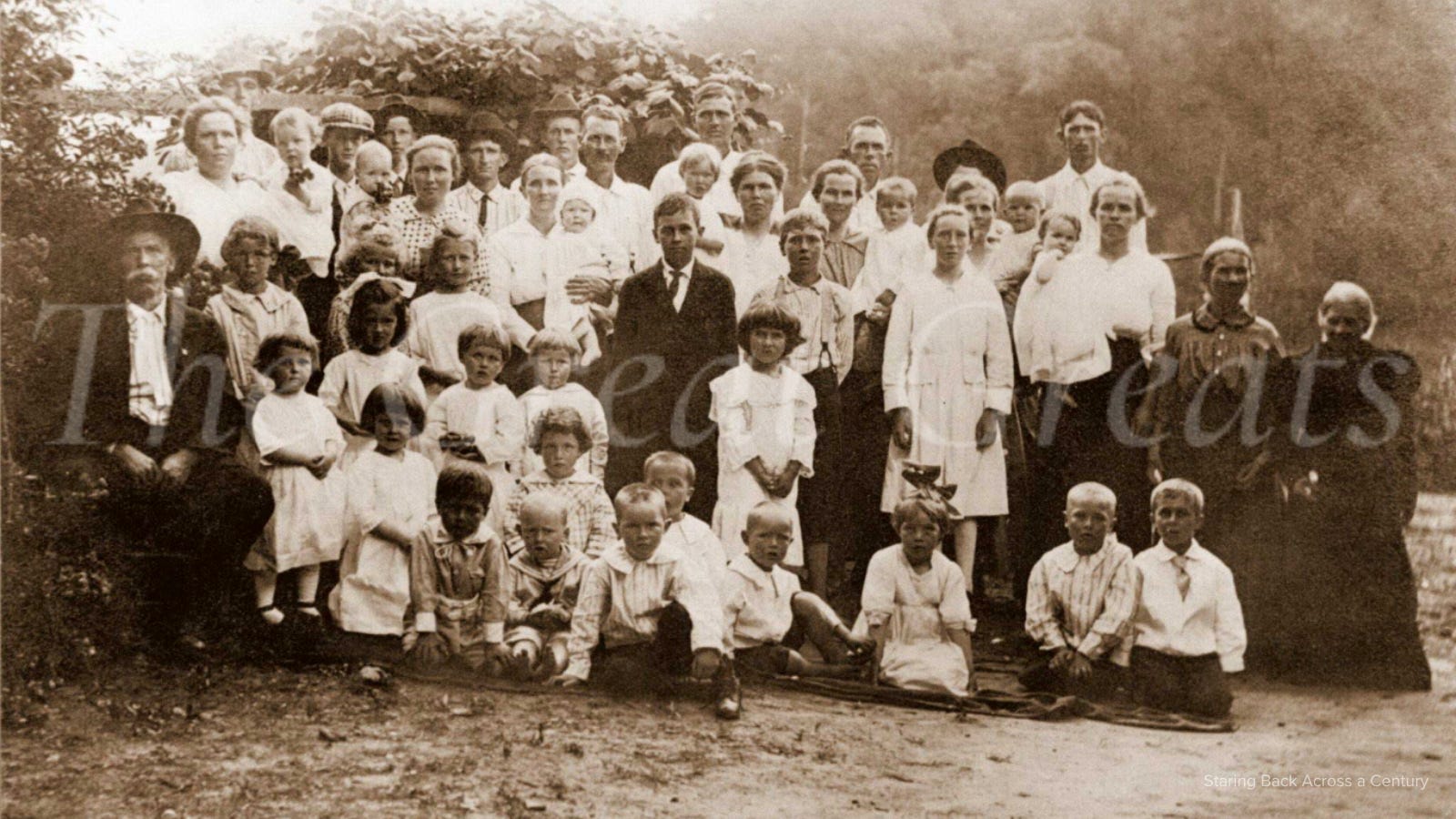
Cotton and wool — nothing else, because in 1911 there was nothing else to wear. The women’s day dresses and the men’s stiff Sunday shirts are cotton, grown and picked and spun within a few miles of where they stand. The heavier skirts, the dark suit jackets, are wool — the fabric that held its shape through farm work and factory shifts and unheated winters. Every fiber in this portrait came from a field or an animal’s back. You can almost feel the weight of it: the scratch of the collars, the heat those clothes must have trapped in a South Carolina July.
And they are standing at the hinge of a whole world. 1911 — the year an empire fell in China, the year revolution stirred in Mexico, the year the Triangle Shirtwaist Fire in New York burned labor law into being. Here in Pickens, South Carolina, a quieter revolution was underway: families like ours were walking off the worn-out tenant farms along Oolenoy Creek and into the mill villages, trading the boll weevil and the falling cotton price for the deafening looms of the Alice Manufacturing Company. Some of the faces in this frame still remembered plowing. Some of the children in it would be at the mill before they were teenagers.
That is the world they lived in. This is the part I’m still learning to say out loud:
I don’t know all of them.
I’ve stared at these faces for weeks now — blown up supersize on my monitor — and I keep hoping. Maybe someone out there still knows this line. Maybe one sister, one nephew, one far-off cousin grew up hearing about one of my greats: a name, a nickname, a story told at a kitchen table. I know the chances are slim, maybe none. I know that as the days pass this portrait gets quietly filed away — indexed, catalogued — but never, ever forgotten. So I’m asking anyway. I would love to hear from you.
Because maybe, together, we can write the rest of this story.
The photograph
Every family has one and in my case many: the photograph that everyone keeps but no one can fully explain. Ours is a portrait made around 1911 in Pickens, South Carolina — a cluster of faces, stiff collars, and Sunday best, staring back across more than a century.
On the back, or in the notes handed down with it, are surnames: Hayes, Anthony, Brown, Massingale, Jones, Burns, and Stewart. A couple is named too — Ella Jane Childs and Wm. Fields Hayes — though I’ve never been able to place them together with certainty.
What I can do is trace how these names knot together. Because when you lay the portrait beside the genealogical records compiled by my great-uncle, John Davis Edens II, and by Lloyd Pace, something remarkable happens: nearly every surname turns out to be a thread in the same family cloth, woven tight around the Oolenoy and Pickens communities.
Here is what I’ve pieced together.
The surnames, and how they connect
The families named on the portrait — Hayes, Anthony, Brown, Massingale, Jones, Burns, and Stewart — are linked by marriage and by land to the Pace and Childs lines.
Childs & Hayes: The clearest connection runs through Martha Angeline Childs (1851–1931), who married Joseph Warren Pace. Their children carried the Hayes tie forward:
Sarah Elizabeth Pace (b. 1867) married Thomas Hayes.
Joseph Ben Pace (b. 1882) married Mary Alice Hayes.
An “Ella Jane” isn’t explicitly listed among Angeline’s children — but her sister Emma Jane Pace (b. 1883) was very much of this era.
Jones: The link comes through my great-great-grandfather Richard Frank Pace (son of Angeline Childs), who married Corrie Ann Jones in 1896. Corrie’s mother was Larcia Ann Jones (1853–1930).
Burns: My relative Jessie Nannie Pace (daughter of Frank and Corrie) married David Burns.
Massingale: The Massengills (Massingales) appear in the records as “early settlers” of the Oolenoy Valley. In 1900, Joseph Massingale sold 184 acres on Adams Creek to my great-great-grandfather, Warren Davis Edens.
Stewart: A primary paternal line. Mary Stewart married James Lewis, whose daughter Sarah Ann became the wife of Warren Davis Edens.
Anthony: The Anthonys tie to the Clarke family, prominent neighbors in the Pendleton District — Elizabeth Clarke married Joseph Anthony and later moved to Wilkes County, Georgia.
Brown: The Brown name recurs throughout the Oolenoy land records. In one thread, George Hudson bought land on Oolenoy Creek that had originally belonged to Alexander Edens back in 1787.
What was happening in 1911
A photograph taken in 1911 caught these families at a hinge point in their history.
This was the moment many of them — the Pace family among them — were leaving the agricultural life along Oolenoy Creek for the industrial rhythm of the Pickens Cotton Mill Village. Richard Frank Pace moved his family to the mill village sometime between 1907 and 1912. His daughter Kate — my great-grandmother — started working in the mill at age twelve, around 1912.
So the portrait isn’t only a gathering of relatives. It’s a snapshot of a whole way of life turning over: the overlapping branches of the Pace–Childs–Hayes kinship network that defined the social and industrial fabric of Pickens County at the turn of the century.
Why I keep coming back to it
I keep returning to this image because it sits right at the edge of what I can prove. The surnames connect — that much the records confirm. But the specific faces, and the exact tie between Ella Jane Childs and Wm. Fields Hayes, still elude me. That gap is the reason I’m writing this at all.
A photograph like this is a question as much as a keepsake. Someone, somewhere, may hold the other half of the answer — a name written on the back of their copy, a Bible page, a mill-village memory passed down.
Can you help fill in the gaps?
If any of these names live in your family tree — Pace, Childs, Hayes, Anthony, Brown, Massingale, Jones, Burns, Stewart, or Edens — I’d love to hear from you.
Do you recognize any of the faces, or have a copy of this same portrait?
Can you place Ella Jane Childs and Wm. Fields Hayes together?
Do you have Oolenoy or Pickens Mill Village stories, photos, or records from this period?
Drop a comment, or reach out directly. Every lead — even a small one — helps bring these faces back into focus.
— With gratitude for the great-greats, and for everyone still searching for them.