


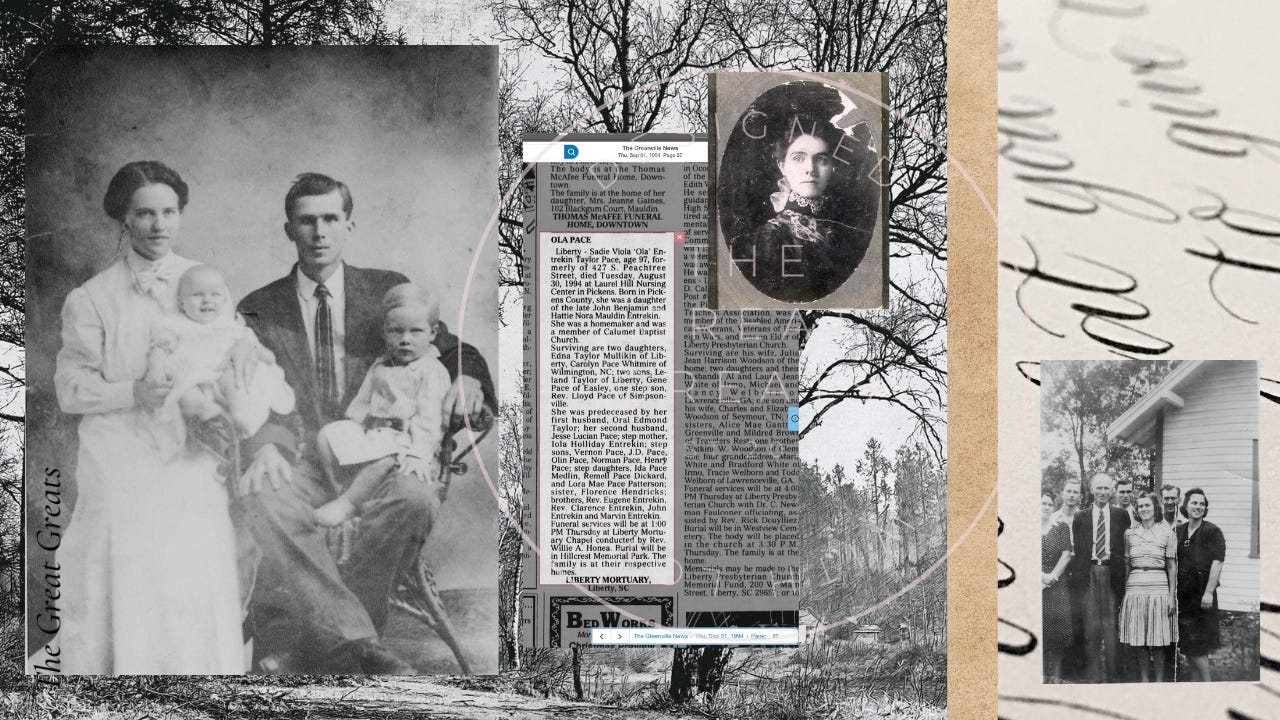
There’s a photograph in my family archive that I keep coming back to. A young mother in white, a baby on her lap. A father in a dark suit, sitting stiff and formal, one hand resting on the arm of an ornate wicker chair. A toddler perched beside him, hair combed flat, staring straight into the camera like he already suspects this will matter someday.
It’s not labeled. I don’t know for certain who these people are. But the era, the studio staging, the wicker furniture — it all points to the same world that produced a man named Jesse Lucian Pace, my 2nd great-granduncle, born September 6, 1886, in Pickens, South Carolina. And the more I’ve learned about him, the more that unlabeled photograph feels like a window into the life he — and everyone around him — actually lived.
A Middle Child in a Very Large Family
Jesse Lucian was the ninth of eleven children born to Joseph Warren “Joe” Pace (1847–1916) and Martha Angeline Childs (1851–1931). Eleven children. Try to picture that household — the noise of it, the sheer logistics of it — on a farm between Pickens and Griffin Baptist Church, in the years when the Piedmont was still mostly agrarian.
His siblings tell the story of a family riding out a hinge point in Southern history: Sarah Elizabeth, John Thomas, Annie, Susan Ada, Cora, Joseph Ben, Seth Lawrence (who died in infancy), James Robert, and two who matter most to my own line — Richard Frank Pace (1871–1959) and Emma Jane Pace (1883–1945).
Richard Frank was fifteen years older than Jesse Lucian. Old enough to have already started raising a family of his own by the time his younger brother was coming of age. And it’s Richard Frank — not Jesse — who carries the direct line down to me: he was the father of my great-grandmother, Kate Pace.
The Fork in the Road
Here’s what I find most striking about Jesse Lucian’s generation: they watched the ground shift beneath an entire way of life, and each sibling responded a little differently.
Around 1912, Richard Frank made a decision that would define the next hundred years of our family’s story. He moved his household off the farm and into the Pickens Cotton Mill Village, chasing something the land could no longer reliably offer — a steady wage. His daughter Kate, my great-grandmother, started working in that mill at age twelve.
Jesse Lucian, meanwhile, stayed rooted in the broader Pickens County network, in the world of Oolenoy Creek and Griffin Baptist Church, even as the textile economy grew up around him. He married Bessie A. Thomas and lived out a life that, on paper, looks quieter than his brother’s — no dramatic relocation, no factory whistle marking the hours. But he was still standing in the same current. The mill villages weren’t a separate country from the farms around them; they were pulling family after family in, one at a time, and Jesse Lucian would have watched it happen to people he’d known his whole life.
That’s what I mean when I call his generation a bridge. They’re the ones who remember the before — post—Civil War agrarian Piedmont, subsistence farming, church as the center of community life — while also living long enough to watch the after take over completely: mill villages, wage labor, a South reorganizing itself around industry.
What the Records Don’t Say
Genealogy has a way of humbling you. I know Jesse Lucian’s birth date to the day. I know his parents, his eleven siblings, his wife. I have a death year — 1964 — but no document to confirm it, even as the family group sheets carefully record the passing of several of his siblings. Somewhere in the archive there’s a gap where his final chapter should be.
I don’t know if that unlabeled photograph is even his family. It might be Richard Frank’s. It might belong to another branch entirely. But I’ve stopped needing that kind of certainty to feel the pull of it. What I know for sure is that somebody in this extended, sprawling, eleven-children Pace family sat for a portrait like this one — dressed carefully, holding a baby, trying to look composed for a camera that would outlive them all.
Jesse Lucian Pace didn’t leave behind mill records or a famous relocation story the way his brother did. But he was there. He watched the whole transformation happen from inside it. And somewhere in that quiet, undocumented life is the same thing this photograph holds: an ordinary family, doing their best to be remembered.
If you’re working through your own family archive, I’d love to hear what gaps you’ve run into — the dates that don’t line up, the faces nobody can name. That’s usually where the real story is hiding.