


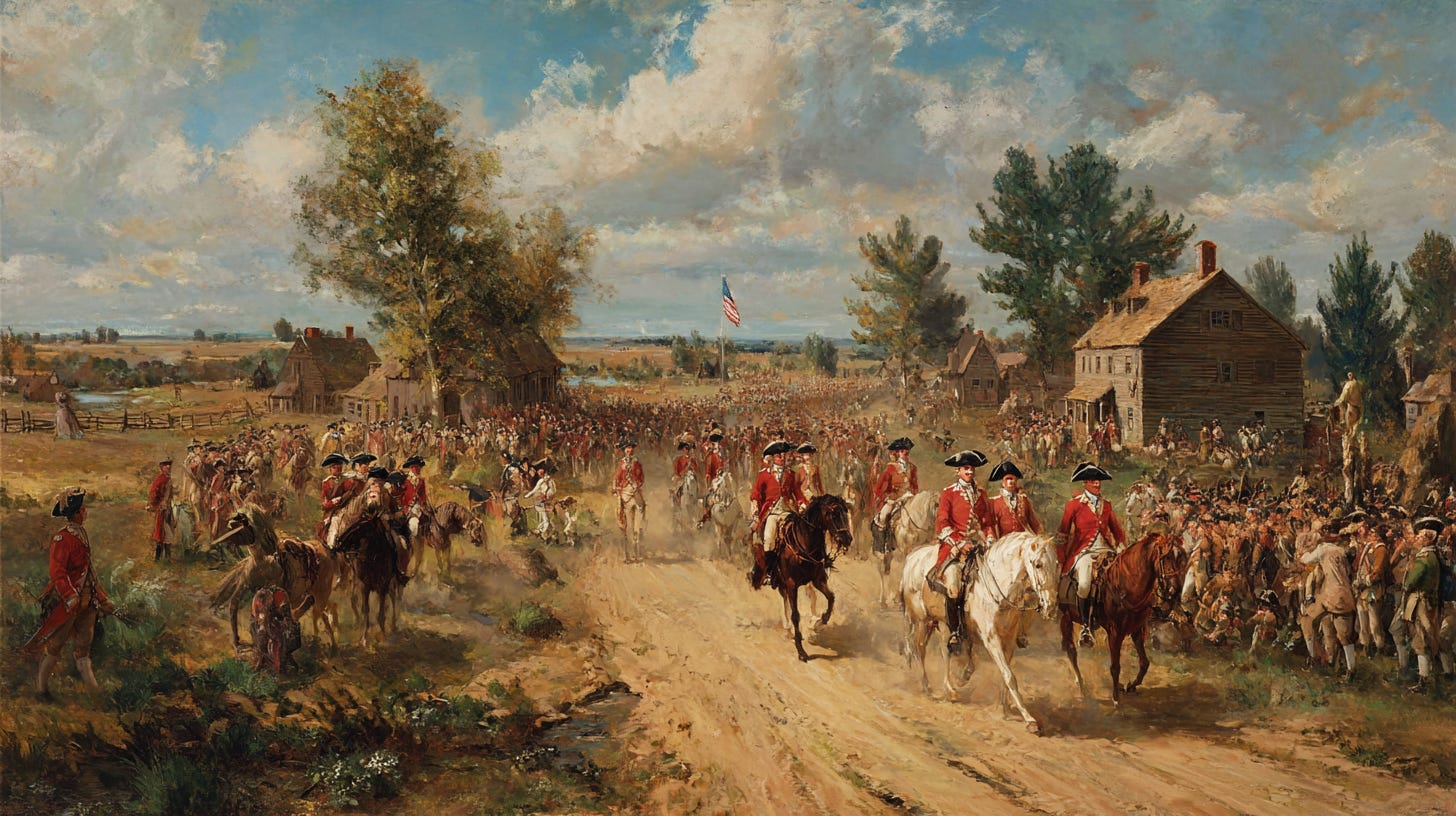
My great-great-great-great grandmother Civility Walker was born in 1770, the daughter of a man who would soon take up arms against a king. Her father, John Jones, was a Revolutionary War soldier—and whether he knew it or not, he was setting something in motion that would echo through our family for the next century and a half.
I’ve been tracing the Walker line lately, and what strikes me isn’t just the dates and battles. It’s the way the Revolution became a kind of family inheritance—shaping how my ancestors named their children, where they moved, and what they were willing to die for.
A Woman Shaped by War
Civility Jones married Isham Walker and became the matriarch of a sprawling frontier family. The sources I’ve gathered describe her as possessing “a degree of autonomy unusual for women of her era.” I suspect that’s putting it mildly.
Think about what she lived through: born a British subject, raised during a war for independence, then spending her adult years on the raw edge of the Georgia frontier. She buried children. She moved her family repeatedly through Effingham, Glynn, Wayne, and Camden counties as opportunity and necessity demanded. She held things together.
Where did that resilience come from? I believe it came from her father. A man who risked everything for an idea about self-governance probably raised a daughter who didn’t wait around for permission. Civility became the bridge between two worlds—the colonial era of King George III and the expanding American frontier—and she passed that steel-spined pragmatism to her eight children.
The Call Kept Coming
Here’s what haunts me about my family’s military history: the pattern never broke. For 150 years, Walker men answered the call, generation after generation.
The Early Republic
Solomon Walker, Isham’s son from his first marriage, served in the War of 1812. James Walker, one of Civility’s sons, rose to Lieutenant and Captain in the Georgia militia during the 1830s. The Revolution was still within living memory, and these men clearly felt the weight of what their fathers and grandfathers had done.
The Civil War
This is where the cost becomes staggering. Isham Walker, born in 1813, served in the Georgia Militia—and died in 1864 on his way home from the war. He never made it back to his family.
His son Joshua, known as “Bud,” was killed in battle in 1863. Another son, Fleming Uriah Walker, took a wound so severe he lived the rest of his life with a silver plate in his head.
Three men from one branch of the family. One dead in battle, one dead returning from it, one permanently marked by it.
World War II
The tradition reached forward into the twentieth century. Jay Rufus Walker served in General Patton’s Third Army—the force that raced across France and into Germany. James Walker died serving in the Navy in 1943.
When I look at this list, I don’t see glory. I see a family that kept showing up, kept sacrificing, kept believing the country their ancestor had fought to create was worth defending.
What’s in a Name?
My family also used names as monuments.
William Cone Walker, born in 1858, was named specifically for William Cone, a famous Revolutionary War soldier whose descendants had married into the Walker line. It was a way of saying: we remember where we came from.
And then there’s Civility herself. Her patriot parents gave her a “virtue name”—perhaps hoping their daughter would embody the civility necessary to build a new nation from the ashes of revolution. They were asking her to be something, not just carry a label.
I find that unbearably moving. In the middle of a war, they named their daughter for the quality they hoped would define peace.
Always Moving, Always Building
The Walker family never stayed put for long. They pushed through Georgia’s frontier counties, transforming what the British had called “colonial parishes” into American communities. Eventually, they crossed into Florida.
I used to wonder why they kept moving. Now I think I understand. The Revolution wasn’t just something that happened to them—it was an unfinished project. The battlefields gave them independence; the frontier gave them something to do with it.
Each generation picked up the work: clearing land, building churches, establishing towns, raising families who would do the same. They carried their dead with them, buried children along the way, and kept going.
The Compass
I’ve come to think of the Revolutionary legacy as a kind of compass the family passed down. Not something that pointed backward toward nostalgia, but something that oriented each new generation as they faced their own wilderness.
Civility used it to navigate frontier hardship with grace. Her sons used it to serve in militias and wars. Their children named babies after Revolutionary heroes and pushed further into unsettled territory. And even in the twentieth century, Walkers were still answering the call.
The compass is still here. I’m holding it now, trying to understand what it means for my generation—the ones who inherited the names and the stories but not the battlefields.
Maybe it means we keep building. Maybe it means we remember what independence actually cost. Maybe it just means we don’t forget the people who carried us here.
This is my family. These are my people. And I’m still figuring out what to do with everything they gave us. Info from my grandmother, Mary Lois Douglas Forrester’s Book - her mother was a Walker.