


A research-based summary of Frederick Douglas’s confirmed life, the confusion surrounding DAR claims, and the caution we now take in revisiting unproven paternal connections.
Opening Statement:
We’ve known for many years that Frederick Douglas (1790–1860), married to Bethany Hannah Anderson, are my 5th great-grandparents. That part is certain — confirmed through land, marriage, burial, and community records in Georgia and Florida.
But for decades, many family trees (including mine) connected Frederick to Alexander Douglass of Edgecombe or Chowan County, North Carolina, a Revolutionary War soldier. That connection was even used in a DAR application — but it was later rejected, and over time, I’ve come to see why.
This post outlines what we do know about Frederick’s life and family, and what the documents tell us about the often-repeated claim of his connection to Alexander Douglass. It’s not about erasing heritage — it’s about honoring it with clarity.
📌 Who Was Frederick Douglas (1790–1860)?
Born: August 2, 1790 — Montgomery County, Georgia
Died: October 22, 1860 — Bradford County, Florida
Spouse: Bethany Hannah Anderson (m. 1811)
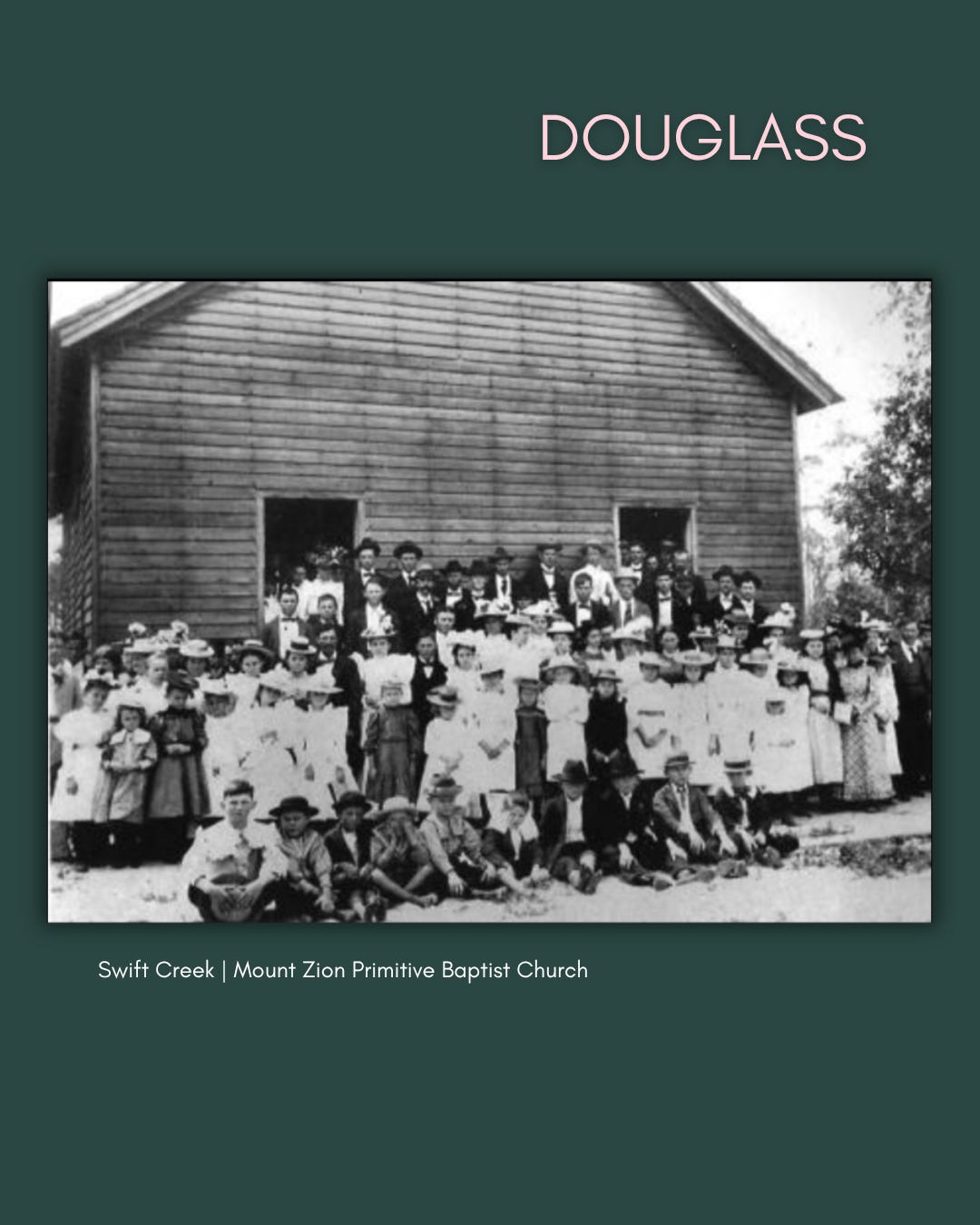
Burial: Swift Creek / Mount Zion Primitive Baptist Cemetery, Lake Butler, FL
Confirmed Source Material:
📷 Frederick Douglass I, Montgomery Co. Tax Digest (1805–1806)
Shows he owned 700 acres in Georgia — clearly an independent adult by this point.
📷 Marriage License – Frederick Douglass & Mary Strong (1811)
Grounds him in Georgia as a resident and family head.
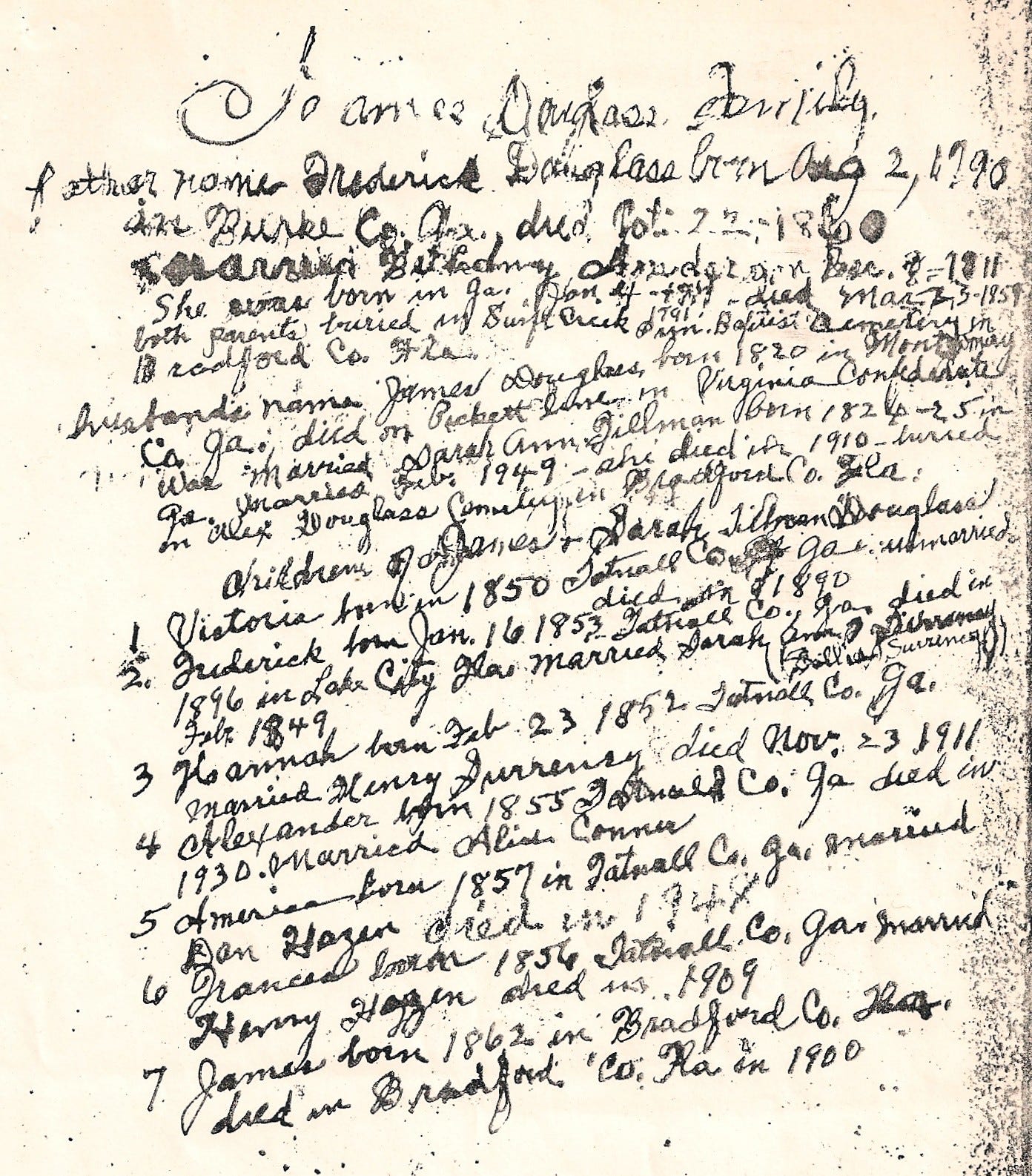
📷 Frederick Douglass Family Sheet / Handwritten Summary
Oral history record — helpful, but not primary.
📷 Douglass Family Bible Inscription – Florida (1862)
Emotional and personal confirmation of family presence in FL, highlighting names.
⚠️ Where the Lineage Claims Begin to Fray
1. Will Confusion and Misattribution
A 1781 will for an Alexander Douglas of Edenton, NC (Chowan County) names a son John, not Frederick. This Alexander was a mariner, not a landowner, and the will references Irish family — including a sister in Tyrone. Over time, this will appears to have been conflated with other men named Alexander Douglass, leading to speculation in family trees and DAR filings. There is no known record of this Alexander having a son named Frederick or any ties to Georgia.
2. Geographic Gaps & Migration Patterns
Alexander is well-documented in North Carolina through 1790. Meanwhile, Frederick’s life — from land records to burial — is rooted in Montgomery and Appling Counties, Georgia, and later Bradford County, Florida. There is no record of Alexander migrating to or residing in Georgia.
3. No Primary Proof of Relationship
No probate, deed, guardianship, or church record links Alexander to Frederick. DAR claims have relied on speculative sources (e.g. Huxford books), not direct documentation.
4. Multiple Alexanders, Multiple Lines
There are several men named Alexander Douglass or Douglas across NC, SC, and GA in the late 1700s–early 1800s. It’s highly likely that identities have been conflated over generations.
5. No Matching Descendants
None of Alexander’s known or suspected children match the documented line from Frederick Douglas. No land-sharing, marriage links, or sibling trails appear in probate records.
6. Community and Burial Patterns
Frederick is buried in Florida with other Georgia settler families — no tie to any NC Douglass family. No overlapping records in church, probate, or burial grounds have surfaced.
7. Spelling Patterns – Douglass vs. Douglas
Alexander’s name appears as "Douglass" (double 's'), while Frederick’s descendants used "Douglas" (single 's') consistently. This is not definitive, but it adds to the list of circumstantial distinctions.
8. Rejected DAR Application
An application filed by descendants (including Jessie Gleason) was ultimately rejected, and later family correspondence (e.g. a 2002 letter from Mary Lois to Anita) admits that the original claim could not be supported by primary documentation.
🧬 A More Likely Lineage: Frederick Douglass Sr. (b. 1760)
In reevaluating the paternal claim to Alexander Douglass, another candidate has quietly stood in the records all along: Frederick Douglass, born circa 1760, who appears in Georgia land, tax, and marriage records between the 1780s and 1825. His age, geography, and civic footprint align closely with the father of Frederick Douglas (1790–1860).
Supporting Evidence:
Land Grants: Received land in Burke County, GA (1785–1787) and multiple grants in Montgomery County (1800–1816, totaling up to 400 acres).
Marriage: Married Mary Strong in 1811 (likely a second marriage based on age and children's birthdates).
Children: Documented or probable children include: Frederick (1790–1860), Wright B., Young, Alexander, Eaton, Jestern, John, Shadrick, and Margaret.
Census & Tax Records: Appears on 1805–1806 Montgomery County tax lists and in the 1820 census for Emanuel County, GA.
Key Notes:
Not to be confused with Alexander Douglass (b. ~1757), who remained in NC.
No headstone confirmed; likely buried in an unmarked grave in Georgia.
No direct proof of Revolutionary War service, but he lived during that period and held land.
His community involvement (e.g. surveyor/chain bearer) suggests a literate and respected citizen.
While the exact parentage of Frederick Douglass Sr. (1760) remains unconfirmed, he is a far stronger candidate as the father of Frederick (1790–1860) than any Alexander identified to date.
📎 Alternate Alexanders & Research Leads
📷 Alexander Douglass – Guardian, Screven County, GA (1818)
Possibly related, but no direct tie to Frederick.
📷 Screven County General Index – Guardianships & Estate Entries
Indicates strong Douglass presence in Georgia, separate from NC lines.
📷 Marriage Bond – Alexander Douglas & Elizabeth Webb (Chowan, NC – 1777)
Possibly the source of confusion in linking Frederick to the Edenton line.
📝 Closing Thought:
Frederick Douglas (1790–1860) built a life, a lineage, and a legacy — without the need for a Revolutionary War title. His descendants, myself included, carry that legacy forward not because of who we hoped he descended from, but because of who he was.
I no longer claim Alexander Douglass of NC as his father — and I share this research in the hope that it will help others working through the same lineage question.
💬 You too?
I welcome conversations, record-sharing, and corrections. Let’s build a clearer family record — together.
Thank you for reading! save, share, like, love subscribe! :) thanks family and others interested
And thanks for sharing this thoughtful and reasonable analysis!
So what do you feel is the level of confidence about the connection between Frederick “Sr” and Frederick “Jr”