


Every family history has a place where the paper stops. In this one, it stops somewhere in the pine flatwoods of the Carolina low country, around 1730, with a man named Isham Walker Sr. (our 5th Great Grand)
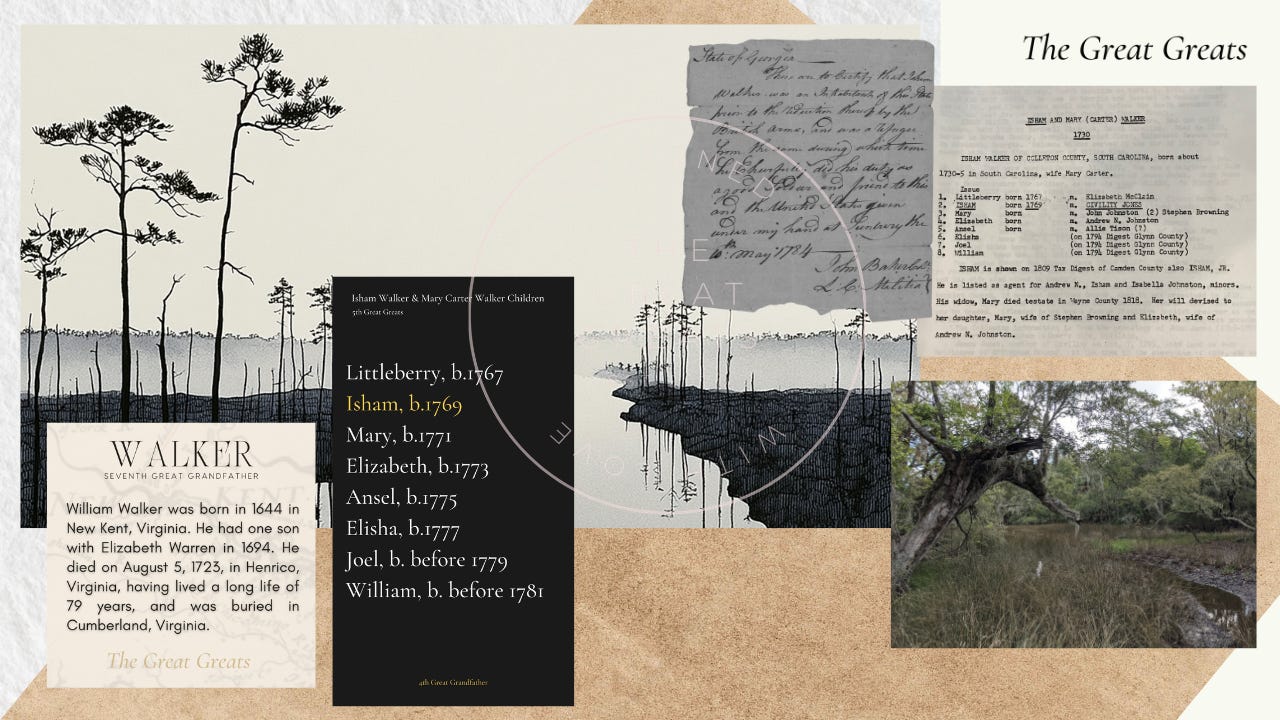
Behind him is silence. In front of him is a trail of tax digests, land grants, deeds, and one widow’s will that follows his children south and west across coastal Georgia for the better part of a century. The quest is to find out what stands behind him — and whether a Virginia planter born in 1644 is the answer.
I thought I’d share some work in progress, its the “trail” and stories that can happen as I seek answers that may never be found.
The tempting record
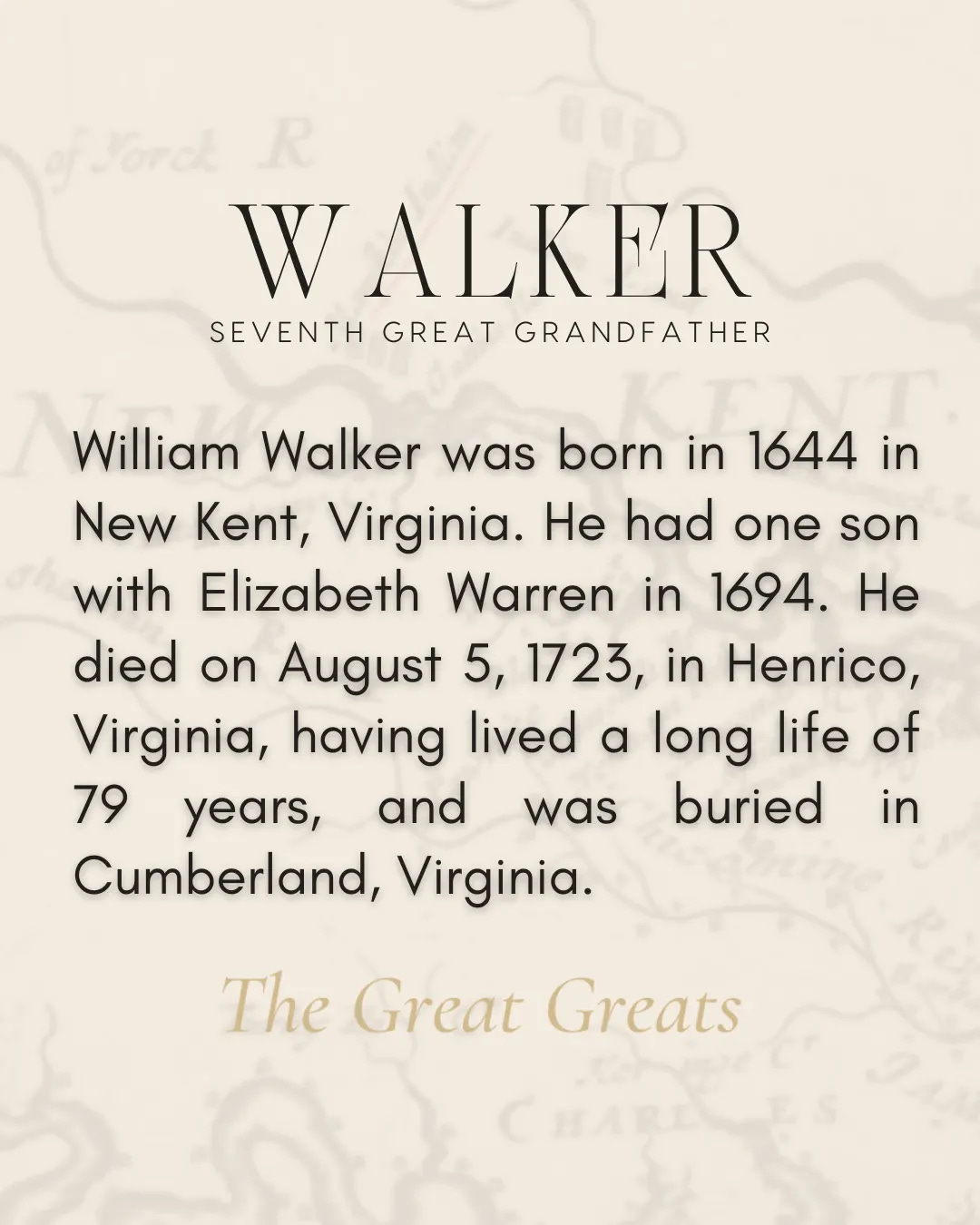
The record that started this is spare, the way early colonial records usually are. A William Walker, thought to be born in 1644 in New Kent, Virginia. One son with Elizabeth Warren in 1694. Death on August 5, 1723, in Henrico. Burial in Cumberland.
Note the hedge built right into the first line — thought to be. That phrase is doing a lot of work, and it deserves respect rather than erasure. Nobody in 1644 New Kent was writing down a birth year that survives to us intact; what survives is usually an inference, run backward from a later deposition or a will.
There’s a second problem worth naming early, because it shapes everything that follows. Cumberland County, Virginia, did not exist in 1723. It was carved out of Goochland County in 1749, twenty-six years after this William supposedly went into the ground there. That doesn’t make the man fictional. It does tell you the record has passed through hands that applied a modern map to an old life — the signature of a compiled online tree rather than a transcribed original. And a fifty-year-old father in 1694 isn’t impossible, but paired with the county anachronism, it’s a second small reason to hold the whole thing loosely.
This is the first discipline of the quest: the record that excites you is the record you cross-examine hardest.
What is actually solid
The Georgia end of this family is not speculation. It is documented, and it is documented well, largely thanks to the compilation work in Mary Lois’s notebook.
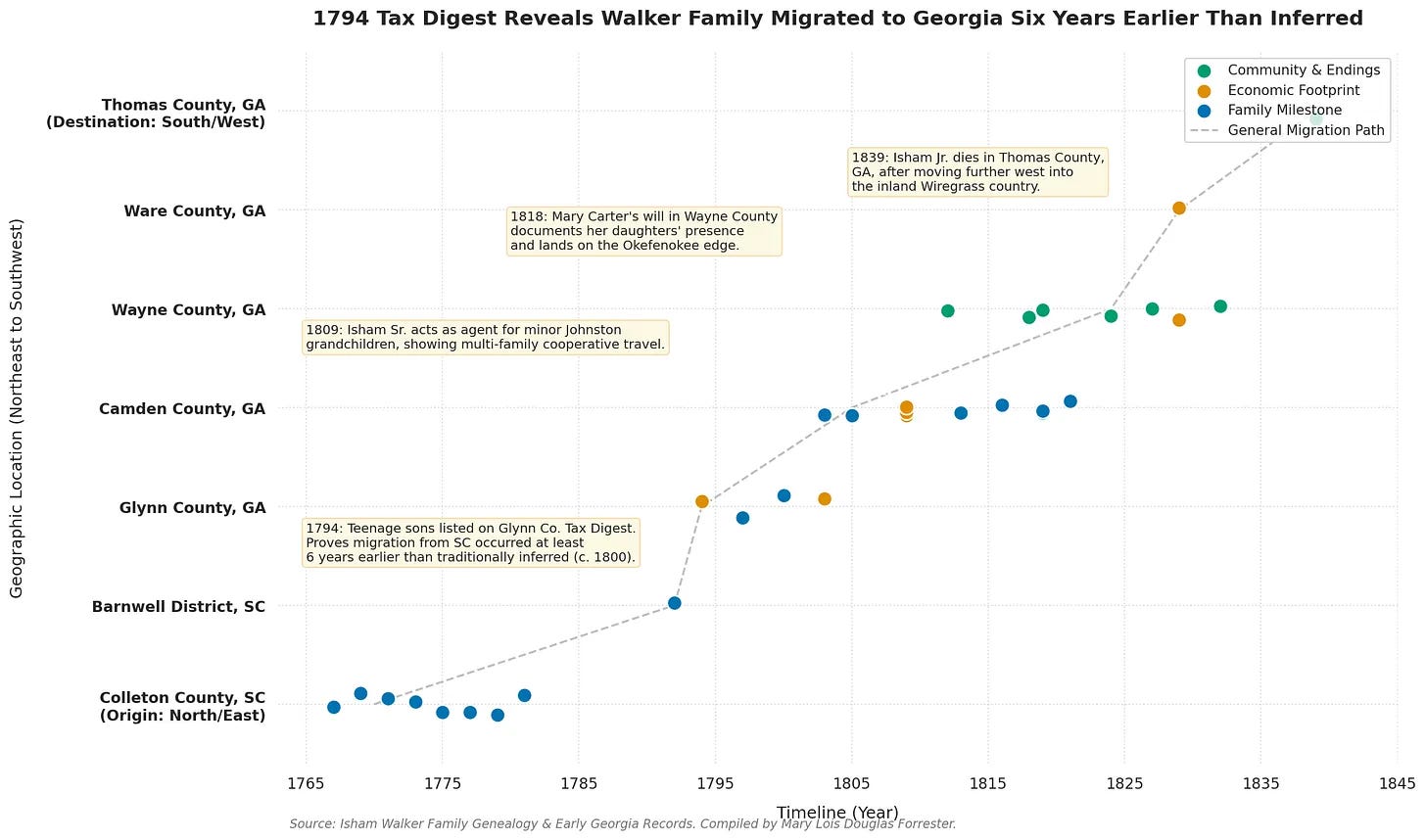
1794 — Glynn County Tax Digest. Three of Isham Sr. and Mary Carter’s youngest sons — Elisha (b. 1777), Joel (b. 1779), and William (b. 1781) — appear on the digest. They were teenagers, roughly thirteen to seventeen. Their names on a tax list is the earliest footprint of this family in Georgia, and it quietly rewrites the family’s own story: the traditional migration date of 1800 is at least six years too late.
1803 — Glynn County land grants. Two grants to “Isham Walker” in Land Grants Book EEEEE: 150 acres at page 484, 135 acres at page 532. Which Isham is an open question — Senior, or Junior, who had married Civility Jones in Glynn County in 1797. Either way, the family had land.
1809 — Camden County. Both Ishams appear on the tax digest, and Isham Sr. is listed as agent for three minor children: Andrew N., Isham, and Isabella Johnston — almost certainly the children of his daughter Elizabeth, who married Andrew N. Johnston. That single administrative line is worth more than it looks. It proves the family didn’t scatter; it moved as a unit and took care of its own. That April, a deed from William Cone conveyed land on Simon’s branch of the Great Satilla River, and the homeplace was established.
1818 — Wayne County. Isham Sr. was gone by about 1812. His widow Mary died testate in Wayne County and left property to two daughters, Mary Ann (wife of Stephen Browning) and Elizabeth (wife of Andrew N. Johnston). The family’s center of gravity had shifted inland toward the Okefenokee.
1829 — Wayne County deed. John Roberts of Lowndes County conveyed 490 acres to “Isham Walker of Ware County,” excepting a quarter acre reserved for the family graveyard.
That last clause is the one that stays with you. Somebody, in the middle of a land transaction, stopped to carve out a square of ground so the dead wouldn’t be plowed under. It is the most human line in the entire file.
The two Williams problem
Here is the trap the quest has to walk around.
There is a William Walker in the notebook. He’s Isham Sr. and Mary’s youngest son, born 1781, on that 1794 Glynn County digest. And there is a William Walker in Virginia, born around 1644.
Two men, same name, 137 years apart, and a powerful human urge to draw a line between them. But William was one of the most common given names in colonial English America, and Walker one of the most common surnames. Finding a William Walker in seventeenth-century Virginia is roughly as diagnostic as finding a Smith in a phone book. Name-matching across a gap that wide isn’t evidence; it’s a hypothesis that hasn’t been tested yet.
Why the gap is hard
The obstacles here are structural, not personal.
New Kent County is one of Virginia’s notorious burned counties — its records were destroyed and destroyed again, first by fire in the eighteenth century and then in the last months of the Civil War. Colonial South Carolina parish records are thin and scattered. And the middle stretch of this journey, roughly 1690 to 1750, is exactly the period where the surviving documentation is worst on both ends.
Meanwhile, the general shape of the migration is entirely plausible. Families did leave the Tidewater, move down through the Carolinas, and continue into Georgia. That plausibility is the danger. A story that fits the known pattern feels true, and feeling true is not the same as being true.

What proof would actually look like
Not a matching name. Not even a matching name plus a plausible date. What would move this from hypothesis to lineage is a record that names two generations in the same document — a will naming a son, a deed of gift from father to child, a court deposition where a man states his age and his father’s residence, an estate settlement listing heirs.
Failing that, the workaround is the associates. Families migrated in clusters, and the clusters are visible in the Georgia records already: Browning, Johnston, Cone. If those surnames turn up alongside Walkers in South Carolina deeds, and the same combination turns up again further north, the cluster becomes a thread worth pulling.
Where to look next
Glynn and Camden counties are the anchor, because that’s where the family is provably standing in the 1790s and 1800s. From there the search runs backward and northward:
South Carolina land deeds and plats for Isham Walker in and around St. Bartholomew’s Parish, Colleton County
Revolutionary War pension and bounty land applications — these often name sons, and Elisha, Joel, and William are distinctive enough as a trio to be recognizable
Colonial South Carolina estate and probate files, looking for any Walker naming an Isham
Records of the Browning, Johnston, and Cone families in South Carolina, tracking the cluster rather than the surname
The honest ending
The most useful thing this quest can produce right now is not a connection. It’s a clean, well-sourced statement of where the documented line actually begins — Isham Walker Sr., South Carolina, around 1730 — with the Virginia William filed separately as an unproven lead, clearly labeled as such.
That may feel like a retreat. It isn’t. An unproven lead honestly labeled can sit in a file for twenty years and cost nothing. A guess promoted to a fact propagates into a dozen other people’s trees and becomes almost impossible to recall.
The quarter acre on Lot 36 was reserved for a reason. Whoever wrote that clause into the deed understood that some things are worth protecting even when they’re inconvenient. The same applies to the truth about where a family actually comes from.
Stay tuned and thank you for reading, sharing, commenting - most appreciated!