


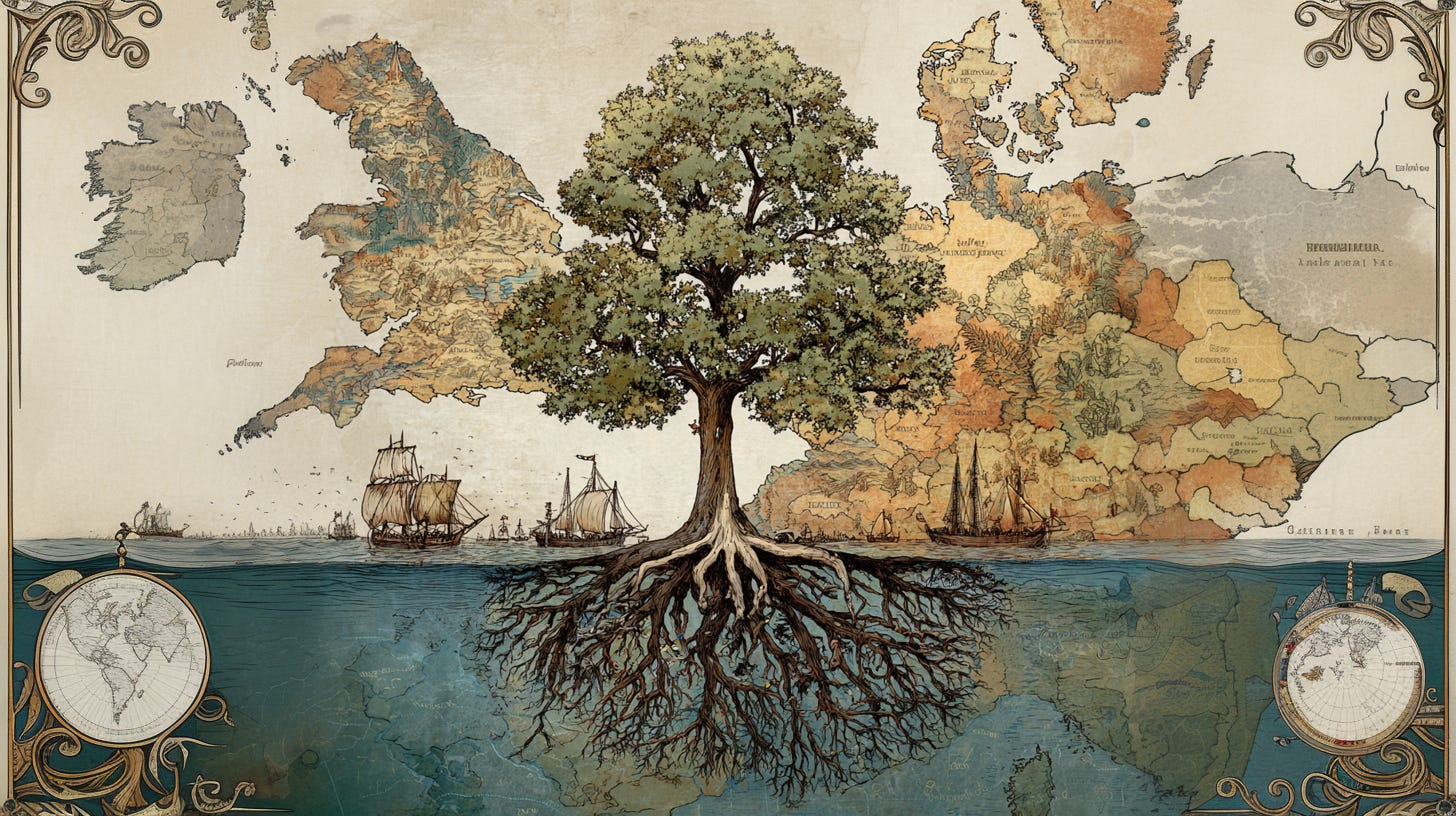
From Flanders to the British Isles
Every family tree has roots that reach back further than memory can grasp. For the Forresters, those roots stretch across the English Channel to Flanders, where the story begins with a fateful crossing alongside William the Conqueror following the Battle of Hastings in 1066. This migration would plant the seeds for one of the most enduring noble families in British history.
While the descendants of Baldwin V settled at Etherstone in England, establishing the English branch of the family, it was his son Richard who would eventually travel north to Scotland—a journey that would define the Forrester legacy for generations to come. The family’s story unfolds across three kingdoms: England, Scotland, and Ireland, with members rising to prominence in each realm. Their activities are vividly preserved in genealogical transcriptions that paint a picture of ambition, service, and sometimes tragedy.
The Corstorphine Progenitors
Wealth, Influence, and the Making of a Dynasty
The first recorded Forrester in Scotland appears not with a sword, but with a pen and ledger. William Forrester, Esquire, is documented in the muster roll of the Peel of Linlithgow in 1311–12, marking the family’s earliest official presence north of the border.
Yet it is Adam Forrester of Edinburgh who stands as the true progenitor of the Lords Forrester. Adam was no mere nobleman content with inherited prestige—he was a wealthy burgess and influential citizen who made his home on Edinburgh’s High Street, the beating heart of Scottish commerce and power. He served the King in lucrative roles, most notably as custumar (customs collector) of two of Scotland’s chief exports: wool and hides. This position placed him at the nexus of trade and royal authority.
In 1378, Adam made the acquisition that would define his family’s identity for centuries: he purchased Corstorphine. This estate, nestled in the rolling countryside west of Edinburgh, would become the seat of Forrester power and the source of their noble title.
Architects of Legacy
Corstorphine Castle and Church
The Forresters were builders as much as they were warriors or merchants. Sir Adam constructed Corstorphine Castle, a formidable fortress with curtain walls stretching 100 feet long and towers rising 40 feet high. The castle’s position and design reflected a practical concern: defense against potential attacks from Edinburgh itself. In an age when political winds could shift overnight, a wise lord prepared for all eventualities.
Perhaps the most remarkable surviving structure from this era is not the castle—which has long since fallen into ruin—but the great dovecot. This massive structure, containing 1,000 individual cells for birds, was a symbol of feudal prestige. In medieval Scotland, the right to keep doves was a privilege reserved for the nobility, and the scale of the Corstorphine dovecot proclaimed the Forresters’ status to all who passed.
Sir John Forrester continued the family’s building tradition by establishing a collegiate church on the foundation of an ancient Norman church. He richly endowed it with annual annuities, ensuring that prayers would be said for the Forrester souls in perpetuity. Within this church lie the recumbent effigies of the Forresters, their stone figures depicted in 15th-century armor—durable memorials that have outlasted the castle they once defended.
A Tradition of Valor
Warriors on the Border and Beyond
In the medieval world, younger sons of noble families faced a particular challenge: with inheritance laws favoring the eldest, they needed to forge their own paths to honor and estate. For the Forresters, the military offered this avenue, and they walked it with distinction.
Sir Hugh Forrester served as governor of Etherstone and achieved the rank of general in 1101, establishing early the family’s military credentials. Even more dramatically, Sir John Forster distinguished himself during the Third Crusade in 1192, where he reportedly saved an entire Crusade army from disaster and rescued the King of England himself.
The Scottish-English border provided a closer theater for Forrester arms. The family was deeply involved in the border wars that defined relations between the two kingdoms for centuries. They held strategic positions including Bamborough Castle and, of course, Corstorphine—locations that allowed them to influence the flow of conflict and commerce alike.
Not all Forrester courage was displayed on the battlefield. William Forrester demonstrated what his contemporaries called “moral courage” in 1638 when he refused to pursue religious doctrines against his principles. This principled stand led to his expulsion from the church—a reminder that the Forresters valued conviction as highly as martial prowess.
The Peerage and Its Tribulations
Rise to the Lords and a Murderous End
On July 22, 1633, centuries of Forrester accumulation reached its formal culmination when the title Lord Forrester of Corstorphine was officially created in the Peerage of Scotland. The family had achieved the highest recognition the Scottish crown could bestow.
Yet the 17th century would prove as turbulent for the Forresters as for Scotland itself. During the Civil War period, the family’s estates were sacked by Cromwell’s Ironsides, forcing the laird and ministers to flee for their lives. The New Model Army showed little respect for ancient titles or noble lineage.
The most shocking chapter in Forrester history came in 1679. The second Lord Forrester, James Baillie, met a violent and scandalous end when he was stabbed with his own sword in the garden of Corstorphine by Mrs. Nimmo—a crime of passion that ended one of Scotland’s noble lines in blood rather than glory.
The Bridge to America
A Legacy That Crossed the Atlantic
While absolute proof remains elusive—as it does for many genealogical claims spanning centuries and oceans—many American Forresters are believed to descend from the Scotch, English, and Irish branches described in these records. The evidence is circumstantial but compelling.
Perhaps the strongest indicator lies in tradition itself: the continued use of Corstorphine Christian names among American descendants. When families carry distinctive given names across generations and continents, they carry memory itself—a thread connecting colonial Virginia or Pennsylvania back to the High Street of Edinburgh and the stone walls of Corstorphine.
The evolution of the Forrester Coat of Arms, with its hunting horns and various mottos including “The deed shal show,” remains a point of pride for any who bear the name. Heraldry was never merely decorative—it was identity made visible, and for Forresters on either side of the Atlantic, these symbols continue to speak of a shared heritage.
✦ ✦ ✦
The history of the Forrester clan in the British Isles is like a grand tapestry woven with threads of both silk and steel; it displays the fine texture of aristocratic wealth and church patronage alongside the rugged, durable weave of military valor and border defense.
From Flanders to Edinburgh, from Corstorphine Castle to the American colonies, the Forresters exemplify how a family navigates the currents of history—building, fighting, praying, and ultimately dispersing across the world while carrying their name and their stories with them. For those of us tracing our “great greats,” the Forresters remind us that every surname is a story, every coat of arms a chapter, and every generation a link in a chain stretching back further than we can see.