


I went looking for an ancestor’s face and found, instead, a whole life waiting behind it. This is the life I found — or the one I’ve imagined back into being from the dates and deeds that survive. He is a Forrester, and so am I — the same old name, carried down through four centuries and across an ocean and handed, eventually, to me. So in a sense this is family. In a sense, all of it is.
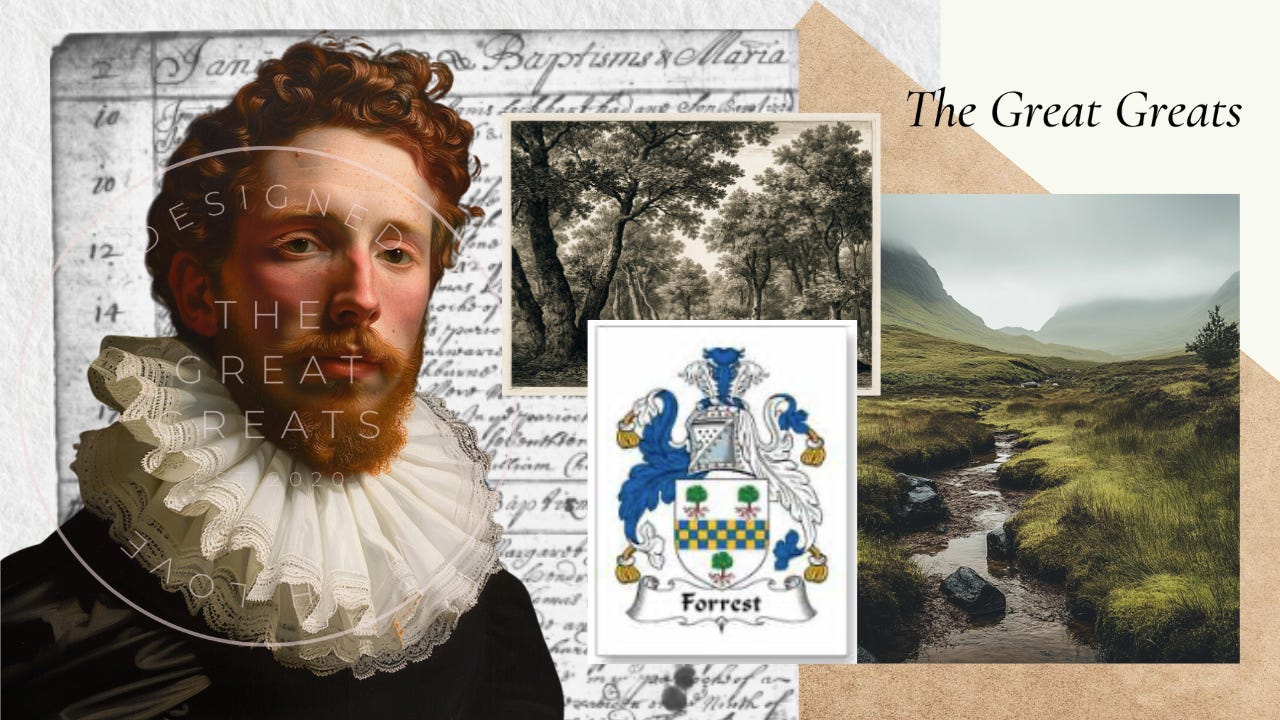
I. A wedding, 1606
The lace at his throat had crossed a sea to get there.
It would not have occurred to George Forrester to think so, standing in the long room at Corstorphine on a cold week at the close of 1606 while a woman tugged his ruff into its proper wheel — but the fine starched linen and the needle-lace that framed his young face had almost certainly come up from the Low Countries, off a Flemish loom, through the Scottish merchant port at Veere where the wool of his own country was traded out and the luxuries of Europe traded in. Scotland in those years did not look only south to England. It looked east, across the grey water, to Holland and Flanders — to their cloth, their painters, their lace, their black dye so deep and even that a man in a good Flemish-dyed doublet announced his standing before he opened his mouth.
George married Christine Livingston that week, on a contract their families had signed four years earlier, in 1602 — the slow, deliberate way the marriages of land and name were made. She was the daughter of Sir William Livingston of Kilsyth; her mother carried a French name, Antoinette de Bord. It was a good match, a careful match, and like all such matches it was about more than the two people standing in the cold room. It was about the joining of houses, the continuation of a line.
He was a young laird, not yet thirty, with a castle, a name, and a great deal of waiting still ahead of him. He did not know how much.
II. The weight of the name
To be a Forrester of Corstorphine was to inherit a story already centuries deep.
The first of them to matter was Sir Adam Forrester, who in 1376 had bought the lands just west of Edinburgh and risen to become Provost of the burgh and Keeper of the Great Seal of Scotland — a merchant’s son who climbed to the right hand of kings. It was Adam who founded the chapel that grew into Corstorphine’s collegiate church, and inside it, by George’s day, lay the carved stone effigies of the old chiefs: hands folded in prayer, swords at their sides, faces softened by generations of Edinburgh damp. George had grown up among those stone grandfathers. A boy learns a particular kind of patience kneeling beside men who have been holding the same pose for two hundred years.
And behind even Adam lay the lore — the stories every proud family keeps and half-believes. That the name began in the forests of Flanders, eleven hundred years back, with a man whose whole office was the keeping of wild and dangerous places. That a crusading knight of the name had gone east with Richard the Lionheart and made his name at the siege of Acre, standing when other men fell. Si fractus fortis, the family liked to say — though broken, brave. Whether the crusader was real or a hopeful invention sewn onto the tree by some long-dead grandfather, no one could swear. But George had learned the thing that every heir of an old name learns: a story does not have to be wholly true to be wholly load-bearing. A man stands straighter for believing he descends from men who stood.
His father Henry held Corstorphine before him; his mother was Helen Preston. When Henry died, the lands, the castle, the church full of stone ancestors, and the name itself all came down to George — and with them the unspoken charge that runs under every inheritance: do not be the one who lets it end.
III. The long middle
History remembers the great moments and forgets the decades. George’s life was mostly the decades.
There was an estate to run, in a Scotland that had been changing under his feet since 1603, when his own king, James VI, inherited England’s throne and rode south to London to become James I as well. The court that had been an hour from Corstorphine was now four hundred miles away. A Scottish nobleman of ambition now had to keep one eye permanently turned toward England — toward the patronage, the titles, the favour that flowed from a king who no longer lived among them.
So George tended what he had. He ran the barony of Corstorphine, the mills and the lands and the tenants, and in 1618 secured his hold on it formally when James — back briefly in his old kingdom — confirmed him at Holyroodhouse in the lands and barony. He traded, as the great Lowland families did, in wool and cloth and the long-established commerce with the Low Countries. The grey loch-and-marsh country around Corstorphine was good for little but grazing, and grazing meant wool, and wool meant the Dutch and Flemish markets where Scottish fleece became Continental cloth and came home again as the fine fabrics that dressed men like him.
There were children — the future the whole enterprise was for. Daughters, Joanna and Lilias among them. And a son, John, called the Master of Corstorphine, the boy in whom the line was meant to continue. For a long stretch of years the plan looked sound. George had a name, lands, a king’s confirmation, an heir. He had done what a Forrester was supposed to do.
IV. A baronet of a country he would never see
In 1625 George reached upward.
King James — and then, that same year, his son Charles I — had revived a curious scheme to fund the colonization of a distant cold coast across the Atlantic that the Scots had named Nova Scotia, New Scotland. The crown offered the new and saleable rank of baronet to men of substance willing to invest in the venture. On the 17th of November 1625, George Forrester became Sir George, 1st Baronet of Nova Scotia — a knight, in effect, of a wilderness he would never lay eyes on, a frontier on the far edge of the known world.
It is one of history’s quiet ironies that the name Forrester, in the very years George was buying a stake in that imagined New Scotland, was already drifting toward America by other roads entirely. Across England and the Lowlands, men of the name in all its spellings were raising families who would, within a generation, put their children on ships and carry it across the same ocean for real. Some crossed as Forsters or Fosters. Others kept the older spelling and went as Forresters — among them the branch that would, in time, come down to me. George bought a paper title to a colony. Other men of his name would go and live in it.
V. The becoming, 1633
The title came at last in the summer of his late years.
On the 22nd of July 1633, Charles I — newly and grandly come north to be crowned at Holyrood — raised Sir George Forrester to the peerage of Scotland as Lord Forrester of Corstorphine. After a lifetime of holding the line, running the lands, tending the name through decades that no chronicle records, George had become what the whole long apprenticeship of his life had been building toward. The boy who knelt among stone ancestors was now a lord in his own right, and would himself, in time, lie carved among them.
He had reached the summit. But a summit, by definition, is where the descent begins.
VI. The shadow at the end
The cruelty of it was simple: the heir was gone.
John, the Master of Corstorphine, the son in whom the line was to continue, died — and George, now a lord with no son to carry the lordship, faced the very thing the whole patient enterprise had been designed to prevent. The name would not pass straight down. He spent his last years arranging for it to pass sideways: marrying his daughters to the brothers James and William Baillie, and securing from the crown an intricate regrant of the title in 1651 so that his sons-in-law and their issue might carry the Forrester name and arms forward in his place. To inherit, they would have to become Forresters — to take the name as a condition of the gift.
George died around 1652, an old man who had been a laird, a baronet, and at last a lord, and who had spent the very end of his life ensuring that his name would outlive the failure of his blood to carry it. His castle would crumble over the following century to a single stone dovecote and a street sign. His title would descend through daughters and granddaughters, and eventually pass entirely out of the male line and into other families, other counties, other countries.
The name, it turned out, was hardier than any one body. It crossed borders. It crossed water. And it kept its shape — Forrester, still — through generations who never saw Scotland and an ocean none of them could have imagined the far side of.
VII.
That is the strange gift of a single old life.
You can read the dates — married 1606, confirmed 1618, baronet 1625, Lord Forrester 1633, died around 1652 — and they tell you almost nothing. The life is in the spaces between them: in the Flemish lace at a young man’s throat, in the wool traded across the grey North Sea, in the stone ancestors he knelt beside as a boy and lay down among as a lord, in the heir he lost and the elaborate, loving machinery he built so that his name would not.
He held the line as long as he could. When his own blood failed to carry it, he found other hands to pass it to. And it kept moving — out of the castle, out of Scotland, across the water, all the way down to the people not yet born.
One of whom, carrying the same name down to this side of the water, is me. And here we are.
💛 Who are your Great Greats? Drop a family name below, and let’s go find their life.