


I have driven through Cheraw, South Carolina more than a dozen times. Every time, something in me slows down.
I used to think it was the light — the way it comes off the Pee Dee in the late afternoon, green and heavy. Or the trees, which lean over the road in Society Hill like they’re listening. I told myself it was just a beautiful stretch of South Carolina and I was a person who noticed beautiful things - and felt connected. I somehow, knew our Nana would have too…
Then I found the paper!
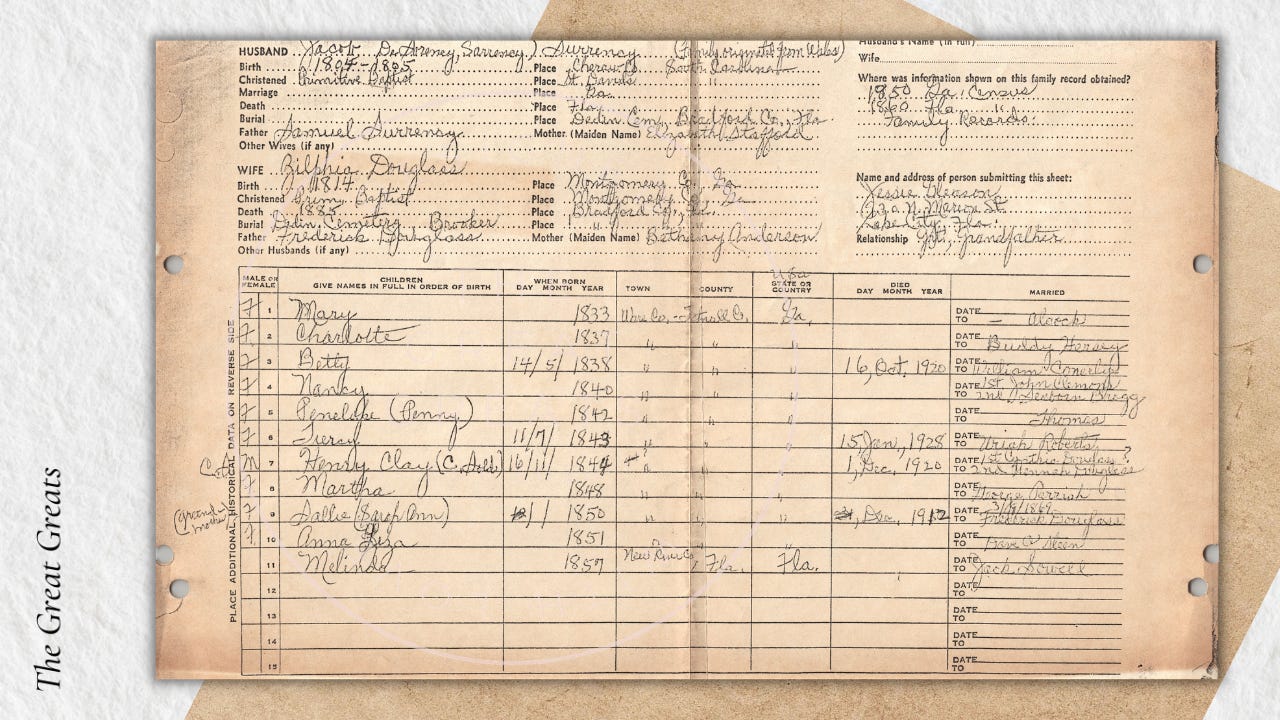
It’s a family group sheet, filled out in my grandmother’s hand — that careful, looping, mid-century cursive that women of her generation used for things that mattered. Across the top, in the space for the husband’s name, she wrote: Jacob (De Arrency, Sarrency) Surrency. Then, in the margin, almost as an aside, four words that reorganized everything:
family originally from Wales
And under Birth: 1805. Place: Cheraw. On the line the form labels Christened: Primitive Baptist — and in the Place column beside it, St. Davids.
I had been driving past them for years. I have even visited St. Davids several times!
What Cheraw was in 1805
It is tempting to imagine a town. There wasn’t one — not yet.
In 1805, Cheraw was about a dozen houses on a bluff above the Great Pee Dee. It would not be formally incorporated for another fifteen years. The post office had opened only four years earlier, in 1801, and was still something of a novelty. The first steamboat wouldn’t churn up the river until 1819 — so everything that came in or went out of Jacob’s world moved by horse trail or flatboat, poled and drifted downriver toward Georgetown and the sea.
The Revolution was close enough that the men in the taverns had fought in it. The cotton gin was new enough that its consequences were only beginning to unfold across the district — the machine that would turn this frontier of subsistence farms, tobacco, cattle, and rice into a plantation economy built on enslaved labor, and would eventually pull families like ours west and south in its wake.
Jacob’s father, Samuel Surrency, was fifty-two the year he was born. His mother, Elizabeth Stafford, was forty-five. Do the math on that and it stops being a statistic. Samuel was a man born around 1753 — a man whose own childhood belonged to colonial South Carolina, to a king. Elizabeth carried and delivered a healthy child at forty-five on a frontier with no doctor within a day’s ride.
Jacob was, in every sense, a late child. A last chapter that turned out to be a first one.
The thing about Society Hill
Here’s what I couldn’t stop thinking about once I read that record.
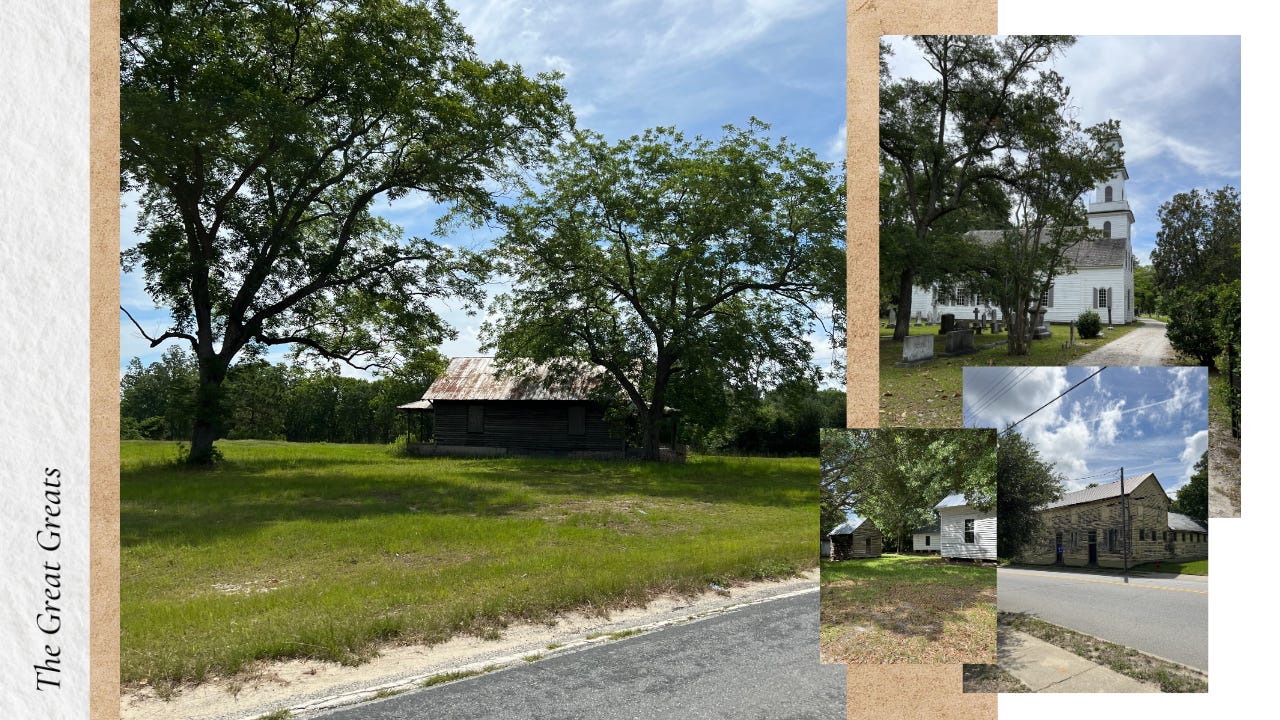
Twenty miles down the road from Cheraw sits Society Hill — and in 1805 it was the opposite of Cheraw in almost every way. Cheraw was a rough trading landing. Society Hill was the intellectual capital of the Pee Dee.
The planters had come up from Long Bluff, where the river kept flooding them out, and rebuilt on higher ground. They put up houses like the John K. McIver place right around 1800 — the kind of houses meant to say we are staying. They named the town for the St. David’s Society, which built an academy on the hill and recruited some of the best-educated tutors in the country to teach classical languages to the sons of cotton men. In 1798, the Welsh Neck Baptist Church picked up and moved to the lot next door, becoming the mother church for a whole expanding frontier.
Welsh Neck. St. David’s.
David is the patron saint of Wales. This whole bend of the Pee Dee was settled by Welsh Baptists who came down from Pennsylvania in the 1730s and named their new country after the old one. And there in the corner of my grandmother’s page, in pencil, seventy years before I read it: family originally from Wales.
She may have been passing along a story her own grandmother told her. She may have been right. I can’t prove it from a family group sheet — but I can tell you that a Baptist family on the Welsh Neck of the Pee Dee, sitting under the name of St. David, is not a coincidence looking for an explanation. It’s an explanation looking for a document.
A note on that word, “christened”
I want to be careful here, because I nearly got it wrong myself.
“Christened” is preprinted on the blank. It’s the third row in the husband’s block — Birth, Christened, Marriage, Death, Burial, Father — and it repeats down in the wife’s block. Every family group sheet of that era has it. Nobody chose to put it there.
And what Nana wrote on that line isn’t a date. It’s a denomination. For Jacob: Primitive Baptist, with the Place column beside it filled in as St. Davids. For Zilpha: Prim. Baptist, place Montgomery Co., Ga. Which is worth noticing on its own, because the Christened row is one of the few she filled in at all — she left Jacob’s Marriage line blank and gave his Death line a single word, Fla. She had no dates for those. She had this.
Here’s the wrinkle that matters: Primitive Baptists don’t christen infants. They practice believer’s baptism by immersion, on profession of faith, as adults or near-adults. That’s not a footnote to their theology, it’s close to the center of it. So a literal infant christening at St. David’s in 1805 is doctrinally unlikely, and I don’t think that’s what this line is telling us.
What she was almost certainly doing is using the line the form gave her to record which church this family belonged to, and where — the way a great many people filled these out. The blank said Christened; she had church information; she put it where it fit.
That’s still valuable. It may be more valuable, because it points at a congregation rather than a single event. A baptismal date is one afternoon. A congregation is decades — minutes, memberships, letters of dismission when a family moved away, disciplinary hearings, the names of everyone who sat in the same room on the same Sundays.
It also tells me where to look, and where not to. Primitive Baptist churches generally didn’t keep baptismal registers in the Anglican sense. They kept minute books — handwritten records of monthly business meetings. That’s a different archive and a different kind of search than I’d been planning.
Maybe that’s the something I’ve been feeling on that road. Maybe it’s just a beautiful place and I’m a sentimental person. I’ve decided I don’t need to choose.
The name that wouldn’t hold still
Look at the header of this post again: Surrency | de Surrency | Sourency. My grandmother listed three, and there are more — Sarrency, De Arrency, Surrancy.
This is not carelessness. This is what happens to a name when the people carrying it can’t always write and the people recording it can’t always hear. A census taker rides up, asks a man on a porch what he’s called, and writes down his best guess. Twenty years later a different man with a different ear writes down a different guess. The family says it the same way the whole time.
The de is the interesting one. A particle like that usually points somewhere — Norman French, Huguenot, or a family’s own memory of gentry it no longer had. Whether it’s authentic or aspirational, somebody in this line thought it was worth keeping. That’s its own kind of fact.
Zilpha
On July 14, 1831, in Tattnall County, Georgia, Jacob married Zilpha Douglass.
She was born in 1814 in Montgomery County, Georgia, and Nana recorded her the same way she recorded Jacob: Prim. Baptist, Montgomery County. Same faith, same tradition — which in a Primitive Baptist community usually meant the families already knew each other. Her father was Frederick Douglass and her mother Bethany Anderson, and I want to note here that Zilpha was about seventeen at that wedding and Jacob was twenty-six, and that this was entirely ordinary, and that she would spend the next twenty-six years of her life bearing children.
The published summary says nine children in seventeen years.
The paper says otherwise. Count the lines yourself:
Mary (1833) · Charlotte (1837) · Betty (14 May 1838) · Nancy (1840) · Penelope — “Penny” (1842) · Tirsey (11 July 1843) · Henry Clay (16 Nov 1844) · Martha (1848) · Sallie / Sarah Ann (1850) · Anna Liza (1851) · Melinda (1857)
Eleven. Ten daughters and one son.
Twenty-four years of childbearing, not seventeen. Somewhere between my grandmother’s page and the tidy summary, two of these women got rounded off. I’d like to put them back.
Look at that column of names. Mary, Charlotte, Betty, Nancy, Penny, Tirsey, Martha, Sallie, Anna Liza, Melinda — and one boy in the middle of them, named Henry Clay after the Great Compromiser, born in 1844 while Clay was running for president. You can date a family’s politics by what they name their sons.
And look at the far-right column, where my grandmother recorded who they married and when they died, because these girls grew up and had whole lives: Betty died 16 October 1920. Tirsey — who married Uriah Roberts — lived until 15 January 1928. Henry Clay died 1 December 1920, having married twice. Sallie married a Frederick Douglass, carrying her mother’s family name forward into the next generation.
Children born on a Georgia frontier in the 1840s lived to see automobiles, telephones, and a world war.
Down to Florida
Now watch the “Town” column on that ledger. Line after line: Wayne County, Tattnall County, Georgia, Georgia, Georgia — and then, on the last line, 1857:
New River, Florida.
Sometime in the mid-1850s, Jacob and Zilpha packed up a household with eight or nine children in it and went south into a Florida that had been a state for barely a decade. New River County existed only briefly before it was reorganized; the country they settled became Bradford County. Melinda was the first of them born on Florida soil.
Think about what that move required. Wagons, stock, a woman in her early forties pregnant or nursing, a road that was mostly not a road, and the flat pine country of north Florida waiting on the other end. They were not young. They did it anyway.
They stayed. Jacob died in July 1880 in Bradford County, seventy-five years old. Zilpha followed in 1885. Both were buried at Dedan Cemetery in Bradford County, and they are there now.
He was born in a village of twelve houses on the Pee Dee, in the last years of the founding generation, and he died in a Reconstruction-era Florida county with railroads coming through it. He crossed the entire nineteenth century on foot.
The paper itself
I keep coming back to the document.
It’s foxed and split along the fold. Someone punched holes in it for a binder. In the left margin, in a shakier hand, someone wrote a bracket and the word “grandmother” next to Sallie’s line — a reader tracing their own descent down the page, exactly as I did.
That’s the part that gets me. This isn’t an official record. Nobody was required to make it. At some point a woman in my family sat down at a kitchen table with a blank form and whatever she had — the 1850 Florida census, the 1860 census, and, in the box for source, the two words that are the whole reason any of us know any of this:
Family Records.
Meaning: what we were told. What we remembered. What somebody made sure to say out loud, over and over, until somebody else wrote it down.
Jacob Surrency has been dead for a hundred and forty-six years. He left ten daughters, one son, a name nobody could spell, a rumor of Wales, and a great-great-great-great-granddaughter who slows down without knowing why on a stretch of road outside Society Hill.
I know why now.
Open threads (for the cousins)
The Wales claim. Welsh Neck, St. David’s, and the Pee Dee Welsh Baptist migration of the 1730s make this plausible — but I want a document. Welsh Neck Baptist Church records are the place to dig.
Primitive Baptist minute books, not baptismal registers. Nana’s “Christened: Primitive Baptist / St. Davids” is a church affiliation, not an infant baptism. That means the record to hunt is a monthly-meeting minute book — and specifically a letter of dismission, the note a congregation wrote when a member in good standing moved away. If Jacob and Zilpha left Georgia for Florida in the mid-1850s, there may be a line in some Tattnall or Appling County church book saying exactly that, with a date. That would pin the migration.
The two missing daughters. The widely circulated summary says nine children; the family group sheet lists eleven. Anna Liza and one other appear to have been dropped somewhere in transcription. If you have these women in your tree, I’d love to compare.
Surrency, Georgia. There is a town by that name in Appling County, not far from Tattnall. I’d bet real money it’s kin. Has anyone traced the connection?
Samuel Surrency, b. ca. 1753, and Elizabeth Stafford, b. ca. 1760 — where were they in the Revolution? That’s the next post.
Dedan Cemetery, Brooker, Bradford County, Florida. Zilpha is burried here in a grave marked “Grandmother”.
Photo: hand-written family group sheet from my grand / Nana ❤️
#thegreatgreats #familyhistory #genealogy #southcarolina #cheraw #societyhill #pedee #bradfordcountyflorida #surrency
As always your writing takes my breath away and stirs my imagination. I, too, descend from Frederick and Bethany Douglass. Even though you didn’t write of them specifically, you set a stage for my imagine to wander and speculate on their lives that brought Zilpha into the world and thus you and your grandmother into my life. Thanks, as always, for sharing your information and your talent for bringing it to life. 💕