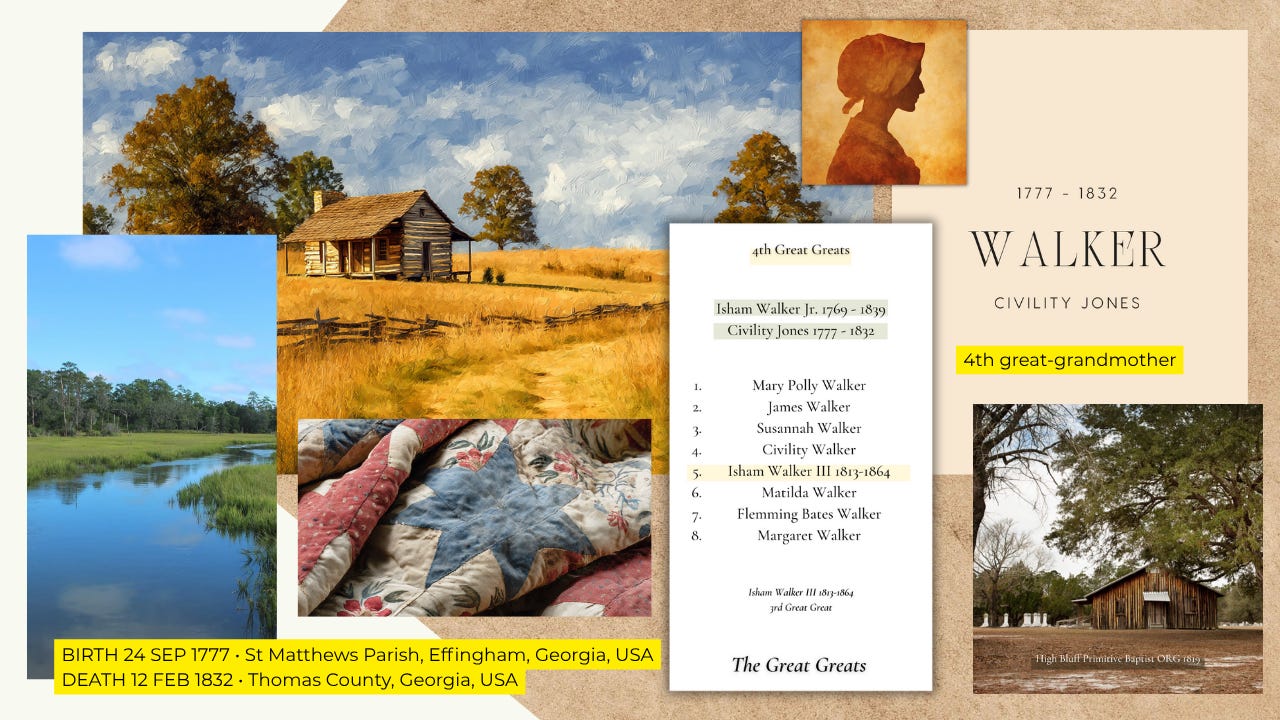
From The Great Greats: Stories of Our Ancestors
In the rolling hills of Effingham County, Georgia, on a warm September day in 1777, a daughter was born to John and Mary Jones. They named her Civility - a virtue name that would prove prophetic for a woman who would navigate the turbulent waters of early American frontier life with remarkable grace and steadfastness.
Civility's birth came at a momentous time. The Revolutionary War was raging, and her father John Jones had answered the call to arms, serving as a soldier in the fight for American independence. While cannons thundered across distant battlefields, baby Civility drew her first breaths in a world being reborn as a nation.
A Spinster's Independence
By 1795, eighteen-year-old Civility had already carved out a place for herself in the world. Court records from October 7th describe her as a “spinster” residing in Liberty County - a legal term for an unmarried woman, but one that also hinted at her independence.
And here’s the part that still makes me smile: she was only twenty. In a time when many young women were already married with children, Civility was forging her own path, living on her own terms. It’s tempting to imagine her with a wry smile, knowing she was doing things a little differently.
Perhaps her father’s Revolutionary War service had instilled in her a spirit of self-reliance, or perhaps she simply had an independent streak all her own. Whatever the reason, those Liberty County records capture a young woman standing on the edge of her adult life - unhurried, confident, and ready for whatever came next.
Love Finds a Way
In Glynn County, fate - or perhaps just good timing — introduced Civility to Isham Walker, a young man with his own layered past. Born in South Carolina in 1769, Isham had already lived a full chapter: he’d been married before to Miss Hiers, and in 1792 they’d welcomed a son, Solomon.
And yet, somehow, in this small corner of Georgia’s growing frontier, it was Civility Jones who would become his life’s true companion. I can’t help but wonder what their first meeting was like - did they trade polite Quaker greetings, or was it one of those “the whole room disappears” moments?
On October 11, 1797, twenty-year-old Civility married Isham in Glynn County. She was no longer the independent spinster of Liberty County, but a wife ready to build a family and a future with a man who, like her, understood what it meant to start over.
The Fruitful Years
The early 1800s filled the Walker household with the sound of children’s laughter — and probably a fair amount of noise, chores, and muddy footprints too. Eight little ones would bless their union: Mary (known affectionately as “Pollie”), James, Susannah, another Civility named for her mother, Isham, Matilda, Fleming Bates, and finally Margaret in 1821.
Each child was a thread in the growing fabric of a family — a link between the Revolutionary War generation and the expanding American dream. You can almost picture the bustling mornings, the smell of cornbread baking, and the constant rhythm of work that came with raising a family on the frontier.
The Walkers moved through Georgia’s counties — from Glynn to Camden, where Isham had settled as early as 1793 — steadily building not just a household, but a name in the community. They were early citizens, shaping the places they lived as much as those places shaped them.
Faith and Community
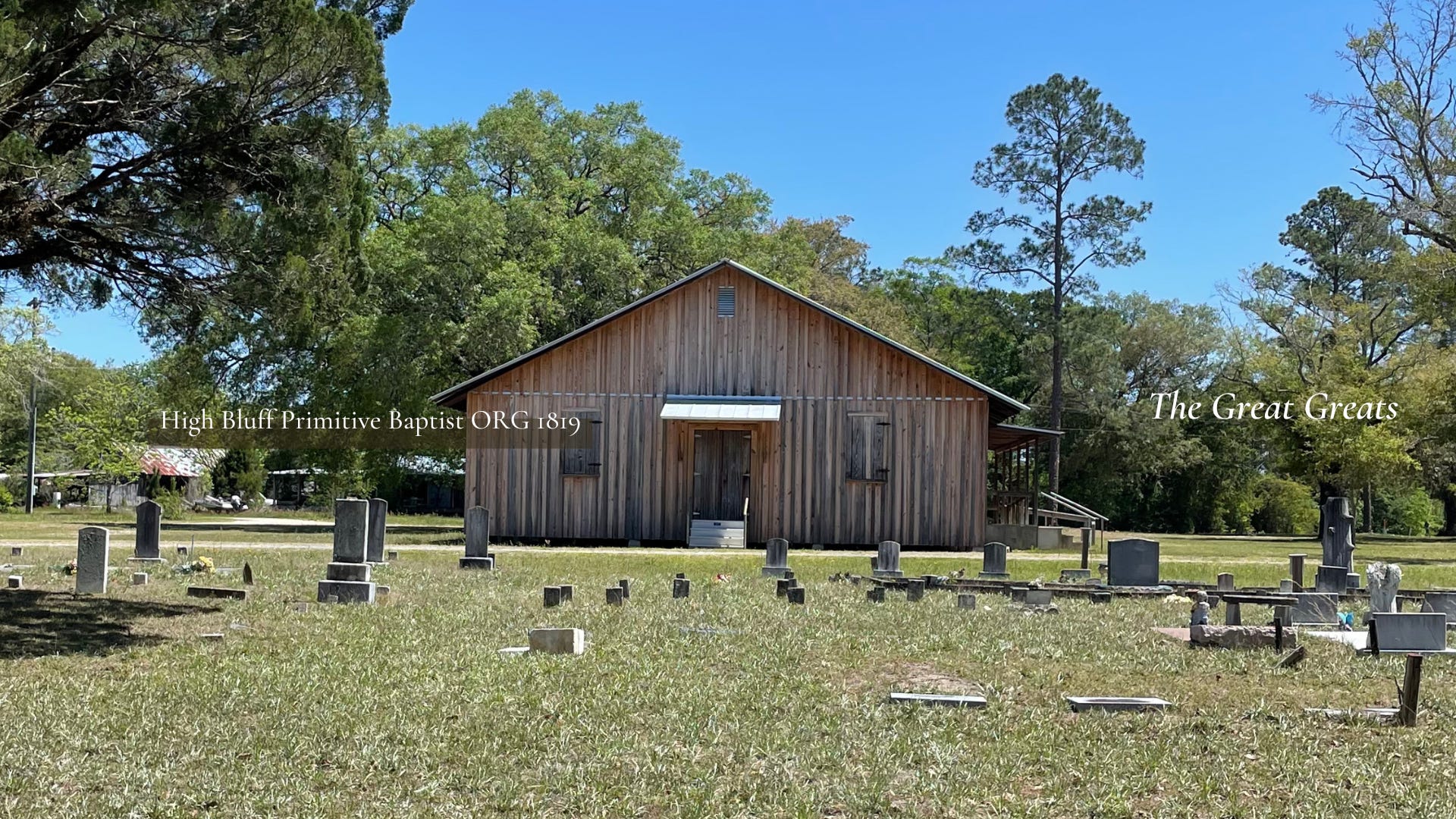
By 1824, with their youngest child Margaret just three years old, Isham and Civility took a step that would anchor them in the heart of their community. On April 10th, they were received by letter into the High Bluff Primitive Baptist Church in Wayne County — a Primitive Baptist congregation founded only five years earlier in 1819.
For Civility, who had been raised in the quiet discipline of Quaker life, this must have been both a familiar and a new rhythm. The meeting house was plain, the worship heartfelt, and the fellowship deeply rooted in mutual care — all values she’d known since childhood.
In a plain wooden meeting house, her life’s purpose intertwined with the steadfast rhythm of frontier faith.
The church became an extended family. When their eldest daughter Pollie married Willoughby Cooper, the young couple also joined the congregation. But frontier faith could be as testing as it was nurturing: in 1826, Willoughby was dismissed for “drunkenness and swearing,” a note in the records that must have brought both public embarrassment and private heartache.
By March 1827, the Walkers themselves were dismissed by letter, the reasons lost to history. Perhaps they were part of the migration to Big Creek Meeting House after a cholera outbreak scattered the High Bluff community. On the Georgia frontier, disease and displacement were as common as Sunday worship — and families like the Walkers learned to adapt, endure, and begin again.
A Life Well Lived
Civility Walker’s earthly journey ended on February 12, 1832, at just fifty-four years old. Isham would outlive her by seven years, spending his final days in Thomas County before his death in 1839.
In her lifetime, Civility had witnessed the birth of a nation, the growth of her family, and Georgia’s transformation from colonial parishes to thriving frontier counties. She raised eight children who carried forward the values instilled by a Revolutionary War grandfather and by parents who believed that true civility was more than manners — it was building communities, holding fast to faith, and creating legacies meant to endure.
Her quiet strength endures, carried forward in the hands and hearts of those who came after.
The daughter of a patriot soldier had become a matriarch in her own right, her life a bridge between the reign of King George III and the promise of the American frontier. In naming her Civility, John and Mary Jones may have hoped their daughter would embody the virtues needed for a civilized society. In the end, she became something even greater — a founder, a mother, and a keeper of the faith that would help shape a nation.
Civility Jones Walker was our 4th great-grandmother, and through her story, we glimpse the courage and resilience that runs through our family line—from Revolutionary War battlefields to Georgia's frontier churches, from independence to interdependence, from one generation's dreams to another's reality.