


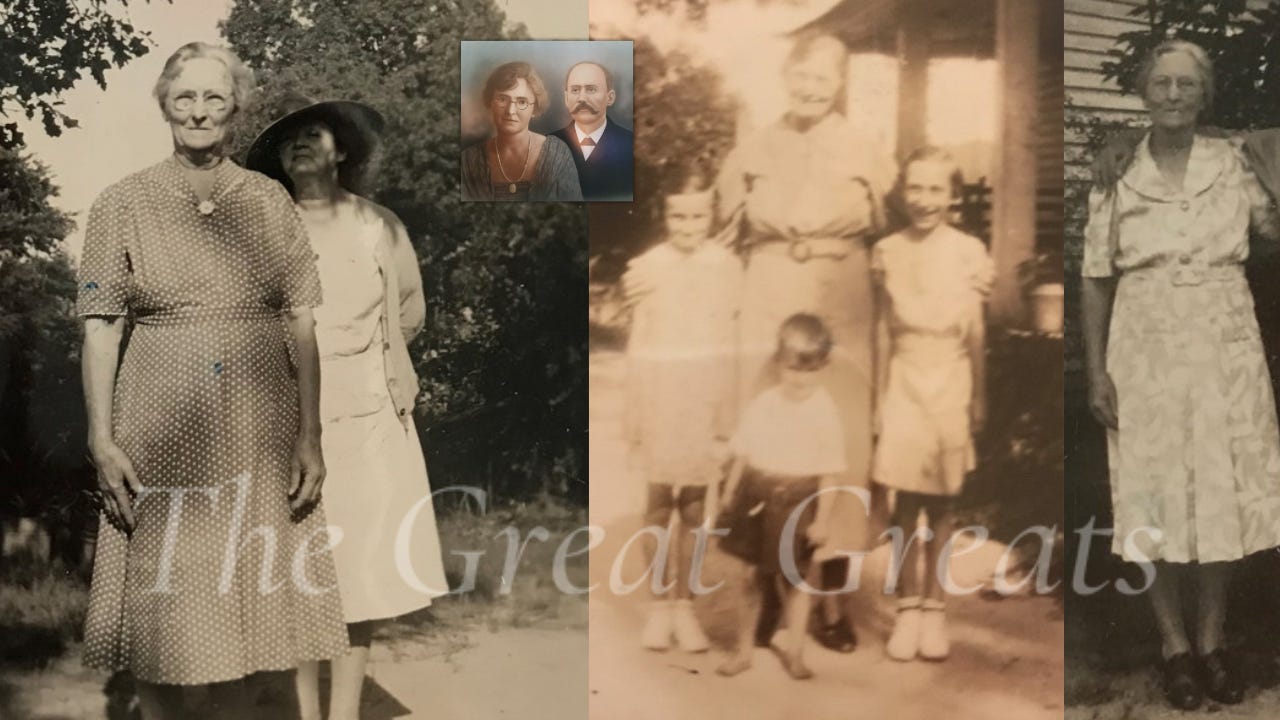
The Bottom Line Up Front: Our second great-grandmother Mary Florence Lynch Edens wasn’t just a survivor—she was a woman who transformed devastating loss into determined strength. Widowed at 43 with four children, including a 12-year-old son (our great-grandfather Jay Robert), she became farm manager, estate administrator, seamstress, and single mother all at once. Her story illuminates the often-hidden strength of early 20th century women who held families together when the world seemed to fall apart.
A Twin Born Alone
Mary Florence Lynch entered the world on November 28, 1871, in Pickens County, South Carolina, but she didn’t enter it alone. She had a twin brother, James L. Lynch, who shared her first breath and her first year of life. But on July 16, 1872, when Mary Florence was just eight months old, James died, leaving her to grow up with the invisible presence of the brother who should have been beside her.
This early brush with loss may have prepared her, in some unknowable way, for the losses that would define her adult life. She was the daughter of Major Gideon Moon Lynch—the Civil War veteran we explored in our previous article—and his first wife, Nancy E. Price. Growing up as one of seven children in the Oolenoy Valley, she watched her father rise from Confederate major to community pillar, serving forty consecutive years as Sunday School Superintendent at Holly Springs Baptist Church.
In Mary Florence’s childhood home, service to others wasn’t just encouraged—it was expected. That foundation would prove crucial when life demanded everything she had to give.
April Wedding, January Funeral
On April 13, 1892, at her parents’ home in the Oolenoy Valley, 20-year-old Mary Florence Lynch married John Davis Edens 1. It was spring in the South Carolina mountains, a time when the dogwoods bloom and the future seems full of possibility. Together, they would have four children: Edward Everett, Annie Esther, George McDuffie, and Jay Robert Edens—our great-grandfather.
For twenty-two years, Mary Florence lived the life of a farmer’s wife in rural South Carolina. John Davis managed their 300-acre farm while Mary Florence managed the household, raised the children, and likely helped with the endless work that farm life demanded. It wasn’t an easy life, but it was a predictable one—until January 26, 1914, when everything changed.
John Davis Edens 1 died that winter day, pneumonia taking him at just 50 years old. Mary Florence, at 43, suddenly found herself a widow with four children, the youngest—our great-grandfather Jay Robert—just 12 years old.
But here’s what makes Mary Florence’s story remarkable: she didn’t just survive this catastrophe. She took charge.
The Administratrix
When John Davis died without a will, Mary Florence could have let the men in her family handle the legal complexities. Instead, she stepped forward and became the administratrix of his estate—a role that required legal acumen, financial management, and the ability to navigate a system designed by and for men.
Working with J.M.D. Cantrell and her father G.M. Lynch, she posted a bond of $1,500 for the personal property. She received one-third of the estate, with each child receiving one-fourth of the remaining two-thirds. This wasn’t just paperwork—it was Mary Florence ensuring her children’s future with careful legal precision.
But managing an estate was just the beginning. She had to figure out how to actually live.
The Art of Making Do
Mary Florence Lynch Edens became a master of what rural women knew best: making something from nothing. With no personal transportation in an era when automobiles were still rare and expensive, she created a life centered around self-sufficiency and community connection.
She maintained a large garden, feeding her family from the soil and canning surplus vegetables for winter meals. She sewed for others, turning her domestic skills into income. She kept a cow for milk and butter, chickens for eggs and meat, and possibly hogs for pork—creating a small farming operation that sustained her family.
Every morning, Mary Florence woke up knowing that four children depended entirely on her ability to make the impossible work. And somehow, she did.
The sources tell us she “had a difficult time rearing them” and that the older boys were “poor role models” for young Jay. This wasn’t failure—it was the reality of single motherhood in 1914, when there were no government safety nets, no child support enforcement, and precious few options for widowed women.
War Comes Home
As if widowhood and single motherhood weren’t challenging enough, World War I brought new heartbreak to Mary Florence’s door. Her son Edward served in the Great War and returned with what we would now recognize as post-traumatic stress disorder, though in 1918 it was simply called “mental problems.”
Mary Florence became Edward’s caregiver, managing the monthly payments she received for his care and navigating the bureaucratic maze of early veterans’ benefits. She carried this responsibility until 1936, when Edward was judged competent—nearly two decades of additional caregiving on top of everything else.
This is the part of Mary Florence’s story that takes your breath away: she never stopped. War trauma, financial hardship, the daily grind of keeping a family afloat—she absorbed it all and kept moving forward.
The Land Manager
Throughout these challenges, Mary Florence proved herself a shrewd manager of the family’s most valuable asset: land. In 1913, she received 95 acres. In 1924, facing financial pressure, she sold parts of her husband’s original 300-acre farm. In 1939, she sold land to her son Jay—our great-grandfather—likely helping him establish his own foothold in adulthood.
These weren’t desperate fire sales. They were strategic decisions made by a woman who understood that land was security, inheritance, and opportunity all rolled into one. She was thinking not just about survival, but about setting up the next generation for success.
Faith and Community
Through it all, Mary Florence remained a member of the First Baptist Church in Pickens, South Carolina. This wasn’t just Sunday morning piety—it was practical community support. The church provided social connection, spiritual comfort, and the kind of mutual aid that kept rural families afloat during hard times.
Her faith was also passed down through family connection. The 1913 letter from her father, Major Gideon Moon Lynch, mentions an upcoming “Protracted meeting”—one of those extended revival services that could transform entire communities. It’s a reminder that Mary Florence came from people who believed in both divine providence and human perseverance.
The Will and the Way
On May 1, 1945, Mary Florence made her will—a final act of the careful planning that had characterized her adult life. She died on March 16, 1948, at age 76, and was buried with her husband John Davis Edens 1 in the Pickens SC town cemetery.
She had outlived her husband by 34 years. She had raised four children through the Great Depression, World War I, and all the personal catastrophes that life could throw at a single mother in early 20th century South Carolina. She had managed estates, farms, businesses, and family crises with no formal training and precious little help.
And she had done it all while ensuring that her youngest son, Jay Robert—our great-grandfather—grew up to become a man who could build his own family and pass down the values of resilience and determination that Mary Florence embodied.
What We Can Learn
Mary Florence Lynch Edens lived through one of the most transformative periods in American history—from Reconstruction through World War II, from horse-and-buggy transportation to the atomic age. She saw women gain the right to vote (in 1920, when she was 49), lived through the Spanish flu pandemic, and watched her community transform from isolated farming valleys to connected modern towns.
Through it all, she demonstrated something that’s easy to romanticize but much harder to actually live: the capacity to absorb devastating loss and transform it into determined action. She didn’t just survive her husband’s death—she built a new life from its ashes.
Her story reminds us that the “strong women” we admire in our family histories weren’t strong because they never faced hardship. They were strong because they faced hardship and refused to let it define their limitations.
Mary Florence shows us what it looks like to be handed an impossible situation and make it work anyway. She was widowed in an era when that often meant destitution. Instead, she became a successful farm manager, estate administrator, and single mother who raised children who went on to build their own families.
Most importantly, she understood that survival isn’t enough—you have to build something that lasts. The land transactions, the careful will-making, the decades of community involvement—these weren’t just about getting by. They were about creating a foundation that future generations could build upon.
That foundation included our great-grandfather Jay Robert, who carried forward the lessons his mother taught through her example: that life will test you, but you don’t have to let it break you.
Mary Florence Lynch Edens was a woman who turned widowhood into leadership, loss into resilience, and hardship into strength. Her story reminds us that our ancestors’ lives weren’t just a series of dates and facts—they were daily acts of courage that made our own lives possible.
What other stories of family resilience should we explore? What questions do you have about Mary Florence’s remarkable life? Share your thoughts in the comments below.