


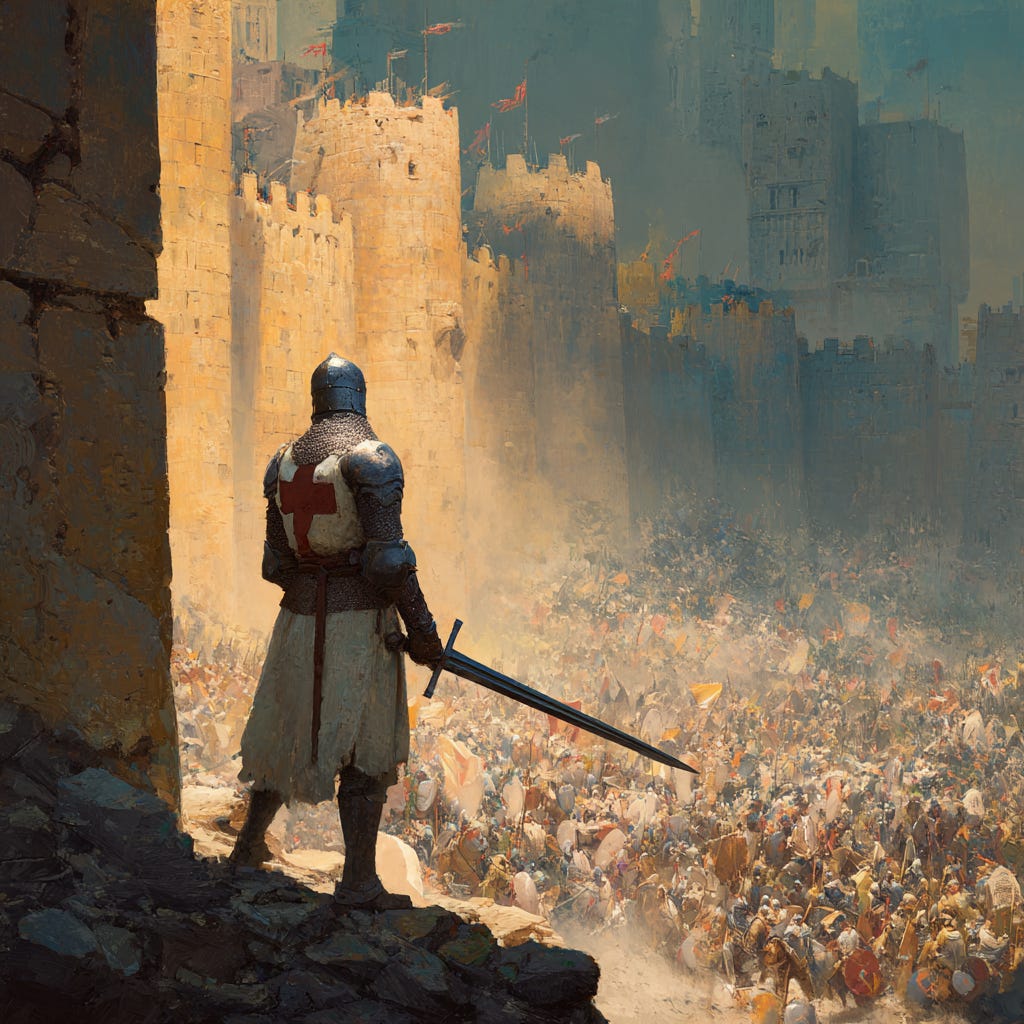
On a sweltering day in the summer of 1191, somewhere in the chaos outside the walls of Acre, King Richard the Lionheart found himself surrounded.
A party of Saracen warriors had sallied forth from the besieged city, cutting through the Crusader lines and encircling the English king. Richard—massive, red-haired, legendary—was about to become a prisoner. Or worse.
Then, from a distance, a knight saw what was happening.
According to family chronicles, Sir John Forster pushed forward with couched lance, his retainers following behind him, all of them shouting: “To the rescue! A Forester! A Forester!”
The king was saved. And a family name was forged in the moment of that charge.
The Battle That Decided Everything
The siege of Acre was the bloodiest, most consequential engagement of the Third Crusade. For two years—from August 1189 to July 1191—the city held, its Muslim garrison trapped between Crusader siege lines and the watching army of Saladin.
The Crusaders themselves were besieged in turn. Saladin’s forces surrounded the Christian camp, launching coordinated attacks while the city’s defenders struck from behind the walls. Disease swept through the squalid encampment. Famine reduced knights to eating their own horses. By the winter of 1190-91, the Crusade itself seemed on the verge of collapse.
Everything changed on June 8, 1191, when Richard’s fleet appeared offshore. The galleys made a brave show—banners streaming, oars churning the Mediterranean to white foam. Within a month, the city surrendered.
But between Richard’s arrival and Acre’s fall came countless smaller engagements: skirmishes, sorties, desperate melees where individual acts of valor could turn the tide. It was in one of these that Sir John Forster made his name.
What a Rescue Earned
For saving the king’s life, Forster received three things.
First, the right to bear a chevron vert—a green V-shape—on his shield. In heraldry, such grants were not decorations but legal documents, literally painted into the family identity.
Second, knighthood from Richard himself, conferred on the field.
Third, and most significantly: the governorship of Bamborough Castle, the great fortress on the Northumberland coast. The Forster family would hold that castle for over four hundred years, providing twelve successive governors across five centuries.
There is said to be a monument to Sir John’s memory in Bamborough Abbey, bearing his effigy in full armor.
Before There Were Foresters
To understand what Sir John’s name meant, you have to understand what happened to England after 1066.
When William the Conqueror crossed the Channel, he brought more than an army. He brought an entirely new legal concept: the royal forest.
In Anglo-Saxon England, kings hunted, but they didn’t claim exclusive rights to the land. After the Conquest, everything changed. Vast tracts of England—fully one-third of the southern counties by some estimates—were declared “forest,” meaning they fell under the king’s personal law rather than the common law of the realm.
The forest wasn’t just woodland. It included heath, grassland, wetland—any territory where the “beasts of the chase” (primarily deer and wild boar) roamed. Within these bounds, ordinary people faced harsh restrictions. They couldn’t hunt. They couldn’t cut timber. They couldn’t even collect fallen branches for firewood. Dogs had to have their front claws removed to prevent them from chasing game.
Enforcing these laws required officers. The man in charge of a forest was called, in Middle English, a forester—from the Old French forestier. The name meant more than “someone who lives near trees.” It meant an official, an agent of royal power, a man who carried a hunting horn as his badge of office and answered directly to the crown.
By the time the surname became hereditary in the 12th century, “Forester” or “Forrester” designated families who had held these positions of trust for generations.
The Forsters of Northumberland
Sir John Forster’s descendants became one of the most powerful families in the north of England. The family records trace their line through:
Sir Randolph Forster, who accompanied Prince Richard to France in 1225, fighting to reclaim the English provinces lost to the French crown.
Sir Alfred Forster, who helped Prince Edward escape from rebel barons and raise an army to free King Henry III from captivity.
Sir William Forster, a general under Henry V who earned his own knighthood for valor in the wars against France.
For four centuries, the Forsters were the principal chieftains in Northumberland, allied by marriage with all the eminent northern families, serving as Knight Bannerets, Lords Warden of the Middle Marches, High Sheriffs, and hereditary Governors of Bamborough.
Their story ended badly. The family was ruined by their participation in the Jacobite risings of the 18th century—the wrong side, as it turned out, of the wrong rebellion. The castle passed out of family hands. But by then, branches of the family had spread across Scotland, Ireland, and eventually America, carrying the name in its various spellings: Forster, Forrester, Forester, Foster.
A Name That Carries Its History
Names tell stories. Most of us forget that.
When someone is named “Forrester” today, they carry—whether they know it or not—a echo of Norman forest law, of hunting horns and royal privilege, of a system that divided England into the king’s land and everyone else’s.
And perhaps they carry something older still: the memory of a charge at Acre, of a knight who saw his king in danger and didn’t hesitate.
“To the rescue! A Forester! A Forester!”
The family’s heraldic horns are hunting horns. The motto—Si Fractus Fortis, “Though Broken, Brave”—speaks to resilience through disaster. The chevron earned at Acre still appears on their arms.
These aren’t coincidences. They’re the accumulated weight of eight centuries, encoded in symbols that outlasted the battles themselves.
Have you traced your family name back to an occupation, a place, or a deed? Share your discoveries in the comments.